Looking Back: Woman charged with killing husband attends his funeral; teen calls school with bomb threat
Published at
IDAHO FALLS — EastIdahoNews.com is looking back at what life was like during the week of April 6 to April 12 in east Idaho history.
1900-1925
LEWISVILLE — A 19-year-old man was admitted to the insane asylum in Blackfoot, The Rigby Star reported on April 9, 1914.
Leonard Hoffman, of Lewisville, had been described as a “hard working boy” but within that past year, he “became indifferent and despondent, and put in his time laying around home.”
He was brought before a judge and was declared to “be a subject” for the insane asylum. A worker at the institution traveled to pick Hoffman up and take him to Blackfoot.
The paper said he “did not object” to the officers taking him to the asylum. Someone asked him where he was going and he told them Blackfoot but that he would only have to stay at the asylum for a short time. He said he’d then return home “cured.”
“His mother has a large family to care for and this son was the oldest of her children,” the article explained. “It is to be hoped his prophecy as to being enabled to return home cured, may prove true.”
1926-1950
POCATELLO — A woman who was being held without bail, charged with killing her husband, attended his funeral service, the Idaho Falls Post Register reported on April 8, 1940.
Mrs. Francis Hardy, 54, was charged with killing her husband Charles E. Hardy, 59. His death from a gunshot wound was originally recorded as suicide.
Francis’s arrest came shortly after a coroner’s jury decided that her husband’s death happened “at the hands of a person or persons unknown.”
Police Chief Robert M. Pugmire signed the complaint charging Hardy with first-degree murder. She was immediately arraigned before Justice of the Peace William Hinckley. A preliminary hearing was supposed to happen early in the week.
Virginia McPherson, a telephone operator, said a call came in from the Hardy house the afternoon he was shot. As the man on the phone gave McPherson a number, McPherson heard a woman shout, “You can’t go out!”
Then, McPherson said, the person calling hung up but the circuit opened again a few minutes later and she could hear a man and woman shouting.
Francis denied there had been any fighting before the shooting. She said her husband came home and started to “work on his books.”
“Suddenly he looked up with a queer expression in his eyes, went to the telephone and tore the receiver from the instrument,” Francis said. “Then he turned to the buffet and pulled a revolver from a drawer. He fired once and the bullet went over his shoulder. Then he fired again.”
The shooting happened around 5 p.m. that day. Neighbors found him with a bullet wound in his chest and called an ambulance but he died shortly after he reached the hospital.
Francis was “veiled and silent” at her husband’s funeral held at the Elks temple in Pocatello. She was closely guarded during the service and returned immediately afterwards to the Bannock County Jail.
Charles, secretary of the Brotherhood of Railway Trainmen, was eligible for retirement in August. He had worked as a brakeman for the Union Pacific since 1918.
1951-1975
POCATELLO — A psychiatric evaluation was ordered for a 14-year-old girl who said there was a bomb at a local junior high, the Idaho State Journal reported on April 8, 1965.
The girl, whose name was not mentioned, admitted she called Hawthorne Junior High School in Pocatello and said a bomb would explode within a few minutes.
The school was immediately evacuated. School officials asked police to question the girl as a “likely suspect.”
Judge W.H. Jensen said such bomb scares are serious offenses and would be dealt with as severely as the law allows. He said a psychiatric evaluation would be a routine procedure in such cases because he felt “a child who does this is emotionally mixed up.”
The girl was being held in the juvenile section of the Bannock County Jail awaiting the evaluation. The results would determine whether she was sent to the State Youth Training Center in St. Anthony.
1976-2000
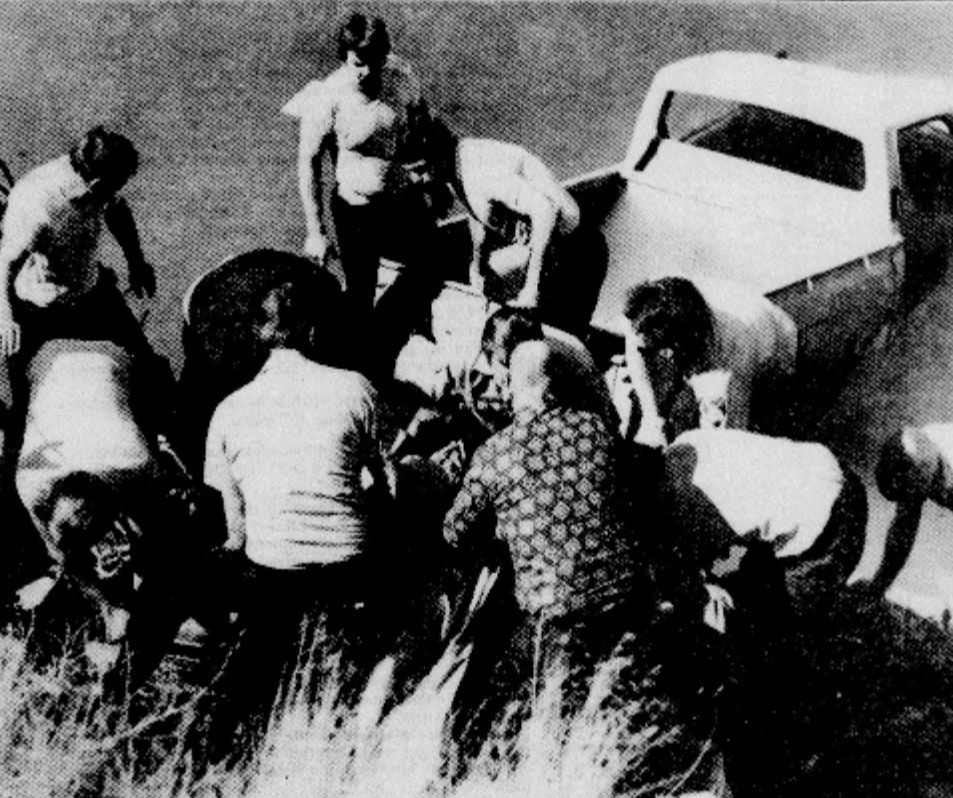
IDAHO FALLS — A 53-year-old Idaho Falls man was killed after his truck plunged into the Snake River, the Idaho Falls Post Register reported on April 7, 1977.
Robert Hagood was traveling south on South Capital Avenue in Idaho Falls when witnesses said his truck gained speed and went over the bank 150 feet upstream from the 17th Street bridge.
Witnesses said the truck hit rocks below the bank before falling into the water.
County Coroner Vernal Rydalch said an autopsy would be performed to determine the exact cause of death.
Hagood was the East Idaho coordinator for Senator Fred Harris’s presidential campaign during 1976.