



Fulcher to face 2 GOP opponents in 2026 Republican primary election on May 19
Published at | Updated at
Laura Guido, Idaho Capital Sun
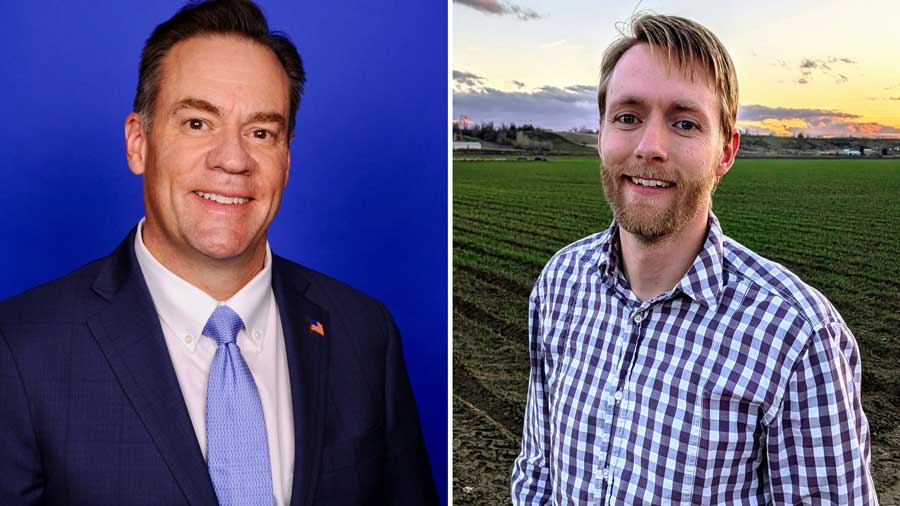
BOISE (Idaho Capital Sun) — Incumbent Idaho Congressman Russ Fulcher will face challengers in the May Republican primary election by two political newcomers. The 1st Congressional District race covers northern and western Idaho.
Andy Briner, a 33-year-old kitchen designer and small farmer, and Joseph Morrison, a Marine veteran and IT support technician, are both running for District 1 Idaho U.S. representative. Morrison did not complete the Idaho Capitol Sun candidate questionnaire for the 2026 voter guide.
The three candidates have differing priorities for the office.
Fulcher, 64, was first elected in 2019 to the U.S. House of Representatives after serving in the Idaho state Senate for 10 years. His priorities are energy independence, election security policy, and facilitating more “local control” of public lands, he said in the survey.
Briner is focused on improving affordability, the “full and total release” of files related to convicted felon Jeffrey Epstein, and ending the war with Iran and removing the U.S. from “all Middle Eastern Conflict.”
Morrison wrote on his website that his top priorities include reining in executive branch “overreach,” ending corporate bailouts, and protecting privacy and limiting surveillance of “law-abiding” citizens.
On public lands, Briner and Fulcher want to see more state management
Nearly two-thirds of Idaho’s land mass is federally owned and managed public land. Fulcher and Briner both supported increased state management of these lands, while maintaining public access.
“Idaho should manage the majority of its land; that being said, Idaho has been known to sell that land to private parties,” Briner wrote. “There needs to be regulation on selling that land, but I think Idahoans care more about their state than the federal government.”
Amid negotiations for the “One Big Beautiful Bill” law, Fulcher voted for a later-removed amendment that would have sold off large swaths of public lands in Nevada and Utah, the Idaho Press reported. In December, he wrote a letter to several Idaho officials to convene meetings to explore transferring management of federal lands to the state, the Idaho Capital Sun reported.
In his survey responses, Fulcher said the need for a shift in public land management is urgent.
“The solution is to keep public lands public but shift (much more) control to the state level,” Fulcher said. “Outdoorsmen, Farmers, Ranchers, loggers, and sportsmen all need to work together with the Idaho Department of lands and local counties, tribes and municipalities to efficiently utilize and take care of this fabulous resource.”
He said there was declining support among non-Western states’ leaders for current programs that offset revenue lost from a lack of property tax revenue from public lands, such as payment in lieu of taxes (PILT) and Secure Rural Schools (SRS).
Last year, the U.S. House of Representatives extended the Secure Rural School payments to the end of fiscal year 2026 in a vote of 399-5. The U.S. House in January approved a large budget bill that included reauthorizing the payment in lieu of taxes program in a 397-28 vote.
The U.S. House previously passed the “Safeguard American Voter Eligibility Act” or “SAVE Act,” which would require proof of citizenship to register to vote and photo ID at polls. The bill, which is a top legislative priority for President Donald Trump, is still under consideration in the Senate.
Fulcher is among the 110 Republican co-sponsors on the bill, which has drawn criticism from Democrats and voting advocates who say it will make it harder to vote for married women who have changed their name to vote, and would end voter registration drives. Some have also expressed concern about its requirement that states submit full voter rolls to the U.S. Department of Homeland Security to check for citizenship status.
It is illegal for those who aren’t U.S. citizens to vote in federal elections.
Fulcher said the bill would be “an enforcement mechanism of the Constitutional provision that states citizenship is required to vote in federal elections.”
Briner said he agreed with the premise that ID should be required to vote in every election.
“However, I also believe the federal government should stay out of elections and leave it up to the states to run their own elections because I want a limited federal government,” he said. “That is my moral dilemma when answering this question.”
The ‘Big Beautiful’ law approved in July is expected to reduce federal spending on Medicaid and the Affordable Care Act marketplace by a total of around $1 trillion over 10 years.
Fulcher said the bill was necessary to reduce the rate of growth in Medicaid spending.
“The growth of the program has been so astronomical that neither state nor federal budgets can keep up with the payments,” Fulcher said. “The (Big Beautiful Bill) removed eligibility for non-citizens and inserted a (very minor) work requirement for able-bodied, working age citizens. Although the vast majority of Idahoans (and Americans) support these changes, the program will eventually be crushed under its’ own fiscal weight. To make the system sustainable over the long term, market forces need to be reinserted into the system and mandated health coverage requirements need to be removed.”
Briner said he opposed “all federal assistance programs,” but that Medicaid cuts were “nowhere near the top of my priority lists.”
“I would like to work with the Democrats on this issue if it means we can stop the trillions of dollars we spend on the defense budget, all foreign aid and this unnecessary war we are fighting in Iran and bring the focus back to helping Americans’ who are just struggling to pay for their food, their housing and their medical expenses,” he said. “I will not focus on any cuts to our assistance programs until those other areas have been addressed.”
Fulcher and Briner disagree over immigration enforcement tactics
Highly visible mass deportation efforts under the Trump administration have at times included U.S. citizens, ProPublicly reported in 2025, with an investigation finding at least 170 citizens who were detained.
Fulcher said that amid the rise in illegal immigration during the Biden era, “there should be no surprise that actions to correct the inevitable problems come at a cost.”
“Thankfully for the overall future of public safety, the current administration and majority of Congress are staying the course,” Fulcher said. “Like all other administrative actions, Congress has oversight responsibility. The tools to execute on that oversight are woefully inadequate, but that’s another topic.”
He said he supported adjustments to worker visas and access to legal citizenship.
Briner said the detention of citizens was an example of the government eroding the rights of American citizens.
“The way the Trump administration has handled immigration has been a disaster for everyone, and he has deported less people than President Obama did at this time in his presidency,” Briner said.
Former President Barack Obama oversaw more than 600,000 deportations in 2013, the first year of his second term. In Trump’s first year of his second term, the administration deported around 540,000 people.
Briner said he supported reforms of the immigration system that would “allow for good, honest hard working people to live here as citizens, but currently both parties are using it as a tool to divide the American people and everyone is being hurt in the end.”
Briner and Morrison have no reported campaign contributions
Briner’s political action committee reported to the Federal Elections Commission on April 17 that it had not met the $5,000 reporting threshold. There was no reporting record for Morrison on the FEC website.
Fulcher and his supporting political action committee have collected more than $500,000 in contributions since the beginning of 2025, according to FEC data. More than $300,000 of those were from individuals, and over $230,000 came from other political action committees.
Idaho Capital Sun is part of States Newsroom, a nonprofit news network supported by grants and a coalition of donors as a 501c(3) public charity. Idaho Capital Sun maintains editorial independence. Contact Editor Christina Lords for questions: info@idahocapitalsun.com.