



Looking Back: A hotel crash, a grave-digging attempt, and the Teton Dam collapses
Published at
IDAHO FALLS — EastIdahoNews.com is looking back at what life was like during the week of June 1 to June 7 in east Idaho history.
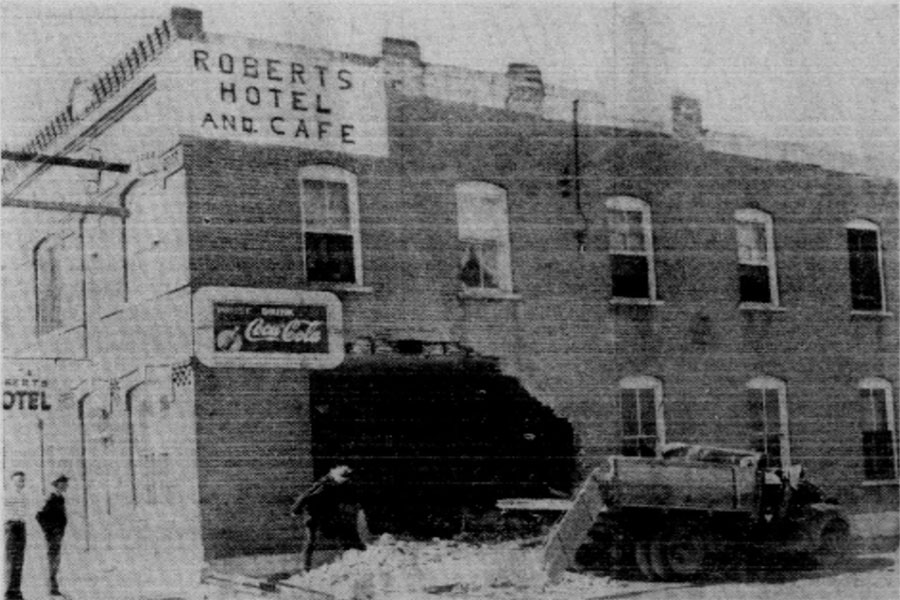
Main Image: 1950
ROBERTS — The Roberts Hotel lobby was dusted free of sand and brick Thursday, May 25, 1950, after a truck loaded with sand crashed through the brick wall into the lobby. The lobby, however, had more fresh air than the proprietors would like with the gaping 12-by-15-foot hole left by the crash.
The driver of the truck, Thomas Jack, of Roberts, escaped without injury. He told state patrolmen investigating the accident that he was forced to swerve when a car in front of him turned off the road suddenly.
Jack said the wheels locked, and he was forced to crash into the side of the hotel. Fortunately, no one was in the lobby at the time of the accident.
The truck, its cab flattened, is shown in the image above after being hauled from the lobby. Caption dated May 25, 1950. | Courtesy Idaho Falls Post Register
1900-1925
BURLEY — Complaints were being made that thieves were stealing flowers in the middle of the night from people’s yards, the Burley Herald reported on June 3, 1922.
Around 11 p.m. the following weekend, some women were seen on a lawn on the southwest part of Burley taking lilacs.
“It looks like a plain case of stealing,” the paper said.
Twin Falls residents were also dealing with people stealing flowers. To prevent further thefts, the news outlet there offered a $25 reward for the “capture of the thief.”
“Residents who have gone to the trouble and expense of growing beautiful flowers should be protected from these midnight prowlers who wouldn’t try to raise a shrub or flower to add an inviting appearance to their home,” the article states. “If a few can be caught, it will stop this desecration of flower beds and lilac trees.”
1926-1950
POCATELLO — A safe was found in the bottom of the Portneuf River, the Idaho Falls Post Register reported on June 5, 1933.
A safe belonging to the Central Fruit store in Idaho Falls was stolen the night of April 25, 1933. The safe was reportedly broken into, and the contents were missing.
A group of prisoners being held in the Bannock County Jail in Pocatello confessed to the crime. The confession was made to police chief A.C. Carlson.
The safe was thrown into the Portneuf River a few miles south of Pocatello.
“The water is too deep to retrieve the safe at present,” the chief said.
The men who made the confession were part of a gang of thieves and robbers held in the jail who confessed to a “long list of crimes” committed throughout Utah, Idaho, Washington and Oregon.
The safe was thrown into the river a short distance away from where a broken safe belonging to the O.P. Skaggs store was once located.
1951-1975
BONNEVILLE COUNTY — A “grave digging attempt” was reported to law enforcement, the Rigby Star reported on June 3, 1954.
The report mentioned someone tried to dig up the grave of a man buried on private ground about 20 years earlier.
It happened 6 miles south of Heise. Officers said those involved were “evidently” scared away around the time they reached the coffin.
An investigation was underway.
1976-2000
SUGAR CITY — A Sugar City deputy marshal recalled the moment his agency was warned the Teton Dam was going to break, the Idaho State Journal reported on June 7, 1976.
“We had maybe an hour’s notice the dam was going to break and to evacuate the town,” Sugar’s deputy marshal, Barry Coleman, told the Journal two days after the dam collapsed.
“I think everybody got out,” he added. “When I left, there weren’t more than three cars in the whole town — all of them being loaded with whatever people could fit in them.”
Within two hours, the article said Sugar City “was gone.” The chapel at the north end of town was washed away, and a highway overpass toppled. Union Pacific railroad tracks were still intact but swept yards from their original roadbed.
“The town, nearly leveled, was home to nearly 700 persons and bore the full brunt of the wall of water that followed the collapse of Teton Dam at Newdale Saturday,” the paper said.
A muddy 4-foot wall of water struck Rexburg at 2:30 p.m., quickly followed by an 8-foot flow that pushed water and debris through the downtown area and the city’s “beautiful block-long” park.
The carcasses of more than 200 head of cattle from a feedlot along the Yellowstone Highway on the north edge of town were swept away in the flood.
At the first warning of high water, businessmen in Rexburg began putting sand and plastic sheets against store entrances and garage doors. But within minutes of the flood, those stores were 4 to 8 feet deep in water.
Sound trucks roamed the streets of the college towns, warning residents to take only the essentials and find refuge on the higher ground of Ricks College camps, east of town.
Officials estimated 12,000 people up and down the Teton Valley were being displaced and worried the farmers in the fields along the river might be out of reach of the warnings that were broadcast the morning the dam broke.