




Two retired INL professionals running against each other for Senate in District 33
Published at
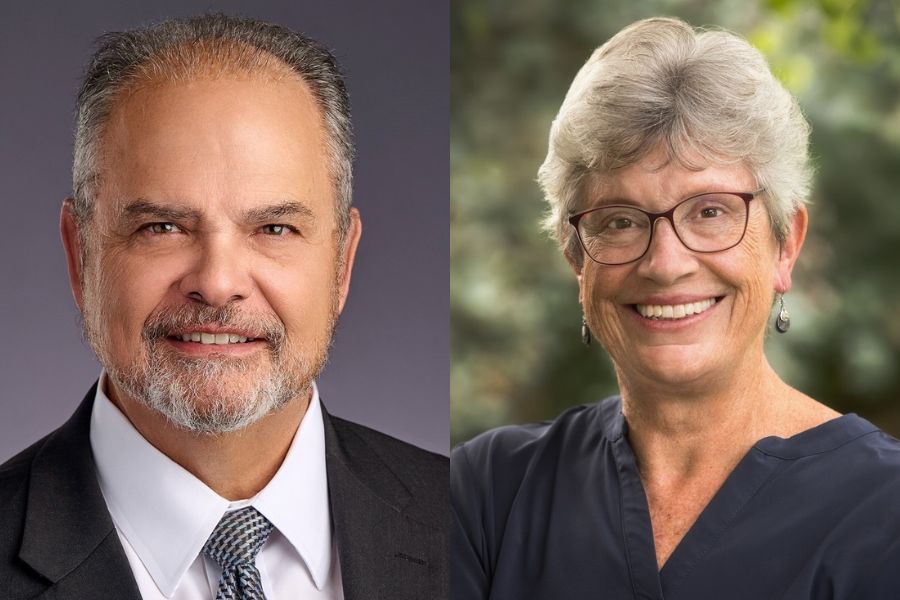
IDAHO FALLS — Two retired INL employees, a former scientist and a former Director of Training, are running against each other for Senate seat in District 33.
Incumbent Republican Dave Lent is running against Democrat Jan Brown.
EastIdahoNews.com sent both candidates the same questionnaire. Lent and Brown’s unedited responses are listed below.
The general election will be held on Nov. 3. Polls are open from 8 a.m. to 8 p.m.
For more candidate questionnaires and information about the midterm election on Nov. 3, check out East Idaho Elects. To learn where to vote or what’s on your ballot, visit VoteIdaho.gov.
Tell us about yourself — include information about your family, career, education, volunteer work, and any prior experience in public office.
Brown: I was born and raised in Van Nuys, California, and I moved to Idaho Falls in 1976 shortly after graduating from the School of Forestry at Oregon State University.
Before retiring in 2019, I enjoyed a 43-year career working in the natural sciences, resource recreation, and watershed conservation. In the 1980s, my ex-husband and I operated a year-round guest lodge in Island Park called Lucky Dog Retreat. During that period, I briefly served as the natural resource assistant to Governor John V. Evans while he ran for the U.S. Senate.
I also worked for two different INL contractors early in my career. As a program specialist for the National Low-Level Waste Management Program, I helped compose the nationwide strategy for safely disposing commercial low-level radioactive waste, a job where I synthesized the input of a multi-state task force and university research teams. Later, while serving as an advisory scientist at the INL, I developed a plan for sharing waste cleanup technologies with several Western states dealing with legacy waste from mining, smelting, drilling, and military activities.
For most of my career, I led nonprofit organizations. I was executive director of the Henry’s Fork Foundation (1999-2000), Yellowstone Business Partnership (2003-13), and the Montana Cooperative Development Center (2015-19). I am an ordained elder in the Presbyterian Church (USA) and have served on multiple resource advisory councils and boards of conservation organizations. From 1993-94, I was a member of Governor Andrus’ Task Force on Irrigation Water Conservation.
Lent: I grew up in Shelley, Idaho, where my family owned a small business. Right out of High School, I attended Utah State University, where it became clear I wasn’t ready for post-secondary education. After a couple of years of Church service, I was ready to settle down and attend what is now College of Eastern Idaho.
Shortly thereafter, I hired on at the INL and worked for a couple of years in Radiation Protection. After that, I left Idaho and spent about 10 years working on large-scale nuclear projects across the country.
As our children grew older and frequent moves became more difficult, I returned to INL and retired as a Director of Training.
Why are you seeking political office in your community? Briefly explain your political platform.
Lent: My two specialties are education and nuclear. I chair the Senate Education Committee and have worked on many critical education issues. I sponsored the LAUNCH program in the Legislature and have spent the last two years holding town hall meetings across the state. This year, I joined forces with State Superintendent Debbie Critchfield in modernizing Idaho’s public education system.
I have also played a key role in working with the Department of Energy and the State in obtaining new projects for the INL. Along with Representative Hill from Boise, I have established a coalition of statewide stakeholders supporting nuclear work in Idaho and will present several pieces of support legislation in the next session. See Nuclearforidaho.com.
Brown: Now that I am retired, I am eager to apply my proven skills in collaborative problem-solving to Idaho’s community and resource challenges.
When I first moved to Idaho, I was drawn to its wide-open spaces, friendly people. and balanced approach to state governance. I was impressed with common-sense Democratic leaders such as Frank Church and Cecil Andrus, and I became a committed Democrat while serving as a political appointee under Governor John V. Evans.
In addition to serving as his INL liaison on nuclear waste issues, I coordinated the state-level response to the U.S. Forest Service on seven Idaho forest plans written in the mid-1980s.
In the 1980s, Idaho had a more balanced tax system, with the “three-legged stool” of sales, income and property taxes each contributing nearly equal amounts to state and local coffers. Since that time, deep cuts to corporate taxes combined with tax exemptions for too many enterprises have shifted the tax burden to sales and property taxes that disproportionately impact low-to-middle class wage earners.
I seek to restore balance to the tax system and ensure that corporations and high-wage earners pay their fair share of income taxes to bolster K-12 and higher education funding.
We also must keep PUBLIC our Public Lands, Public Health, and Public Education. I oppose the short-sighted sales of federal and state public lands, especially sales that ignore public input and local land use plans. I support science-based management of federal lands and long-term stewardship of our school endowment lands.
With rising housing, fuel, and food costs facing Idahoans, can the state government help bring relief to Idaho citizens? Is it the role of the Idaho Legislature to help deal with these issues?
Brown: The Legislature can blunt the cruel impact of Trump Administration policies on Idaho if it can:
- Increase the Idaho Homeowner Exemption from $125,000 to $200,000, giving immediate relief to homeowners. In 2016, the Idaho Legislature eliminated the annual adjustment to the Housing Price Index and froze the exemption at $100,000 (with only one adjustment up to $125,000 in 2021). I support returning to an indexed annual adjustment.
- Encourage housing cooperatives and community land trusts to form in Idaho as both are affordable bridges to home ownership for working families. Families can build equity to support future home downpayments while living in supportive, lower-cost communities.
- Incentivize public transit, car sharing and van pools in Idaho’s urban centers, as well as rail travel across rural Idaho, so families will have alternatives when global conflicts cause fuel prices to rise.
- Continue to promote electric charging stations at key locations so EV owners can confidently travel throughout our state.
- Support formation of food cooperatives in rural areas that may no longer have markets operating nearby. Food co-ops operate at cost and can bring stability to small towns when corporate stores can no longer stay viable.
- Fully participate in federal SNAP and other food programs, recognizing that most families will not defraud the government and that work requirements often impact caregivers critical to staying home with disabled or elderly family members.
Lent: Unfortunately, most of the decisions being made that affect the current inflationary cycle are happening at the federal level. We can only change what is within our control. My focus is to provide a quality education system and help establish high-paying jobs for our young Idahoans.
How will you best represent the views of your constituents – even those with differing political views? How do partisan politics play into your role as an elected leader?
Lent: I believe that collaboration built on respectful relationships is the secret sauce of good governance. I deliberately avoid extremes and work toward practical solutions to everyday issues.
Brown: We need to recognize that partisan politics in Idaho have become so toxic that many residents are disgusted with the negativity and are not even registering to vote. This attitude must be addressed. Our quality of life and our democratic freedoms are at stake. Thankfully, the Idaho Democratic Party has a very big tent, so I would like to do the following for my constituents:
- Oppose those promoting White Nationalism in Idaho and the concentration of power at the executive and legislative levels. We need to return more local control to cities and counties. I support local option tax authority and strong local land use planning.
- Repeal Senate Bill 1300 passed by the 2026 Idaho Legislature, restoring the power of three bipartisan agency boards/commissions (ITD, IDFG, IDPR) to hire department directors who are not subject to partisan politics.
- Safeguard our religious freedom and keep separate the activities of church and state. Rescind the “minute of silence” now being imposed on public schools and oppose unconstitutional “bathroom bills” and other cruel legislation targeting transgender people.
In addition, I would like to introduce regular, community-building dialogues both during and outside of the Legislative sessions to better listen to Idaho Falls constituents of both parties. Current legislators are not showing up to town hall meetings or candidate forums, behavior that demonstrates real disrespect for their opponents and the public at large.
What parts of the Legislative budget could use more funding? Where are places in the budget where cuts could be made?
Brown: Idaho does not have a spending problem; its budget problems lie on the revenue side. Most people understand the need for taxes to support a well-run government, but they want a system that is fair and efficient. At times, legislative leaders seem opposed to funding government as a matter of principle and have used tax cuts to hobble our agencies, weaken public infrastructure, and hurt those most in need of assistance. Here are my priorities in the budget arena:
- Repeal of the Parental Choice Tax Credit that forces the public to subsidize the tuition and eligible expenses of private and home schooling without having the recipients accountable to the public for educational outcomes. This would restore up to $50 million.
- Restore needed funding to the Idaho Transportation Department so it can fix unsafe roads and bridges, and address needed highway improvements to handle the increasing traffic on all our major roadways. This should save lives.
- Empower local governments, law enforcement, and nonprofit organizations to cooperatively meet their community’s mental health challenges as opposed to slashing needed funding for treatment and rehabilitation. This will cost less than incarceration.
- Properly fund our local health departments. Restore public confidence in adult and childhood vaccinations and community-based disease prevention by challenging falsehoods. Restore day-care vaccination requirements to protect children from undue health risk from those still denying the efficacy of vaccines.
Lent: I believe Career Technical Education will need more funding as we move toward an outcome-based education system. Students should leave public education with a marketable skill or a clear academic path. Traditional public education is severely overregulated and could benefit from major “red tape” reduction.
In 2026, Idaho suffered a historic drought, leaving eastern Idaho’s reservoirs at an all-time low. As a result, crop yields were significantly impacted. What specific strategy or legislation would you support to protect groundwater and surface water resources, and what is your timeline for measurable Improvements?”
Lent: Water is a very complicated issue with significant history. I strongly agree with Representative Raybould’s emphasis on continued investment in storage, aquifer recharge, irrigation efficiency, and aging water infrastructure to prepare for dry years. This is one of those situations where we plan for the worst and hope for the best.
Brown: Idaho must recognize that climate change is directly affecting our water supply. Global warming is not a hoax, and Idaho should embrace science rather than believe that the current drought is temporary. There is less water available each year as much of our moisture is falling in the form of rain instead of snow. We must all become more efficient in our water use and not just in agriculture. My recommendations are:
- Leave in place the Snake River Adjudication that validated surface and ground water rights after a 19-year legal process. Honor the prior appropriation doctrine.
- For the Eastern Snake Plain Aquifer, support funding for managed aquifer recharge and integrated (conjunctive) management of surface and ground water.
- Where justified, place canals into pipelines (e.g. the Marysville canal system) to better manage surface water irrigation, reduce evaporation, and accommodate managed recharge downstream. Where economically feasible, modify existing dams in the Upper Snake Basin to increase reservoir capacity, but do not rebuild the Teton Dam.
- Promote collaborative problem-solving in watershed management as advocated in Idaho’s State Water Plan. Establish more multi-stakeholder watershed groups such as the Henry’s Fork Watershed Council.
- Support a more aggressive schedule for metering water in cities such as Idaho Falls to ensure that domestic, commercial, municipal and industrial users of water all pay their fair share of water management improvements.
- Ensure that subdivision developers across Eastern Idaho build community water systems as opposed to requiring new rural homeowners to drill individual wells.
One of the biggest issues on the November ballot is Proposition 1, a citizen-led ballot initiative that would repeal Idaho’s abortion ban. Do you support Proposition 1? Why or why not?
Brown: I am a mainline Protestant who believes that reproductive health decisions are the private domain of the family, their physician, and their pastor. Every faith is entitled to their beliefs on the viability of a fetus versus the health of the mother, and all sides may legally express their religious beliefs in the public square.
However, no faith is entitled to impose their beliefs on the rest of us, especially when laws such as Idaho’s abortion ban have created such pain and confusion. Many gynecologists have been compelled to leave Idaho to practice medicine without fear of prosecution, which impacts our overall health care statewide.
The Legislature has had four years to fix this flawed trigger law, and Proposition 1 is our best chance to remedy its problems. I believe the proposition has a good chance of passing, so if elected, I will advocate that the Reproductive Freedom and Privacy Act remain intact as the Legislature is likely to attempt to overturn the wishes of the voters.
I do not support abortion as a method of birth control, but I do understand that a minor in an unhealthy family situation might need outside help to deal with a pregnancy from rape or incest – even if not initially reported in a timely manner.
Idaho’s current abortion ban is unnecessarily restrictive and is hurting our state. It is discouraging businesses from locating here and preventing adequate maternal care in our most rural communities. We all need to VOTE YES on Proposition 1.
Lent: I do not support the current Proposition 1. I do believe that the legislature needs to look very closely at the issue and consider legislation that would clarify and better define the extremely rare circumstances where abortion may be considered. Convenience abortions are never appropriate.
Idaho House Joint Resolution 4 (HJR 4) is a constitutional amendment on the November ballot that would give the legislature exclusive authority to legalize or decriminalize marijuana, narcotics, and psychoactive substances. It would also ban citizen initiatives that would allow voters to directly have a say on the issue. Do you support the passage of HJR 4? Why or why not?
Lent: I am supporting HJR4 not to give the legislature power, but to block the powerful big-money lobby from these drug companies.
Brown: It is critical that we all VOTE NO on HJR 4 as it would yield to the Idaho Legislature our current Constitutional right to legislate as citizens. This granting of undue power to the Legislature to rule on any “psychoactive substance” is poorly defined, too broad, and ultimately would not be restricted to marijuana or narcotics.
This is a dangerous amendment that is not needed, and we citizens need to guard against efforts such as this to concentrate power in Boise as opposed to protecting our lawmaking authority as Idaho citizens.