



Battling cottony maple scale
Published at | Updated at
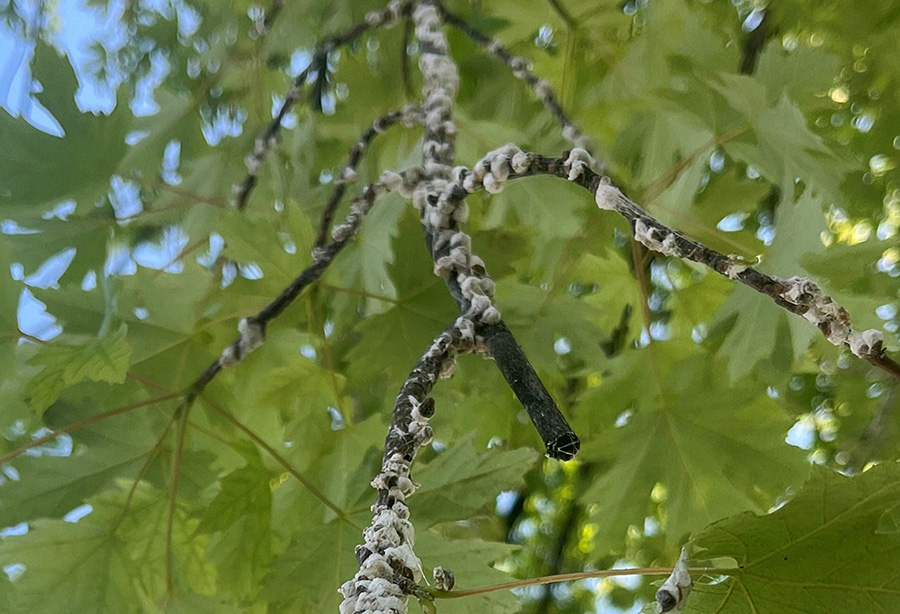
For whatever reason, my office has seen an explosion of homeowners bringing in branches covered in cottony maple scale.
I believe 100% of the cases to be on either silver maple (Acer saccharinum) or Autumn Blaze maple (Acer x freemanii). Cottony maple scale is a soft scale insect that feeds on maples (and some other species) by sucking sap from branches and leaves.
These pests are most recognizable by the white, cotton-like egg sacs females produce in late spring and early summer, often giving infested branches a popcorn-covered appearance.
Understanding the life cycle
The scale overwinters as immature females on twigs and branches. In spring, they resume feeding and mature, laying eggs in conspicuous cottony masses. Crawlers—tiny, mobile nymphs—emerge from mid-June through July and migrate to leaves to feed. By late summer, males emerge, mate, and die, while fertilized females return to branches to overwinter.
Treatment Strategies
1. Cultural Control: A healthy tree is your best offense. In addition to traditional tree care practices, silver and Autumn Blaze maples in our high pH soils often need additional iron. In my opinion, EDDHA iron chelate is the best solution (besides not planting these species in the first place).
If you don’t give your tree a good growing environment, don’t waste your time and money on other forms of treatment.
2. Biological control: This method may not be sufficient to overcome heavy infestations, especially if tree health issues are not addressed. However, natural predators play an important role in pest management. Avoid unnecessary or overly aggressive insecticide use. Do your part to promote beneficial insects. Most pest populations can be kept at tolerable levels if you do.
3. Chemical control:
- Horticultural oils: These can be used in early spring to target females emerging from hibernation. Apply just prior to bud break.
- Insecticides: Target the crawler stage in late June to early July with insecticidessuch as permethrin, cyfluthrin, esfenvalerate and others. With larger trees it is easier to treat with systemic insecticides like imidacloprid or dinotefuran. These products are taken up by the roots and the insecticide is translocated to where the insects are feeding. Systemic treatment is applied in the spring after leaves have expanded.
Cottony maple scale can be a persistent nuisance, but with a combination of tree care and well-timed treatments, you can protect your trees and restore their vitality. Because silver and autumn blaze maples often have iron chlorosis problems in our high pH soils, EDDHA iron chelate will need to be applied periodically to maintain tree health.