



Codling moth in home apple and pear trees: What east Idaho growers should know
Published at
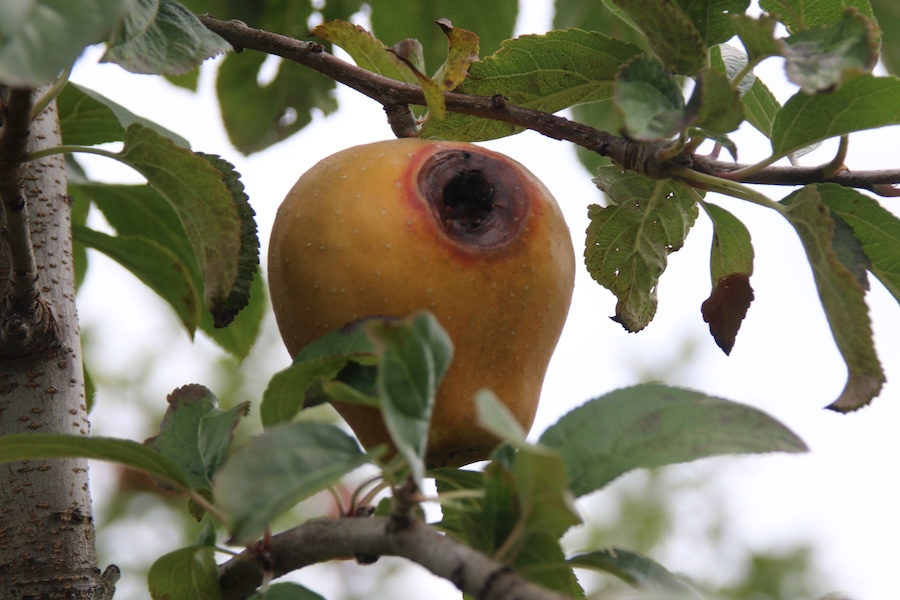
IDAHO FALLS — Codling moth (Cydia pomonella) remains one of the most persistent and destructive pests of homegrown apples and pears. Understanding how to identify it, how it develops through the season, and how to use degree day models and integrated pest management strategies can dramatically improve fruit quality for backyard growers.
The most irritating thing about codling moths is that they are not even interested in the fleshy fruit. They want to eat the seeds, but they must tunnel through the fruit flesh to get in and out of the seed cavity.
Identification and damage
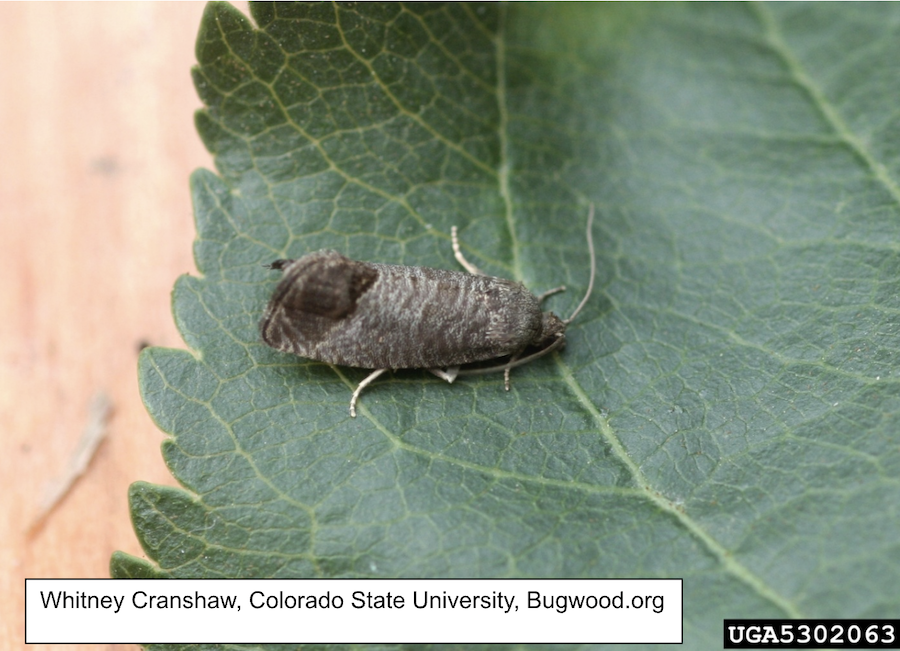
Adult codling moths are small — about three-eights of an inch long — and generally mottled grayish-brown. Males have a distinctive band of shiny, coppery scales at the wing tips. Larvae — the “worms” often found inside apples — are a half-inch to three-quarters of an inch long and white to light pink in color, with a dark brown head capsule.
Fruit injury shows as shallow “stings” or larger exit holes with brown frass (insect feces) pushed out — common signs that larvae have tunneled toward or left the seed cavity. The exit tunnel is filled with frass, where internal rot may begin. As larvae feed on the seed, fruit may drop prematurely.
With heavy infestations, every fruit on the tree can be damaged.
Life cycle
Codling moth development is closely tied to temperature. In Idaho, the insect overwinters as mature larvae in cocoons under loose bark, leaf litter or other protected areas. Pupation occurs in early spring, and adult moths emerge around the time apple trees reach pink-to-bloom stage — when evening temperatures exceed about 55 degrees Fahrenheit. Female moths lay eggs on leaves and young fruit; larvae enter fruit soon after hatching, then feed on the seed inside the fruit for three to five weeks before exiting to pupate under bark or in orchard debris. Egg-laying can continue into early fall.
Depending on where you are in Idaho, codling moths have one to three generations per year (maybe four in Lewiston), with the first adults emerging from overwintering sites just before bloom.
For Idaho growers, this means fruit can be susceptible from late spring through early fall, depending on accumulated heat and local microclimate.
Using degree days for accurate timing
Because codling moth activity is temperature-dependent, degree day models are essential for predicting egg hatch and timing control measures.
- Codling moth models typically use a lower threshold of 50 degrees and upper threshold of 88 degrees.
- The “biofix” — the starting point for tracking degree days — is usually the first trap catch in spring.
- Egg hatch often begins around 220 DD, with peak first-generation hatch between 340 and 640 DD.
Once traps detect adult moths, local degree day calculators (such as those linked to Idaho weather stations) can be used to pinpoint when larvae will hatch. Applying control methods too early wastes effort, while applying too late misses the first major wave of feeding.
East Idaho residents can sign up for the University of Idaho Extension’s East Idaho Pest Alert Newsletter to receive regular email newsletters to help them identify the time of codling moth generations in their location. Click here to sign up for the newsletter — we won’t share your email with anyone else.
The Pacific Northwest Pest Alert Network contains a growing degree day calculator and can be accessed at pnwpestalert.net.
Integrated Pest Management (IPM) for homeowners
An effective IPM program combines monitoring, cultural tactics, physical barriers, and — when needed — carefully timed, low-toxicity insecticides.
1. Monitoring
- Hang pheromone traps by early to mid spring, depending on your USDA zone (early March in Zone 7; early April in Zones 4–5).
- Check traps every few days. When moths appear and evening temperatures exceed about 62 degrees, begin calculating degree days.
2. Sanitation
Simple cultural practices significantly reduce infestation:
- Pick up and destroy all fallen apples throughout the growing season.
- Clean storage areas as larvae may overwinter in boxes, sheds or crates.
- Remove brush piles, dropped fruit, wood piles and other protected pupation sites.
3. Trunk banding
Wrapping trunks with corrugated cardboard or burlap can capture migrating larvae. Bands should be removed and destroyed before adult emergence. Timing of removal depends on location and the weather, but they should be removed after the completion of each generation before the next generation starts.
This method does not work for the first generation, but it helps reduce the population of the second and third generations in small orchards or isolated trees.
4. Fruit thinning
Codling moth damage is often seen where fruits touch. Regardless of the control method, apples and pears should be thinned when the fruit is about the size of a nickel to a quarter.
- Each cluster should be thinned to one fruit.
- Additional thinning may be needed so neighboring fruits are no closer than 6 inches.
5. Fruit bagging
- Fruit bagging is highly effective. Bag fruit when it reaches a half-inch to 1 inch in diameter — typically four to six weeks after bloom. Most home growers find this very reliable if they have only a few trees.
- Bags must stay in place until the fruit begins to ripen. If bags block the sunlight, they should be removed for a couple of weeks before harvest for the fruit to color up.
6. Biological options
- Natural predators exist, but they usually cannot access larvae once inside fruit.
- Egg parasitoids (e.g., Trichogramma) show potential but work best when combined with other methods.
- Codling moth granulosis virus (e.g., Cyd-X) targets larvae and is safe for beneficial insects and pollinators.
7. Chemical control (when needed)
When populations exceed thresholds or prior year damage is high, selective insecticides may be needed. For best effectiveness:
- Spray as soon as degree day models indicate egg hatch (usually 250 to 300 DD after biofix).
- Each generation may require multiple applications depending on the product used and the weather.
8. Area-wide IPM awareness
Codling moths are mobile, multi-generational pests. A coordinated effort — among neighbors or across a neighborhood — improves success. IPM programs work best when multiple tactics are used consistently, year after year.
Practical takeaways for east Idaho
- Start monitoring early and track degree days from your nearest weather station.
- Maintain excellent sanitation — this alone can sharply reduce populations.
- Use a combination of traps, bagging and well-timed sprays if necessary.
- Treat the first generation carefully — effective early control prevents later-season damage.
- Because codling moths can fly up to a mile, neighborhood-wide participation strengthens success.