



Building relationships: Hindu statesman explains ancient faith at BYU-Idaho
Published at | Updated at
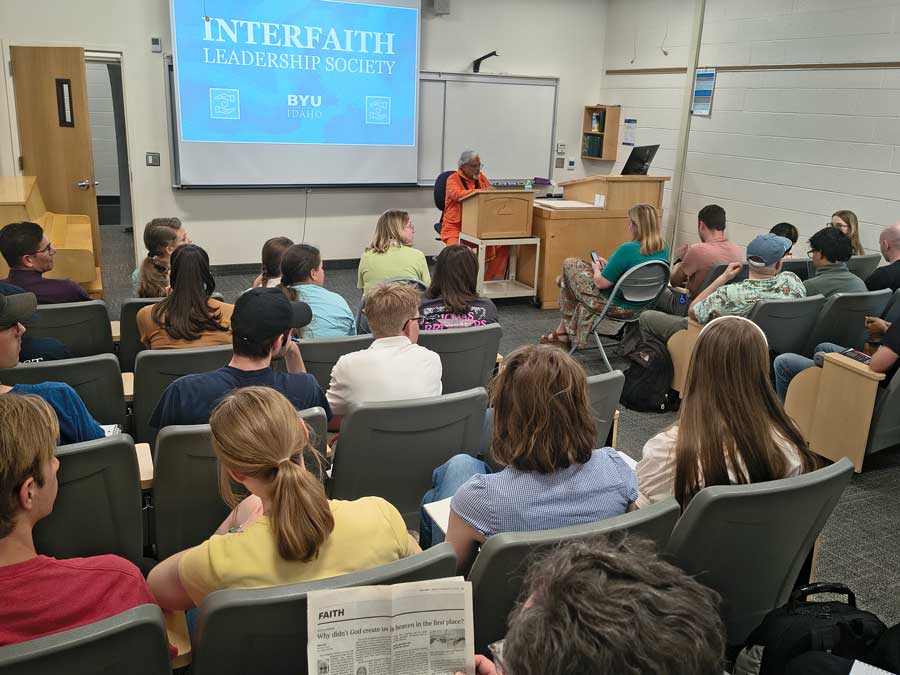
REXBURG — Students and faculty gathered at Brigham Young University-Idaho for an interfaith discussion featuring Hindu statesman and religious leader Rajan Zed. He spoke candidly about Hinduism, interfaith cooperation and the importance of understanding religious differences in a global society.
The Thursday event was hosted by the Interfaith Leadership Society at BYU-Idaho, and students had the opportunity to ask questions about Hindu beliefs, practices and traditions. Charles Ginn, vice president of the society, said the event reflected the group’s mission to promote greater understanding between people of different faiths.
“As an interfaith society, we try to learn more about other religions, to grow our knowledge and our appreciation for other people, and to learn how to work well with others,” Ginn said. “I think this event with Rajan is a great way to do that and to build those relationships.”
A legacy of interfaith activism
Zed is the president of the Universal Society of Hinduism and a longtime advocate for interfaith dialogue. He is often described as a Hindu statesman and interfaith leader who gained national attention after delivering the first Hindu opening prayer in the United States Senate in 2007.
He has also offered historic Hindu prayers in numerous state legislatures and city councils across the western United States, and he was invited by former European Parliament President Hans-Gert Pöttering to Brussels in 2008 to discuss Hindu and interfaith issues.
Zed has received several honors, including the World Interfaith Leader Award and the Nevada Religious Unity Award. In addition to his religious and civic leadership, Zed has served on numerous community and governmental boards in Nevada and holds degrees from the University of Nevada, Reno, San José State University, and Panjab University.
Building bridges at BYU-Idaho
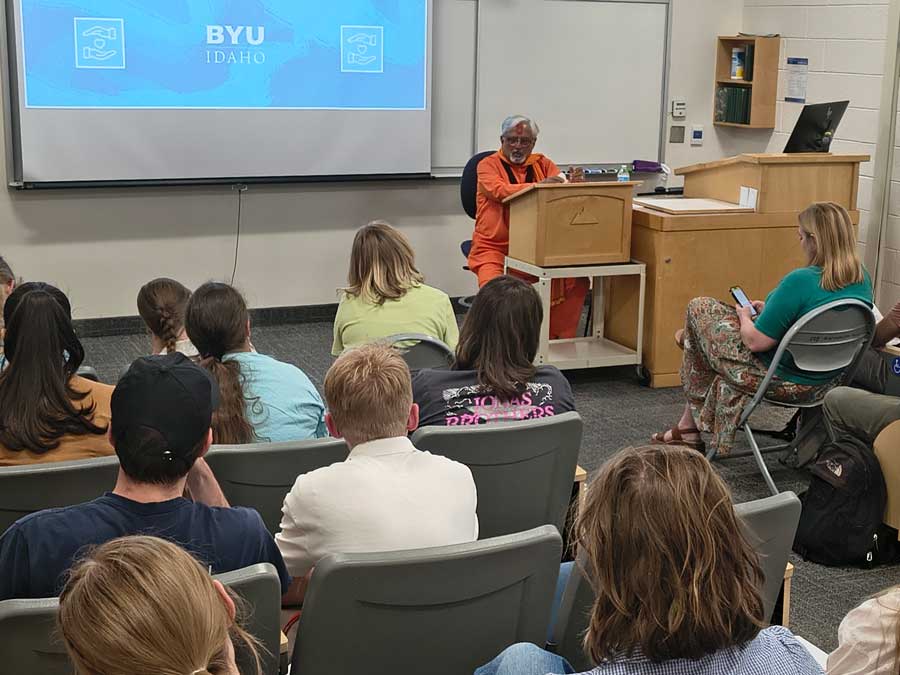
At BYU-I, Zed shared an overview of Hinduism’s history and structure. He explained that Hinduism has no single founder, no central governing authority, and a vast collection of scriptures rather than one defining holy book.
“We have no founder,” Zed said. “We have no central organization, nobody who can excommunicate me. We have to create our own moral boundaries.”
Throughout the discussion, Zed described Hinduism as one of the world’s oldest religions, tracing its roots back thousands of years. He spoke about major concepts, including reincarnation, karma, moksha and devotion. According to Zed, Hindus believe in a cycle of rebirth, and the ultimate spiritual goal is moksha — breaking free from that cycle and remaining with God.
“Karma is ‘whatever you sow, you reap,’” he explained. “If you do good karma, you will have a better life next time.”
Students asked questions about the Hindu caste system, arranged marriages, gurus, miracles and the relationship between various Hindu traditions.
Zed acknowledged ongoing social challenges in India, including caste discrimination and gender inequality, while also noting that younger generations are moving away from many older prejudices.
Alvin Charles, a recent BYU-I graduate who attended the event, said he appreciated Zed’s insights and agreed that Hindu culture is evolving in positive ways.
Charles, who was raised in a Catholic family in India before converting to The Church of Jesus Christ of Latter-day Saints, also mentioned that he finds value in the Hindu scriptures, even as an active member of a Christian church.
“As someone who’s struggled with mental health, finding purpose in life, and chasing goals and dreams, the discourse between Krishna and Arjuna in the battlefield in the Bhagavat Gita really helped me improve my perspective of life,” he said. “I think it works really well with the teachings of the Gospel of Jesus Christ and the Book of Mormon.”
In pursuit of a greater purpose
Zed emphasized repeatedly that interfaith understanding is increasingly important in a diverse and interconnected world. Zed encouraged students to learn about religions outside their own traditions so they can better relate to coworkers, neighbors and communities from different backgrounds.
“When you go out for work, you don’t know who is sitting next to you — what is his background?” Zed said. “If you know a little bit about his faith, then you can work better.”
Zed also praised The Church of Jesus Christ of Latter-day Saints for its organization and global growth, describing it as “one of the fastest growing denominations in the world” and “the best managed religion” from an organizational perspective.
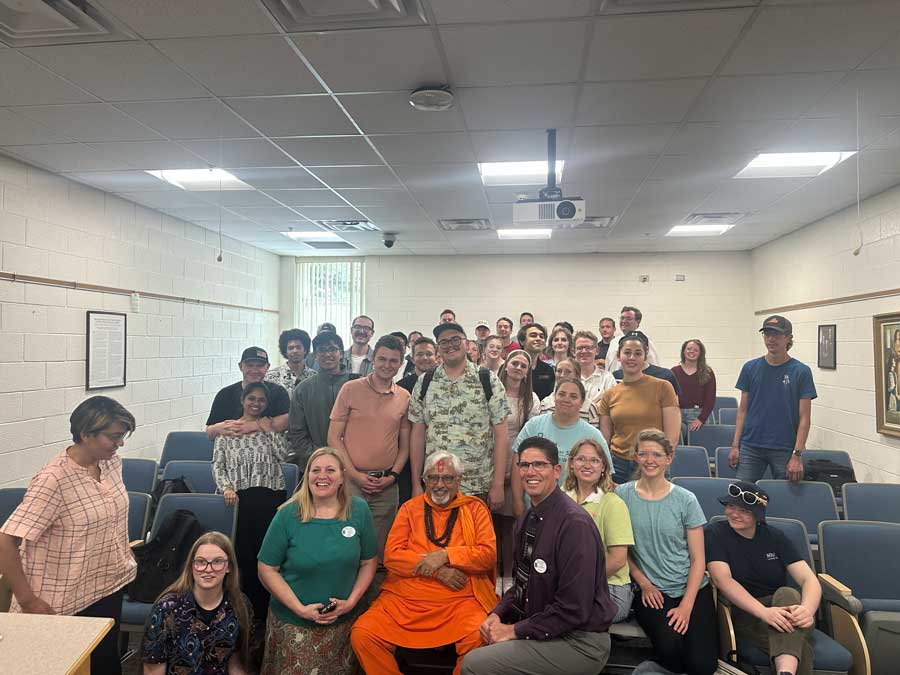
The discussion concluded with students continuing informal conversations and gathering for photos with Zed, reflecting the evening’s broader theme of curiosity, dialogue and mutual respect between faith traditions.