




Longtime District 28 Republican incumbent faces Democrat newcomer
Published at | Updated at
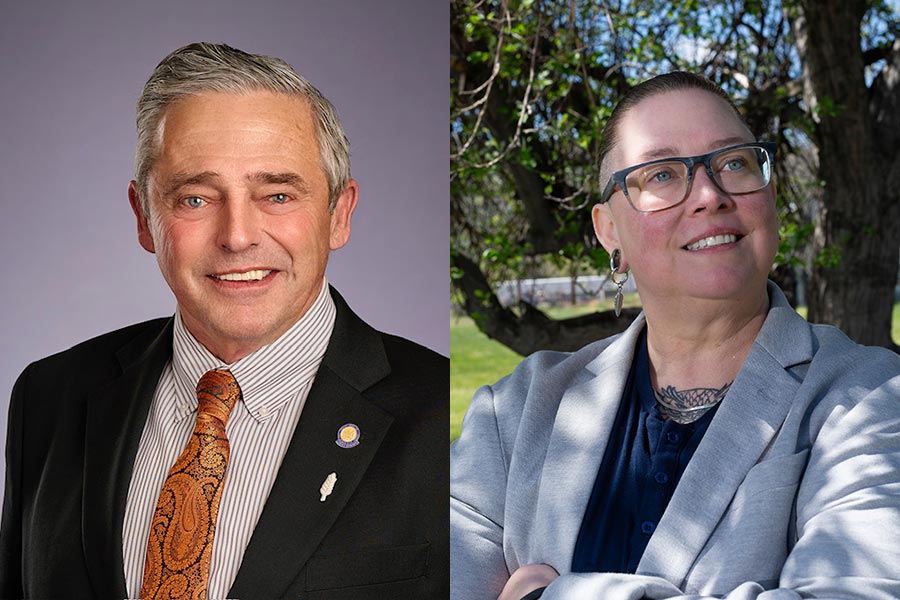
CHUBBUCK – A Democrat is challenging an Idaho senator for the seat he’s held for fourteen years.
Republican Senator Jim Guthrie is seeking to get reelected by his constituents, who voted him into office in 2012, while challenger Democrat Mandy Peace is running to replace him.
District 28 encompasses over 2,000 square miles, including the entirety of Power and Franklin counties, much of rural Bannock County, the majority of Chubbuck, and portions of Pocatello. The district’s legislators represent around 51,200 residents.
EastIdahoNews.com sent the same eight questions to Guthrie and Peace. Their responses, listed below, were required to be 250 words or less, and were not edited.
The general election is Nov. 3.
Tell us about yourself — include information about your family, career, education, volunteer work, and any prior experience in public office.
Guthrie: I was born in Pocatello and have lived in the Marsh Valley area within a 15-mile radius my entire life. I have two sons, one daughter, ten grandchildren, and one great grandson, all of whom I am extremely proud of. I was raised on a farm and still farm and ranch in the Marsh Valley area where I raise beef cattle and hay. I am fortunate to have great parents who taught me the value of hard work that has served me well throughout my life.
While building up my farm and ranch operation, I worked for many years in construction and heavy industry. I worked for several years as a union journeyman carpenter and for over a decade at Ash Grove Cement in Inkom. I have been in the Idaho Senate for fourteen years and prior to that served two years in the House of Representatives, six years as a Bannock County Commissioner, and six years on the Marsh Valley school board. I have spent time as a youth coach and served on numerous boards including the Portneuf Medical Center board of trustees.
Peace: I am a lifelong Idahoan, a proud wife, and a mother of two. My entire life has been dedicated to the service of my community in many ways. Grounded in practical problem-solving, my professional background spans years of hands-on experience in higher education finance, administration, and public service. Managing complex budgets and tracking resources taught me how to demand fiscal accountability and make every taxpayer dollar count. Wanting to preserve Idaho’s pristine public lands and outdoor heritage for my own children, I deeply value the open spaces that define our local way of life. Driven by a deep belief that every child deserves a safe, supportive place to thrive, I have spent many years advocating for our children, including serving as a dedicated foster parent and working alongside community leaders on nonprofit boards and local city advisory committees.
My commitment to helping others in times of crisis includes volunteering as a first responder with Bannock County Search and Rescue and South County Ambulance, and deploying to disaster relief zones during Hurricanes Katrina and Rita with the Medical Reserve Corps and the American Red Cross.
My background is rooted in community leadership, practical administration, and direct service rather than career politics. Whether stepping up in an emergency or advocating for our children, my approach is simple: show up, listen, put in the work, and deliver real results for Idaho families.
Why are you seeking political office within your community? Briefly explain your political platform.
Peace: I am seeking public office because my campaign is built on a simple, straightforward model: community at heart and service in action. For too long, working families, parents, and rural communities in Southeast Idaho have needed real relief. I am running to bring practical problem-solving back to the Idaho State Senate, putting people over politics and focusing on the everyday challenges we face.
My platform is built on common-sense solutions that protect our quality of life:
Defending Public Education: Keeping public tax dollars in public schools, fully funding our classrooms, supporting competitive teacher pay, and protecting our local school districts as the economic anchors of our rural communities.
Lowering the Tax Burden: Easing financial pressure on working families and stopping reckless fiscal policies that price people out of their homes.
Accessible Healthcare: Protecting and expanding healthcare access so that no Idahoan has to choose between medical care and putting food on the table.
Protecting Our Land & Water: Safeguarding public land access and our outdoor heritage, while securing vital water infrastructure for the Upper Snake River Basin.
Responsible Governance: Prioritizing public safety, transparency, and fiscal accountability.
Idahoans need leaders who listen first and govern with integrity. I am ready to bring that practical, community-first approach to the State Senate.
Guthrie: It has been an honor to serve my community, school district, county and legislative district in several different capacities. Each opportunity presents unique challenges, and I have grown as a decision maker because of that diversified service. I believe those experiences coupled with my commonsense approach to problem solving position me to be a strong advocate for this part of the state.
As for my platform, I have great respect for local control and understand the importance of our elected officials at all levels. One size does not fit all because local jurisdictions have differing personalities, needs, budgets and economies. I am very appreciative of the rural nature of Idaho and as such place a high value on our agriculture, timber, mining industries and maybe most importantly protecting our water. I believe in the least possible regulation and a fair, stable and predictable tax structure. I have always been a proponent of public schools, and our higher education systems. I have great respect for those who dedicate their careers to teaching our next generations. I am pro-life and understand the importance of doctor-patient relationships as difficult decisions are considered in life saving situations affecting both mom and baby. I am a strong supporter of our second amendment rights and our ability to hunt, fish and enjoy all the outdoor wonders that Idaho has to offer. As such, I do not support selling off our public lands.
With rising housing, fuel, and food costs facing Idahoans, can the state government help bring relief to Idaho citizens? Is it the role of the Idaho Legislature to help deal with these issues?
Guthrie: The issues I hear most about are inflation, coping with growth, property taxes, and concerns about education and water. Certainly, there are many other issues. For many years the political battle cry has been we need to bring more jobs and people to Idaho. We offer huge tax incentives for business and industry to come here. In my opinion that is a narrative that needs recrafted. Let’s not sell Idaho short by giving away the farm at the risk of losing our farms.
At the state level we have appropriated money to help mitigate ever increasing property taxes, but they remain an issue. In my opinion we have placed too much focus on cutting income tax rates and instead should have placed more importance on the property tax dilemma. Our children and even many middle-aged citizens cannot afford housing and single-family dwellings are giving way to apartment complexes. Incentives for affordable housing development may help soften that sticker shock. The growth cycle we are in has put incredible pressure on Idaho’s water, education systems and every aspect of our infrastructure. We need to get back to a more methodical growth trajectory and make sure those coming in pay their fair share. In time this will help stabilize prices but there is no silver bullet.
Peace: Yes, state government has a fundamental duty to address the affordability crisis pricing working Idahoans out of their own communities. When property taxes skyrocket and families cannot afford groceries, gas, or a stable home, sitting on our hands and calling it a free market is a dereliction of duty.
The Idaho Legislature has direct tools at its disposal to deliver meaningful relief. We must tackle the root drivers of the cost-of-living crunch by reforming our regressive tax structure, shifting the burden off working homeowners and families and ensuring large corporate interests pay their fair share. We must invest aggressively in workforce housing infrastructure, protect consumers from predatory pricing, and stop passing policies that inflate everyday expenses.
Government should not pick winners and losers, but it must step in when regular people are drowning under economic pressures. My commitment is to put working families first, cutting red tape where it hurts, and deploying state resources responsibly to ensure that if you work hard in Idaho, you can actually afford to live here. Navigating this crisis requires leaders who prioritize people over corporate handouts, and that is precisely what I intend to do in the State Senate.
How will you best represent the views of your constituents – even those with differing political views? How do partisan politics play into your role as an elected leader?
Peace: True leadership is not about echo chambers, it is about showing up, listening, and serving every single member of your community, regardless of how they vote. My entire life has been defined by service, whether responding to emergencies in crisis zones, sitting across the table on nonprofit boards, or advocating for vulnerable children as a foster parent. In those moments, asking someone’s party affiliation does not save a life or solve a problem. Shared humanity and practical results do.
Partisan posturing and nationalized wedge issues have poisoned our politics, distracting us from the real kitchen-table challenges facing Southeast Idaho. When I am in the State Senate, my allegiance will not be to a political party faction or special interest, it will be to the people of District 28.
Representing constituents with differing views means keeping an open door, holding regular community conversations, and treating every neighbor with dignity and respect. If a policy is good for our schools, our water, our healthcare, and our working families, it does not matter if it has a Republican or Democratic label on it, we should pass it. It is time to strip the partisan noise out of Boise and bring back a government that works for everyone.
Guthrie: Talking with constituents at various venues and meetings helps me understand things that are important to my district. I try to reflect on that directive and what is best for Idaho overall as I decide on supporting or opposing legislation. One thing I have found is that I might think something is a great idea and begin working on a legislative solution. When I share the draft with parties that could be impacted by a statute change it puts everything out in the open for discussion before the idea is pushed forward.
As I hear concerns, I might decide on changes that are needed or dismiss the idea altogether. Interaction and education on both sides of the political aisle can be beneficial not just for the issue at hand but as we build relationships and trust going forward. I even look for opportunities where I can co-sponsor legislation with a democrat colleague. I remind myself that regardless of political affiliation we are all there to represent our constituents and make the best decisions possible to move our state forward in a positive direction. The media sometimes exploits political differences but most of the time common ground among political counterparts is an important element in our public service capacity.
What parts of the Legislative budget could use more funding? Where are places in the budget where cuts could be made?
Guthrie: We hear all too often that education is always wanting more funding. As we consider those requests we should keep in mind, we are near the bottom nationally in funding per pupil. That said, Idaho schools do an excellent job with the funds given to them, but we can ill afford to ignore the importance of education.
Failing is not an option because by educating those who in the future will be our next political and industry leaders, will drive our economy, help feed our nation, invent the next big thing, care for our medical needs and so much more we create the best chance for continuing generational success. And to make the circle complete it is them who will educate those who follow. Besides keeping our financial commitment to K-12 and higher ed one area needs additional attention. Special needs students require in some cases the expenditure of district resources far more than any reimbursement they receive. We must develop a different funding model to mitigate this disparity.
As for cutbacks, an interim committee met this summer to identify places where cuts and efficiencies could take place with some success. I expect that effort to continue. Because of the holdbacks the Governor issued by executive order in July last year and the subsequent cuts for the FY 2027 budget, we are at a moment where we need to recalibrate our entire revenue, expenditure, budget process prior to future budget reductions.
Peace: Idaho’s budget is a statement of our moral and economic priorities, and right now, those priorities are upside down.
We must dramatically increase funding for our public education system. For too long, Idaho has lagged near the bottom in national classroom investment. We need to fully fund our public schools, fix crumbling rural infrastructure, expand resources for special education students, and provide competitive compensation to retain qualified teachers. We also need targeted investments in our water infrastructure and natural resource management to protect our agricultural economy and secure our regional water supply.
Conversely, we must find the courage to cut wasteful spending and misplaced priorities. We should immediately eliminate taxpayer-funded private school voucher schemes that siphon critical dollars away from our constitutionally mandated public school system into private and religious institutions with zero public accountability. Furthermore, we must audit state-level corporate giveaways and sweetheart tax loopholes that benefit out-of-state entities while failing to deliver a measurable return on investment for Idaho taxpayers.
Fiscal responsibility does not mean starving our public goods, it means making sure every hard-earned tax dollar is spent where it actually serves the people of Idaho, supporting our families, strengthening our communities, and building a sustainable future.
In 2026, Idaho suffered a historic drought, leaving eastern Idaho’s reservoirs at an all-time low. As a result, crop yields were significantly impacted. What specific strategy or legislation would you support to protect groundwater and surface water resources, and what is your timeline for measurable improvements?”
Peace: Water is the lifeblood of eastern Idaho, and addressing our historic drought requires true partnership. Crucially, the Shoshone-Bannock Tribes must have a primary, sovereign seat at the table as equal leaders in shaping our regional water strategy.
To protect our groundwater and surface water, I support a comprehensive approach anchored in strict aquifer recharge programs, modernized delivery infrastructure, and collaborative basin-wide agreements that respect senior water rights and tribal sovereignty. We must empower the Idaho Department of Water Resources to prevent over-allocation while securing targeted state capital investment to line canals, upgrade aging storage infrastructure, and incentivize agricultural water-efficiency innovations.
Regarding timeline, we need immediate emergency mitigation to support impacted producers for the upcoming seasons, paired with a strict 3-to-5-year benchmark window to stabilize aquifer declines, modernize monitoring systems, and implement basin-wide conservation protocols. Water policy cannot wait for election cycles. As your Senator, protecting our water rights, honoring tribal partnerships, and ensuring our farmers and communities have a reliable supply for generations to come will be a top, non-negotiable priority from day one.
Guthrie: Water management and pressure put on that resource by growth is a critical issue in Idaho exacerbated by the drought cycles we seem to find ourselves in, perhaps this year more than ever. During my time in the Idaho Legislature, I have consistently voted for funding for recharge projects, cloud seeding and other efforts to conserve water. I am in favor of raising dam levels where it makes sense for more storage capacity, including looking into rebuilding the Teton dam if proven it can be done safely.
As most are aware, the contention between surface and ground water users has a multi-year history. Currently there is an agreement in place to keep most users in water, but I predict those efforts will need constant attention. As a country boy I have watched a state grow faster than my comfort level would suggest. I would like to see Idaho be a little more discriminating on when and where we use tax incentives to lure business to our state. We have so much appeal and the nation is becoming more aware all the time that Idaho is a great place to live and do business. It begs the question; do we really need to pay people to come here? My thought is you are welcome, but we need you to pay your fair share. Everyone else here is paying theirs. Idaho is a rural wonder; I would like to preserve some semblance of that heritage.
One of the biggest issues on the November ballot is Proposition 1, a citizen-led ballot initiative that would repeal Idaho’s abortion ban. Do you support Proposition 1? Why or why not?
Guthrie: The short answer is I am voting no on Proposition 1 because it takes a subject that needs addressing and goes too far, way too far. That being said, in my opinion Idaho’s current laws addressing the abortion issue needs some modest adjustments. I have advocated the past several years to my legislative colleagues for changes to our current laws. It is imperative we are sensitive to not just the life of the mom but give her and her health care provider assurance that she doesn’t t face life altering, ongoing health consequences due to limited treatment options. Health care providers need the latitude to treat problematic pregnancies without wondering if their best faith efforts will put them in legal jeopardy. It is troubling to me that Idaho has seen the exodus of dozens of OBGYN docs and women who face pregnancy complications being forced to go out of state for treatment. We also need a more sensitive policy for victims. Along with most of Idaho I am prolife, but I firmly believe we can achieve those objectives and still protect the unborn. In conclusion, Proposition 1 swings the pendulum way too far towards elective abortions and risks removing parental awareness of serious decisions facing their minor child. I understand the frustrations that led to this ballot initiative, but I wish the authors had been more measured in their approach.
Peace: Yes, I support Proposition 1 because healthcare decisions belong between a patient, their family, and their doctor, not politicians in Boise.
Idaho’s current near-total abortion ban has created a public health crisis in our state. By criminalizing essential reproductive healthcare and threatening medical professionals with felony prosecution, we have driven skilled obstetricians and gynecologists out of Idaho, leaving maternity wards closing and rural hospitals struggling to care for pregnant women in emergency situations. This is not pro-life, it is dangerous, government-mandated intrusion into private medical decisions.
Proposition 1 restores common-sense protections. It ensures that women have access to life-saving medical care during emergencies, protects access to contraception and fertility treatments, and safeguards doctors from being treated like criminals simply for doing their jobs and honoring their medical oaths.
As a mother, a foster parent, and a community advocate, I believe we should be supporting families, strengthening healthcare access, and trusting women. The current extreme laws are failing Idaho families. It is time to restore privacy, protect healthcare providers, and bring balance back to our laws.
Idaho House Joint Resolution 4 (HJR 4) is a constitutional amendment on the November ballot that would give the legislature exclusive authority to legalize or decriminalize marijuana, narcotics, and psychoactive substances. It would also ban citizen initiatives that would allow voters to directly have a say on the issue. Do you support the passage of HJR 4? Why or why not?
Peace: No, I do not support House Joint Resolution 4. This constitutional amendment is a direct, calculated attack on the constitutional rights of Idaho citizens and the foundational principle of direct democracy.
The Idaho Constitution explicitly states that all political power is inherent in the people, who reserve the right to propose laws and bring issues directly to the ballot. HJR 4 seeks to strip that power away from everyday citizens, permanently locking the people out of the legislative process whenever the ruling political establishment in Boise decides they do not want to listen.
Whether an individual supports or opposes specific drug policies, every Idahoan should be deeply alarmed when the legislature attempts to rewrite the constitution to insulate itself from accountability and silence the voters. If politicians refuse to listen to families struggling with medical conditions or ignore the will of the public, the citizen initiative is our ultimate check and balance against government overreach.
We should trust the people of Idaho, not strip away their constitutional voice. I urge a vote against HJR 4 to protect our foundational democratic rights and keep power where it belongs, with the people.
Guthrie: During this past session, I voted to put HJR 4 on the ballot because I believe it is past time for citizens to weigh in on the marijuana issue in particular. I am not in favor of legalizing marijuana for medical or recreational purposes, but many are. HJR 4 will take the temperature of Idaho voters as to how they feel about this. We have seen many states after approving the use of this drug experience negative consequences with an uptick in addiction. In addition, because when legal it would be taxed and as such has the negative result of consumers looking to illegal sources for financial reasons. So, in short, you end up with the worst of both worlds. If HJR 4 is to pass it will send a clear message that Idaho voters do not want this decision to be placed solely in the hands of legislators. To be honest, I would respect that message.