



The untold story of the father of the Teton Dam — and how it cost him everything
Published at | Updated at
EDITOR’S NOTE: This is the ninth in a series of stories highlighting the 50th anniversary of the Teton Dam Disaster.
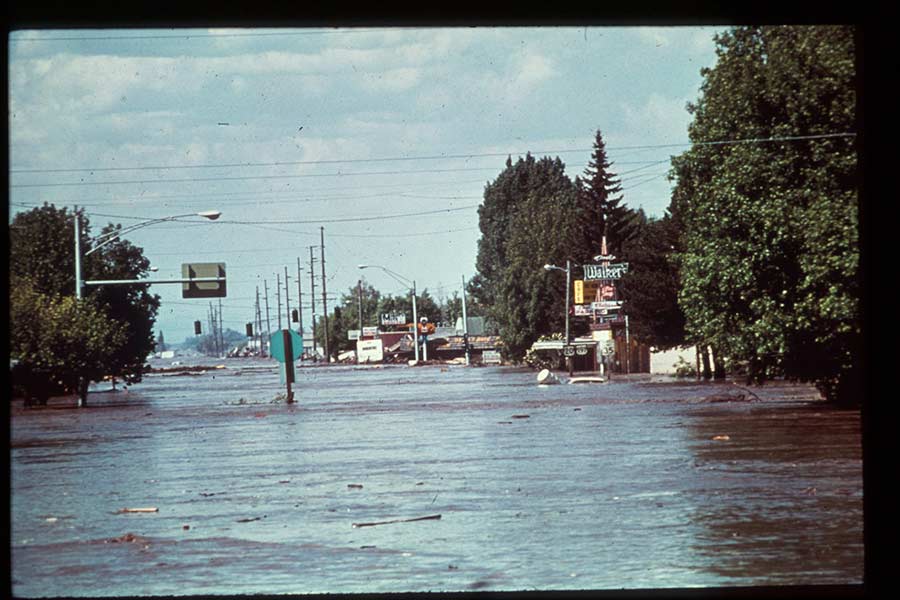
REXBURG — Willis Walker spent decades fighting to bring a dam to the Teton River. On June 5, 1976, he stood atop a bridge in Rexburg and watched as the project he’d championed unleashed a wall of water that destroyed his farm and devastated his community.
The failure sent an estimated 80 billion gallons of water surging across eastern Idaho, devastating communities from Wilford and Sugar City to Blackfoot. The disaster made national headlines, and the floodwaters eventually traveled 70 miles downstream before being contained at American Falls Reservoir.
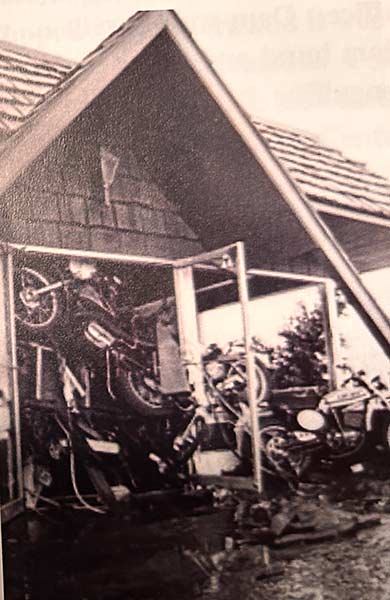
Not only was the city of Rexburg buried under 5 feet of water, but 11 people and about 13,000 head of livestock were killed. Beyond that, about 3,000 homes and tens of thousands of acres of land were destroyed or heavily damaged.
Cleanup took months and cost over $2 billion — more than $11 billion in today’s dollars. The U.S. Bureau of Reclamation, the agency that built the dam, spent the next 11 years compensating those who were affected. The roughly $400 million in payments did not come close to covering the losses.
Known locally as the father of the Teton Dam, Walker had spent decades advocating for its construction. He was also among those whose lives were devastated by its failure. Walker is no longer alive to tell his story, but his grandson, Glenn, remembers the disaster vividly. He was 13 when the dam broke.
He tells EastIdahoNews.com his grandfather owned a dairy farm that sat on the east side of the Teton bridge where Albertsons and CAL Ranch now sit. The flood wiped it out.
“It completely stripped everything and destroyed it all,” Glenn recalls.
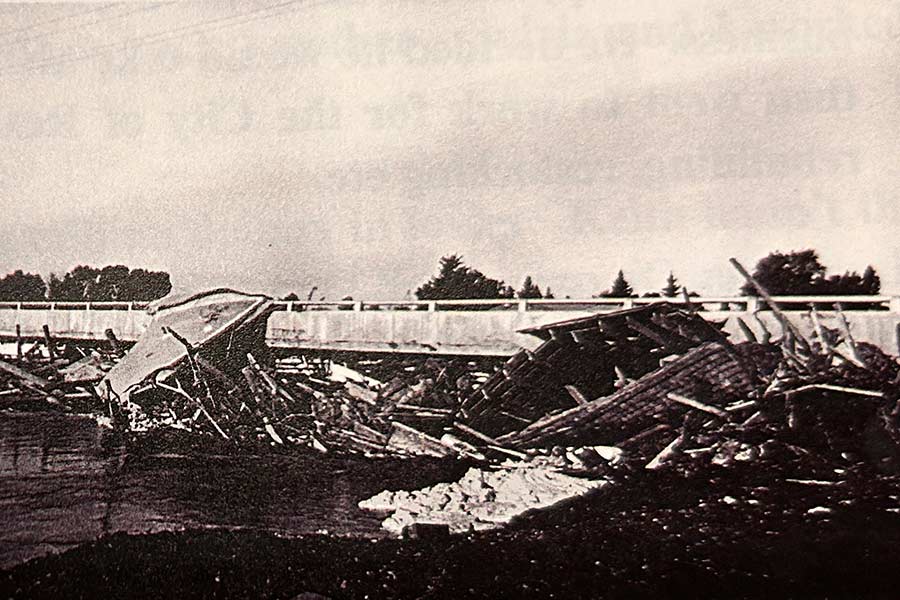
Despite losing his home and livelihood, Glenn says that what hurt Willis most was the public criticism he faced in the aftermath. Willis had no role in the dam’s design or construction and was not responsible for its failure. As a founding member of the Fremont-Madison Irrigation District, he had spent decades advocating for the project, believing it would provide farmers with a more reliable supply of irrigation water.
As concerns about flaws in the dam’s design surfaced, Willis remained involved in the discussions. But he had no engineering expertise and was not responsible for the decisions that ultimately led to its failure.
But in a moment of crisis following the dam’s collapse, Glenn says the public needed someone to blame and Willis became the scapegoat.
“His desire was to help his community and the state of Idaho. The amount of hours he put into this was unbelievable … and to have it (end the way that it did) really broke his heart,” Glenn says.
Willis was 83 when he died three years later. Although the official cause of death was a heart attack, Glenn believes the emotional strain of the disaster ended his life prematurely.
Long before the Teton Dam became a reality, Willis had a personal reason for wanting to control the river. It began with his own experiences as a farmer in the Upper Snake River Valley.
‘One of the greatest investments’
Willis grew up farming in Labelle, northwest of Rigby, before eventually moving to Rexburg, where he operated a dairy farm and raised crops along the Teton River.
Like other farmers in the area, Willis relied on the river to irrigate his fields. But each spring, runoff frequently spilled over its banks, flooding farmland and destroying crops. He believed a dam could help control the flooding while capturing water for future irrigation.
In 1935, Willis and other local irrigators organized the Fremont-Madison Irrigation District and began pursuing federal support for the project. They approached Idaho Congressman D. Worth Clark, who championed a proposal for a flood-control dam on the Teton River. The original plan called for a reservoir holding about 40,000 acre-feet of water, according to a 1980 oral history interview with irrigation district board member Cy Young. Clark requested $2 million to fund the project, but Congress never approved it.
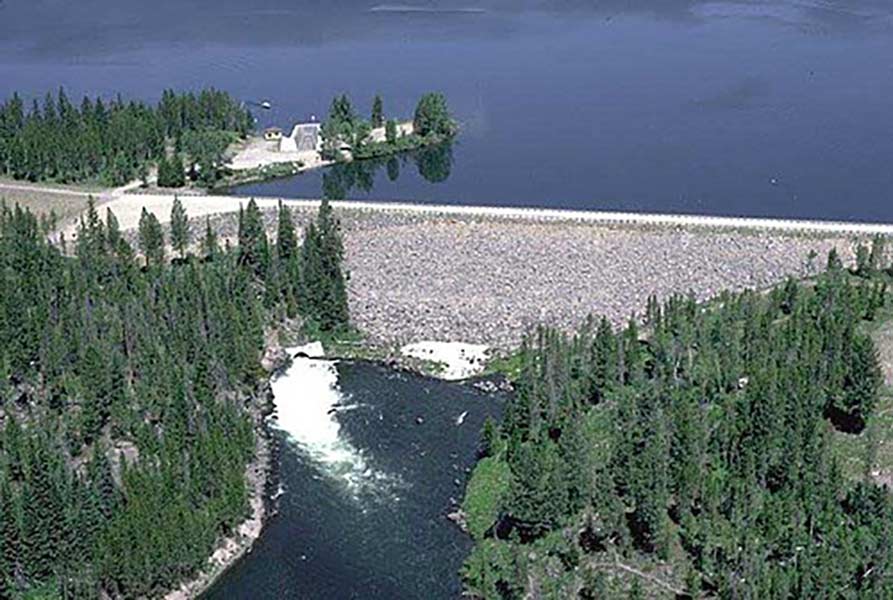
Meanwhile, the Bureau of Reclamation was developing Island Park Dam on the Henrys Fork of the Snake River. Completed in 1938, the 91-foot earthen dam provided about 128,000 acre-feet of storage and became an important source of supplemental irrigation water for the Upper Snake River Valley.
Young later called Island Park Dam “one of the greatest investments” farmers in the Upper Valley had ever made.
“This dam has been a tremendous source of supplemental water supply in the area, and the dam always fills and spills. Even in the dry years, we still impound enough water to fill the dam at Island Park,” he said.
Its construction led to the development of the Cross-Cut Diversion Dam, commonly known as Chester Dam. Completed the same year, it raised the Henrys Fork by about 10 feet, allowing water to flow into the Cross Cut Canal and be diverted into the Teton River through existing irrigation canals.
Grassy Lake Dam, about 15 miles southeast of Ashton in northwestern Wyoming, was completed the following year. Nearly two decades later, Palisades Dam was completed in 1957. Although these projects served different purposes, both contributed to a more dependable irrigation supply for eastern Idaho farmers, including those who relied on the Teton River.
But none of these projects were designed to prevent flooding along the Teton River. That problem persisted, and another major flood in 1962 prompted the irrigation district to renew its push for the Teton Dam.
A renewed push for the Teton Dam
That year, six district representatives traveled to Washington, D.C., to revive the proposal. Willis and Young were among them.
“(Willis) led the delegation that went back to Washington,” Young recalled.
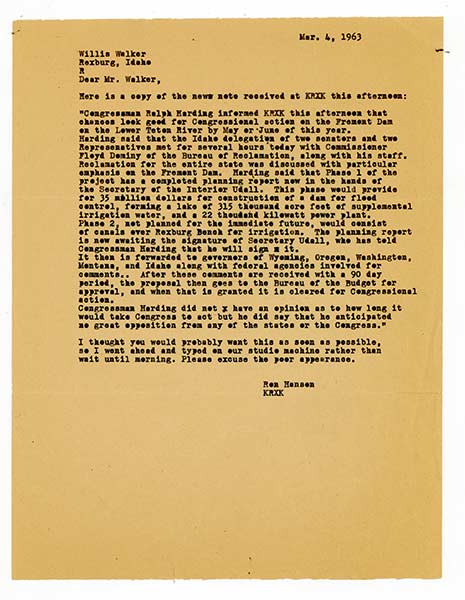
The renewed proposal was considerably more ambitious than the original plan. With help from U.S. Sen. Frank Church and Rep. Ralph Harding, legislation moved forward for a multipurpose dam that would provide flood control, hydroelectric power, recreation and supplemental irrigation water for 111,250 acres of farmland in the Upper Snake River Valley.
“Congressman Ralph Harding informed KRXK this afternoon that chances look good for Congressional action on the Fremont Dam on the Lower Teton River by May or June of this year,” Ron Hansen with the former Rexburg radio station wrote in a memo to Willis on March 4, 1963. “He anticipated no great opposition from any of the states or the Congress.”
Congress approved the project in 1964, but political disputes delayed construction for seven years. In 1971, the Bureau of Reclamation awarded a $39.5 million construction contract to Morrison-Knudsen Company Inc. Work began the following year, and construction was completed in 1976.
By June 5, the reservoir was nearly full. Within hours, the dam would collapse, unleashing the flood that devastated the Upper Snake River Valley and forever changed the lives of the people who had spent decades fighting to build it.
A vision that never died
Despite being wiped out in the flood, Willis remained a proponent for the dam’s reconstruction.
“In fact,” Willis said in an interview days after the flood, “the Fremont-Madison Irrigation District is already starting moves toward plans for rebuilding the dam.”
But it never happened. Instead, the dam site was closed, and all the contracted employees lost their jobs. The tragedy brought an end to large scale dam construction projects nationwide.
Fifty years later, proposals to rebuild the Teton Dam are back on the table. State lawmakers made a similar trip to Washington D.C. last year to petition Idaho’s congressional delegates for help in moving it forward.
RELATED | Local legislator asking you to sign petition in support of water storage projects in Idaho
A year later, the conversation has shifted. While long-term water storage projects are still a focus, rebuilding the Teton Dam is no longer the immediate priority.
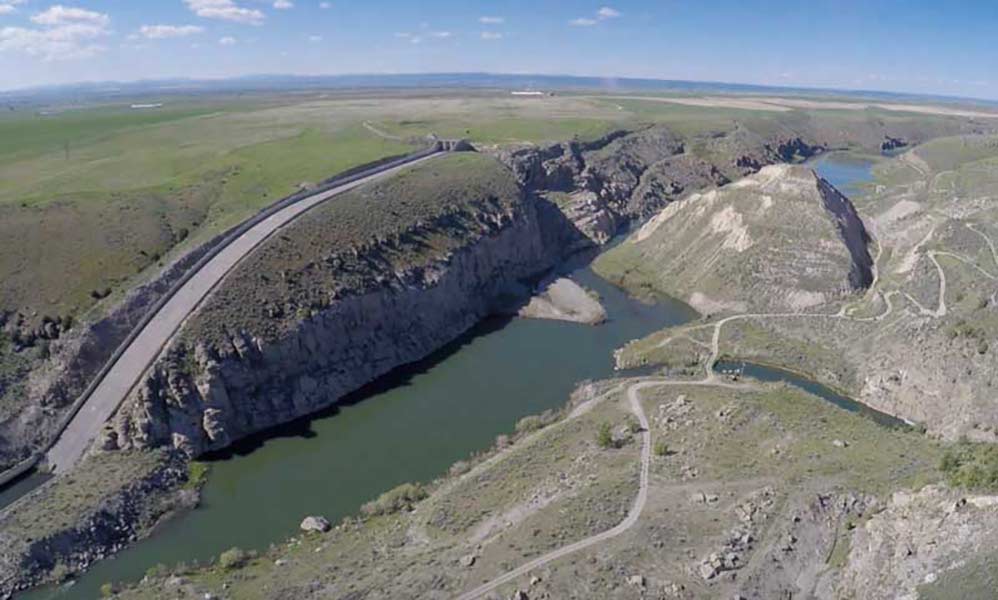
For many people, the Teton Dam is remembered for the devastation it caused. The story of the man who championed its construction is largely overlooked.
Glenn says his grandfather’s dedication to water projects and his community is a legacy worth remembering.
“It’s amazing to me how many hours he put into (water projects) to help our community,” says Glenn. “I’m grateful for him, and I appreciate what he did.”
WATCH OUR INTERVIEW WITH GLENN WALKER IN THE VIDEO ABOVE.
This weather-related story is brought to you by Pony Express Car Wash, Idaho's premier express car wash destination, renowned for its commitment to exceptional service and quality. Voted the No. 1 car wash company in Idaho for five consecutive years, we pride ourselves on delivering an unparalleled experience for every vehicle and customer. Our state-of-the-art facility utilizes name-brand soaps and cutting-edge equipment to ensure your car receives the ultimate clean. Established in eastern Idaho in 2019, Pony Express is proud to be a locally owned and operated company that caters to the unique car washing needs of our Idaho Friends and neighbors. We invite you to experience the difference at Pony Express, where your satisfaction is our ultimate goal.