



‘Little miracles.’ Survivor recalls the day Teton Dam broke
Published at | Updated at
Scott McIntosh, Idaho Statesman
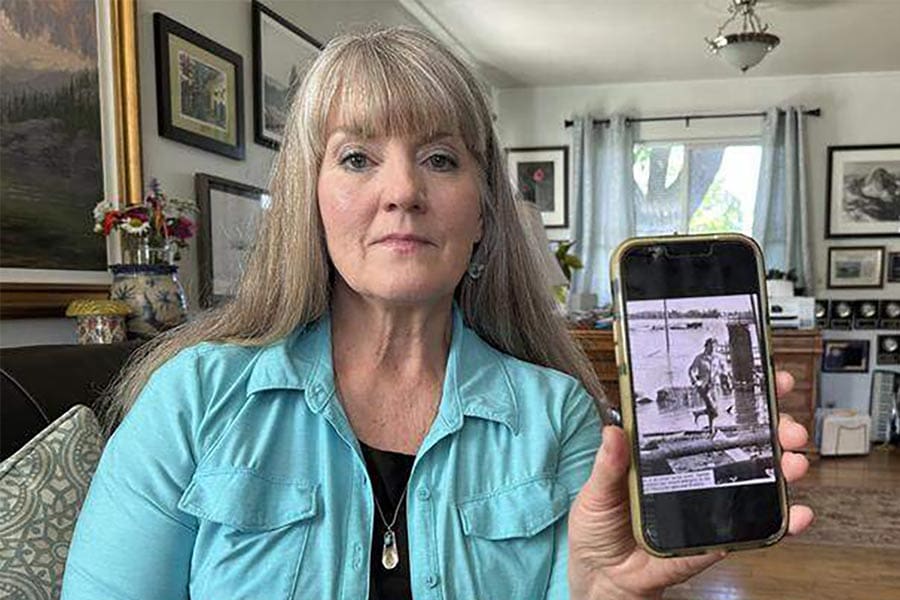
REXBURG (Idaho Statesman) — Anita Knapp remembers it was a beautiful Saturday morning 50 years ago, June 5, 1976.
She was 11 years old, playing with her 8-year-old sister at their house in Hibbard, an unincorporated community in Madison County, about 18 miles southwest of the newly constructed Teton Dam.
That idyllic morning was interrupted when a neighbor called and said the dam had collapsed, and the radio announcers were telling everyone to evacuate the area. Thousands of people fled to higher ground at what was then Ricks College, now BYU-Idaho, in neighboring Rexburg. Her father and brother, who were working on a job site in another town, finished their job then went to Ricks College, where they expected to meet up with the rest of the family.
Anita’s mom, though, decided to stay in place, figuring that the dam collapse was far enough to the east that it wouldn’t reach them.
She was wrong.
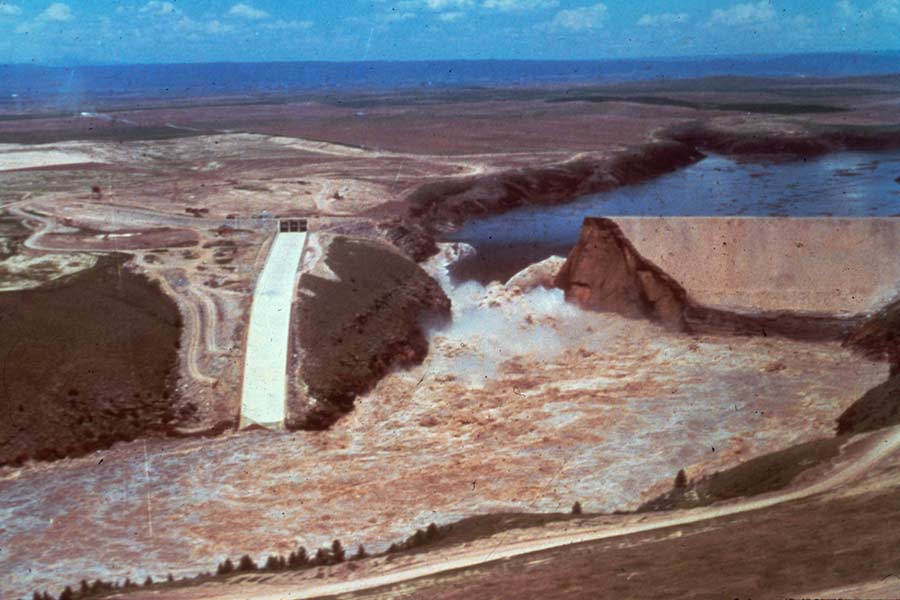
Hibbard ended up in the path of the floodwaters and was one of the harder-hit areas of the Teton Dam collapse, which released about 80 billion gallons of water into the valley. About 80% of the structures in Hibbard were destroyed or heavily damaged, according to the Association of State Dam Safety Officials.
Friday marks the 50th anniversary of the Teton Dam collapse and flood in eastern Idaho, which killed 11 people and 16,000 livestock and caused an estimated $2 billion in damages when the earthen dam experienced a catastrophic failure as it was filling up for the first time.
The failure of the Teton Dam, later determined to be caused by poor design, flooded five counties, inundated over 300 square miles and sent water 155 miles downstream. A new Idaho Experience documentary, Teton Dam Disaster, will air at 8:30 p.m., Thursday, June 4, and 7:30 p.m., Sunday, June 7, on Idaho Public Television and at idahoptv.org.
‘Like a sideways tornado’
Anita Knapp remembers the details of that day more than any other day of her life.
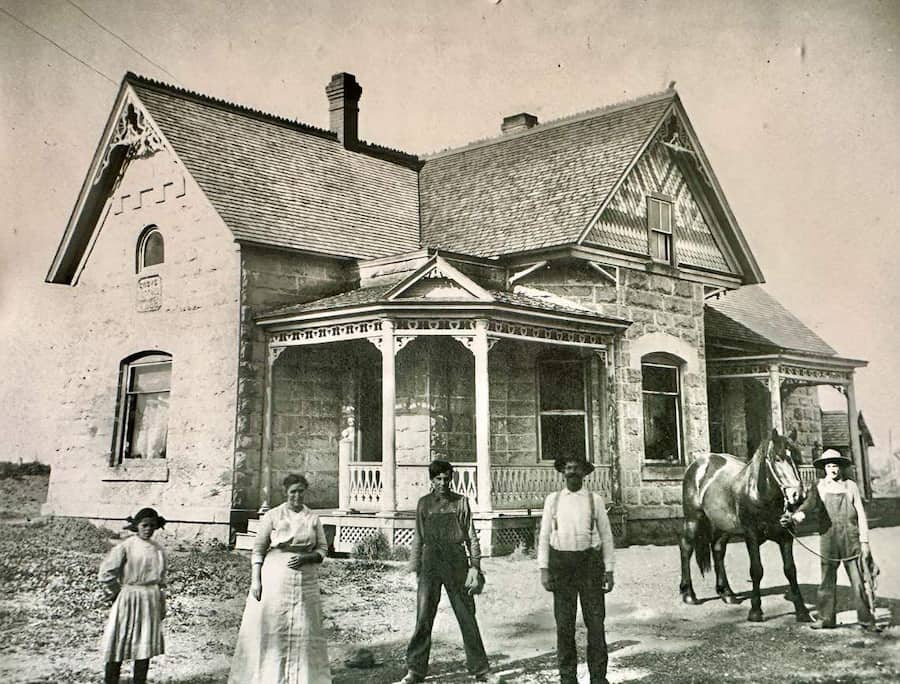
As floodwaters began to approach their property, Anita and her mother and sister gathered everything that was on the floor of their two-story 1905 stone farmhouse, put them up on beds and moved some items to the second floor.
To protect their piano, they opened up a fold-out couch and tipped the piano onto it.
Outside, Anita and her sister climbed to the top of an old boxcar on the property that served as a storage shed and used binoculars to see if there were any signs of the incoming flood.
“Eventually I did see something coming, but I couldn’t figure it out,” she said.
She thought she’d see something like a tidal wave like you see in the movies.
Instead, “all I could see from a distance was this big long line of brown swirling, rolling dust and debris, and it was just this big dirt cloud, and it was rolling like a sideways tornado,” she said. “It was rolling toward us, and you could also see debris in it, even animals and things like that.”
Many neighbors, as they were evacuating, had released their animals to at least give them a fighting chance at survival.
As that big brown swirling line of water quickly approached, Anita and her sister and mother spotted two horses running wild along the highway and straight into a barbed wire fence, where they became trapped.
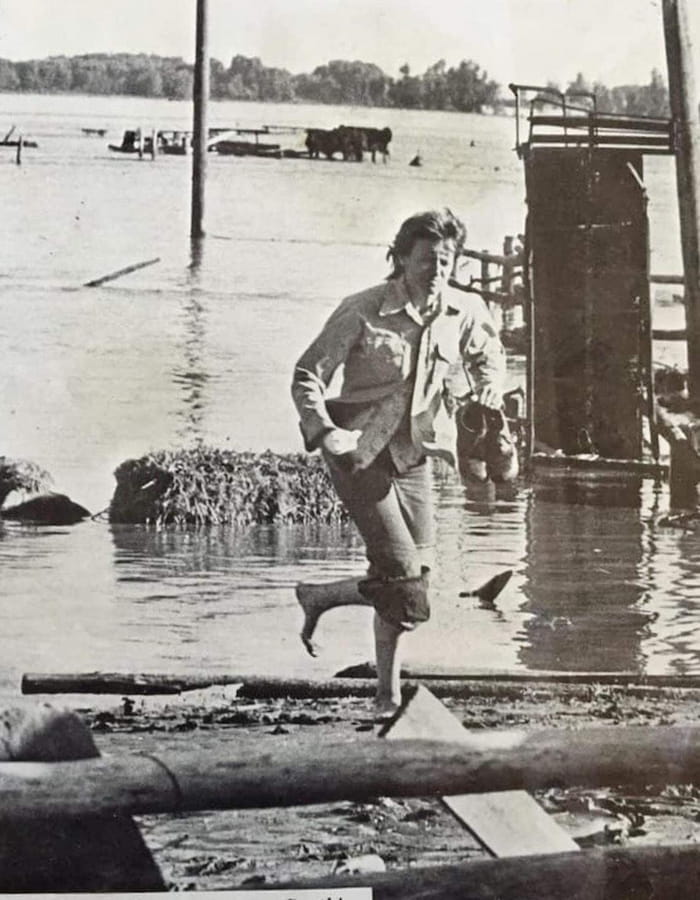
Anita’s mom, Carolyn Thompson, decided to save the horses. She ran to where the horses were and somehow got them free, but she still had to make her way back to the house and relative safety before the floodwaters reached her.
“She turned and just ran as fast as she could back down the lane,” she said. “She must have just thought, ‘I’ve got time,’ but my sister and I, we’re on the front stoop, and we’re yelling at her to hurry. And we know this water’s coming, and she’s coming this way, and the water’s coming this way. She got back just in time, really. Honestly, she got up onto the stoop, and then just moments later, in came the water, and it kind of swallowed the stoop and came in the house.”
That was one of the only times she was truly scared that day.
“It was such a close call,” Anita said. “I have always felt like divine providence saved my mom that day. … If she hadn’t been (saved), I have no idea the condition me and my sister would have been in.”
Although 11 people were killed and so much was lost that day, Anita feels it could have been so much worse. The fact that it happened on a Saturday and not a workday, that it happened in the morning and not in the middle of the night, so people could get warnings and evacuate. It happened in relatively good weather, in the summer, not the bitter cold of winter.
“To me, there were just sort of these little miracles that happened throughout this disaster, not just to me, but to us in general as a population,” she said. “There were so many little tender mercies that we felt protected. We felt how much worse it could have been.”
Might as well make a roast
The floodwater rose about a foot or two inside the house. The fold-out couch did its work, protecting them and the piano.
Anita’s mom figured that they were going to lose power at some point, so she decided to put a roast in the oven, which finished cooking just before they lost power. The three of them sat on the couch, their legs dangling in the water, eating the roast.
“It was very weird,” she recalled. “It’s probably the strangest dinner anyone’s ever had.”
Eventually, the water began to ebb, and they were able to make their way out of the house.
They watched as the floodwaters carried rooftops, lumber, dead, bloated cows and farm debris past their house.
A dog was on top of a floating rooftop passing by, and they convinced the dog to come off the roof to try to save it. The dog jumped into the water but decided to turn back and drowned before getting back to the roof.
Anita said she remembers the tiniest details from that day.
For example, she remembers sitting at her bedroom window, looking down at the floodwaters that were just at her windowsill, and a mouse on top of a leaf floated past her. She tried to save the mouse, but the mouse swam away.
Helicopter rescue
At some point that day, Anita grew so tired, she lay down on the top bunk of her bunk bed, wet clothes and all, and fell fast asleep.
A strange noise woke her up.
It was the sound of a helicopter.
It turns out that her father, safely on the hill at Ricks College, was frantic with worry about his family, who had failed to meet him at the college. With the help of a school principal, he persuaded the National Guard to take a helicopter out to his place to look for his wife and daughters.
Anita remembers the look of relief on her father’s face when the chopper touched down on a safe patch of land, and he realized his family was alive.
As they flew away from the scene, Anita said she was struck by the lack of any sign of landmarks — no roads, no railroad tracks, no property lines. Fences were washed away, the landscape below a vast brown swath dotted with debris, dead animals and abandoned vehicles.
‘These people saved us’
It’s 50 years later, but Anita still begins to cry when she thinks about the hundreds if not thousands of volunteers who descended upon the valley to help with the cleanup efforts.
“If these people had not come in, these volunteers, the morale would have been so low, and there’s no way that that cleanup could have occurred like it did,” she said, tears filling her eyes. “It was just kind of a nightmare scenario, but these people, I mean, these people, and I get a little emotional, so I’m sorry, but these people saved us. I mean, they saved us.”
That’s perhaps why Anita later volunteered for nine years with the American Red Cross, responding to hurricanes, floods and other disasters to help people just like her community was helped then.
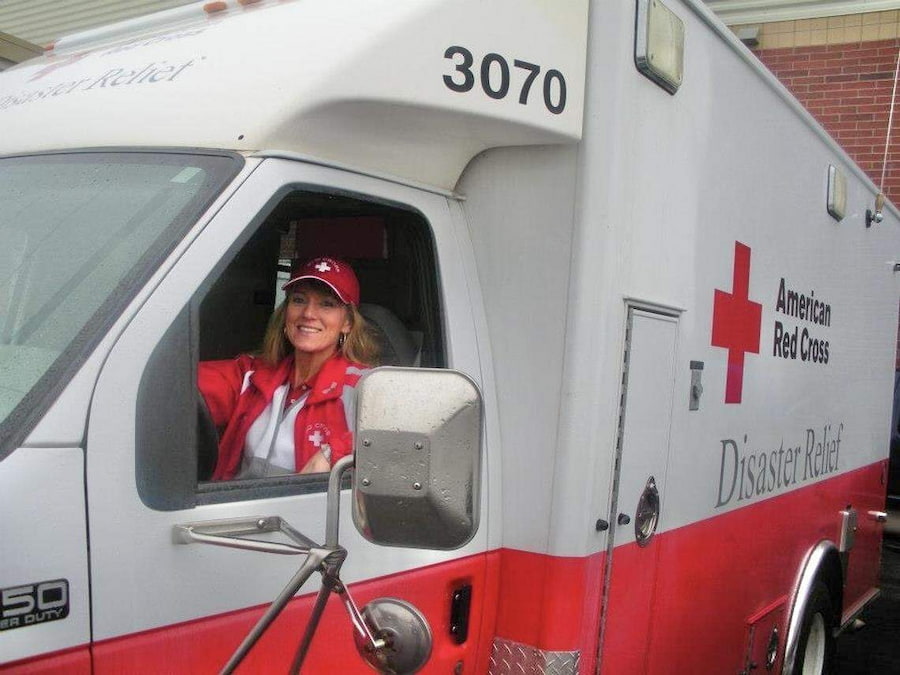
“I know it’s (volunteering with Red Cross) directly related to understanding what it feels like to not be in control of a situation and have no control over what’s going to happen to you after that situation,” she said. “And then, most importantly, I know what it feels like to have had all these people come and help.”
The flood left behind a layer of what they called “flood mud,” creating a musty, earthy smell that she sometimes detects in basements and which gives her a visceral reaction, even 50 years later.
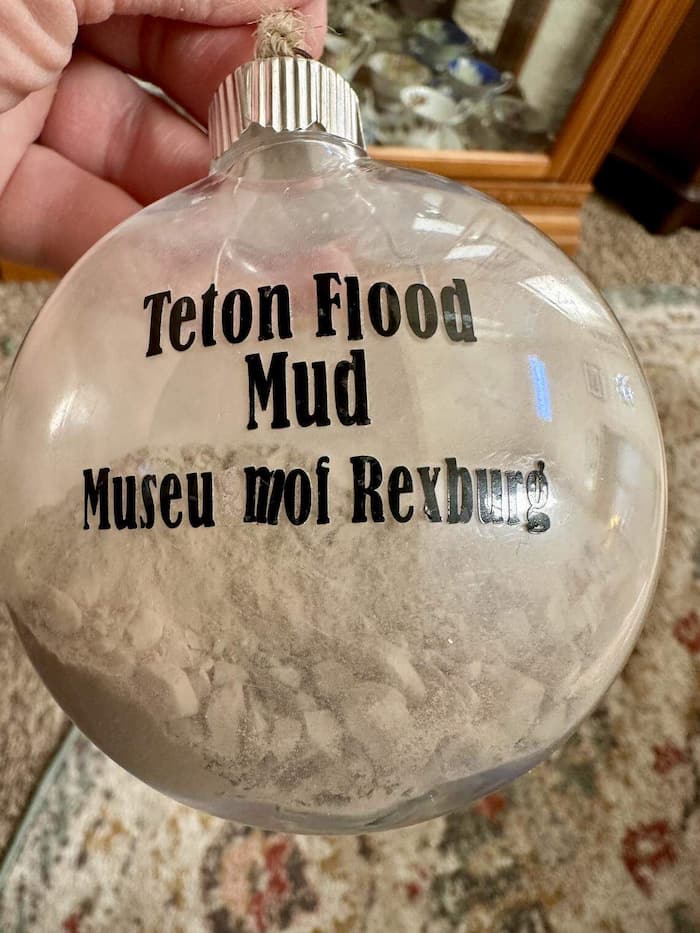
“Occasionally I do smell flood mud,” she said. “Smells can really just send you to a place and time, and it would all come back in two seconds.”
Massive cleanup effort
The cleanup effort was massive. So many structures were severely damaged, and the government poured so much money into recovery efforts, that many historic houses and buildings were demolished, with new structures taking their place.
Demolition included the beautiful stone farmhouse that Anita and her family were renting.
When the house was built in 1905 by the Parker family, a stone plaque was embedded in an outside side wall. Before the house was demolished, Anita’s father and a Parker family member chiseled that stone plaque out of the wall to save it.
That plaque, which reads “Grove Cottage PP Parker 1905,” has been outside the Museum of Rexburg, which was home to the Teton flood exhibit. It is now on the Parker homestead.

‘Grateful for what you have’
It’s difficult to comprehend the feelings that come with experiencing a disaster like that, whether it’s manmade or natural. But I can imagine the feeling of helplessness when faced with the sheer force of nature, like 80 billion gallons of water being released onto the landscape.
Anita’s father, Robert Thompson, recounted his feelings in an oral history interview about the event.
“Compared to my family, my wife and my children, anything that I was able to accumulate in a material way on this earth wouldn’t be worth a pinch of salt,” Robert Thompson said.
Anita similarly talks about a sense of gratitude, in the face of losing everything.
“I don’t know anybody who has bitterness, not one single person,” she said. “Everybody talks about gratitude. They all talk about gratitude. They were sad that it happened. They were devastated for a while because you’re in shock and don’t know what you’re going to do next, but they all have gratitude. I have gratitude. I have gratitude for the lessons that it taught us. And so many people were humbled, and humbled in a good way, not in a bitter way, but in a way that they just became better people. I think that’s what it really comes down to.”
Scott McIntosh is the communities editor and columnist for the Idaho Statesman. You can email him at smcintosh@idahostatesman.com or call him at 208-377-6202. Sign up for his free weekly email newsletter The Idaho Way.