



Make jerky easier with this classic rock music playlist
Published at | Updated at
EDITOR’S NOTE: This is the first in an ongoing series of feature articles from EastIdahoNews.com News Editor David Kennard. He’ll bring you along as he pairs his weekend chores with some of his favorite music. Don’t like his music selections? Feel free to suggest something better.
IDAHO FALLS — As an 11-year-old kid, I looked forward to camping trips with my local Boy Scout troop, mostly because I had my mother convinced that beef jerky was one of the required items.
Back then, beef jerky was pretty pricey and still is today.
My dad was a closet prepper — who regularly ate bread and milk for dinner — tried to convince the rest of the family that powdered milk had the same flavor as whole milk; it didn’t.
He had his own wheat grinder to grind whole flour, which he’d then use to bake his bread. That was actually not too bad.
He wasn’t quite as mad as Caractacus Potts, but he was headed in that direction with several gadgets like that he collected to use — once. The best gadget was the food dehydrator that made fruit roll-ups and — of course: beef jerky.
Over the years, I’ve experimented with making my own beef jerky to some success.
The best method I’ve found is the “low and slow” method. That is, keep the heat on the dehydrator low and give your creation plenty of time, like a couple of days.
The Playlist:
How I Do it: Making Beef Jerky:
- “The House Is Rockin’,” Stevie Ray Vaughan & Double Trouble
- “Back In Black,” AC/DC
- “The Ballad Of Curtis Loew”, Lynyrd Skynyrd
- “Life in the Fast Lane,” The Eagles
- “Black Betty,” Ram Jam.
A quick note on this last one. “Black Betty” is a cover of a cover – and maybe a cover – of an early 20th-century American work song.
“The original song, ‘Black Betty,’ started as a work song, sung predominantly by Black people in the early 20th century,” states a report by Jacob Uitti for Americansongwriter.com. “Though its roots may even extend beyond that into the 19th. While it may seem obvious the song is about a woman named “Betty,” that meaning is likely not accurate—at least, not entirely.”
Uitti states that Black Betty may refer to a bottle of alcohol, a prison vehicle, or a whip “used so often … on the prisoners’ backs, ‘bam-ba-lam.’ In more modern references, a “Black Betty” may have been a fast car or motorcycle.”
It’s been recorded by a number of artists over the years, but Ram Jam’s version, in my opinion, is the best. And it fits the rock era genre.
My recipe:
A big block of London broil beef sliced by the butcher into thin strips, or 5-ish pounds of flank steaks.
- A couple of teaspoons of black pepper.
- 1 teaspoon liquid smoke.
- About a quarter cup of soy sauce or low-sodium soy sauce.
- About the same amount of Worcestershire sauce.
- Some lemon juice from one lemon.
- No more than a drop of Carolina Reaper hot sauce. I mean it, use only a very small drop.
Optional ingredients (stuff I’ve tried but have since abandoned)
- 2 teaspoons chili powder
- 2 teaspoons garlic powder
- 2 teaspoons cayenne pepper, more if you like it hot
- 2 teaspoons onion powder
The process:
Cut your London broil into very thin strips. It’s much quicker to ask the butcher at your supermarket to do it on his slicer.
Next, marinate your strips overnight in your concoction in the fridge.
“The U.S. Department of Agriculture (USDA) Meat and Poultry Hotline’s current recommendation for making jerky safely is to heat meat to 160°F and poultry to 165°F before the dehydrating process. This step assures that any bacteria present will be destroyed by wet heat. But most dehydrator instructions do not include this step, and a dehydrator may not reach temperatures high enough to heat meat to 160°F or 165°F.”
So, once you’ve killed everything that can kill you, you’re ready to start dehydrating.
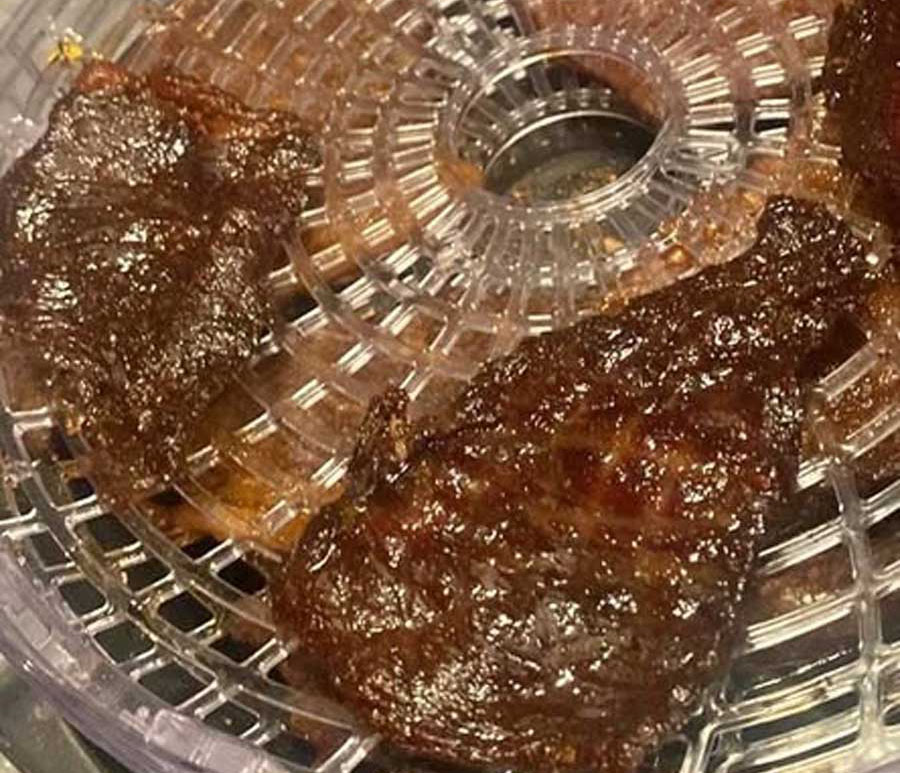
Neatly lay out your wet jerky on your dehydrator’s shelves, doing your best to keep them from overlapping. Once your meat has turned dark brown, it’s ready to check.
When you can pick up a slice and it doesn’t flip over like a wet noodle, it’s probably ready. There’s probably a science to it, but after you do it a couple of times, you’ll know what works.
When it’s ready, fill a Ziploc bag and head out on your next adventure.