



LDS Church president dedicates Burley Temple
Published at | Updated at
BURLEY – President Dallin H. Oaks of The Church of Jesus Christ of Latter-day Saints dedicated the Burley Idaho Temple on Sunday — his first temple dedication as Church president.
“We dedicate and consecrate unto Thee and Thy Beloved Son this Burley Idaho Temple of The Church of Jesus Christ of Latter-day Saints,” President Oaks prayed. “We invoke Thy power to assure that Thy Spirit and Thy glory will always be present here and upon all Thy sacred work that will be done here.”
Latter-day Saints consider each temple a house of the Lord and the most sacred place of worship on earth. Church members participate in sacred ceremonies such as marriages, which unite families forever, and proxy baptisms on behalf of deceased ancestors who did not have the opportunity to be baptized while living.
The Burley Idaho Temple, a 45,300-square-foot structure, was first announced at the April 2021 general conference. Ground was broken on June 4, 2022. Idaho’s other dedicated temples are in Boise, Idaho Falls, Meridian, Pocatello, Rexburg and Twin Falls. Other temples announced or under construction in the state are the Caldwell, Coeur d’Alene, Montpelier and Teton River Idaho Temples. Idaho is home to nearly 500,000 Latter-day Saints in around 1,300 congregations.
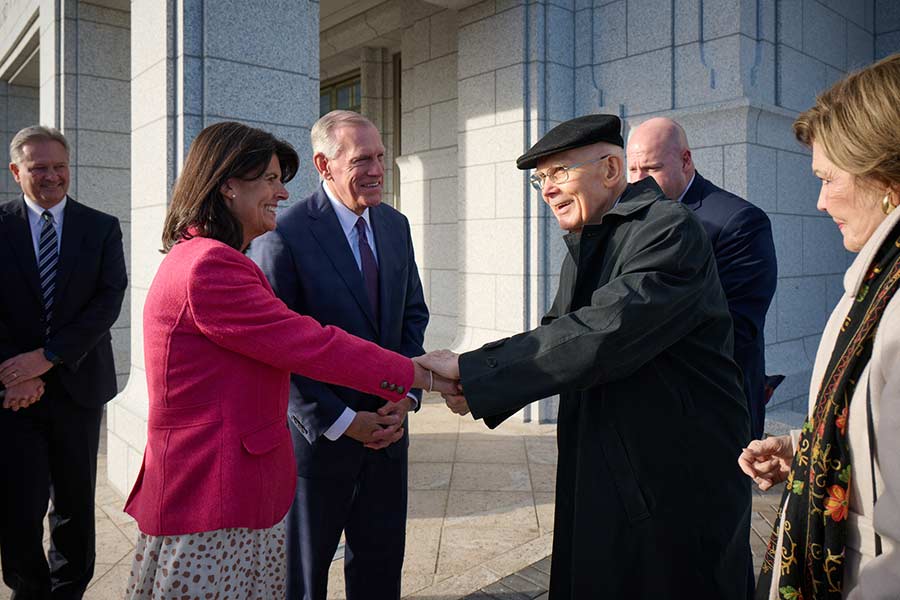
President Oaks was joined at the dedicatory service in Burley by his wife, Kristen, and several Church leaders: Elder Steven R. Bangerter, Executive Director of the Temple Department, and his wife, Susan; Elder José A. Teixeira, United States Central Area President, and his wife, Filomena; and Elder K. Brett Nattress, General Authority Seventy, and his wife, Shawna.
In remarks given before offering the prayer, President Oaks shared personal reflections about this temple. He said he chose to dedicate the Burley Temple because “it (is) close to my heart.” As a child, he lived in nearby Twin Falls, Idaho, for about five years.
The 93-year-old prophet also noted that the Church is “in a glorious season of temple building.” He reminded Saints in Burley that the purpose of the Church’s now 212 operating temples — plus 150 more in design or under construction — is to point people to Jesus Christ.
“The work of temples is centered on our Savior and Redeemer, Jesus Christ. All that is learned and done here relates to Him,” said President Oaks. “Here in His house, we make sacred covenants with and in the name of Jesus Christ, which among other meanings signify His authority and His work. All who worship here receive the blessings of His authority and participate in His saving work. These blessings and this saving work, which we call ‘temple work,’ are supremely important for all of God’s children, those still living in mortality and those in the spirit world.”
He echoed teachings from the late President Russell M. Nelson that the house of the Lord is “at the center of strengthening our faith and spiritual fortitude because the Savior and His doctrine are the very heart of the temple.”
President Oaks noted that Latter-day Saints around the world will need such spiritual strength in the coming days.
“As we experience Satan’s deadly onslaught on morality and the integrity of families, and as we read the prophecies and feel the signs of the times, we cannot doubt that the future holds great sacrifices and challenges for Latter-day Saints individually and for the divinely prescribed work of The Church of Jesus Christ of Latter-day Saints,” he said. “The scriptures speak of perilous times, when men’s hearts will fail them. They also speak of worthy disciples escaping these things, of their standing in holy places and not being moved.”
In these holy temples, Latter-day Saints make covenants with God. This, the prophet explained, is “the way the Lord reminds us to stay worthy of His blessings and to translate the knowledge we receive in the temple into service to our fellowmen.”
“Surely,” President Oaks said, “the times ahead will call for us to remember our temple covenants and to rely on the blessings promised in these houses of the Lord here in Burley and throughout the world.”
“This is His house. This is His work. We are His servants,” the prophet concluded.
‘Be faithful’
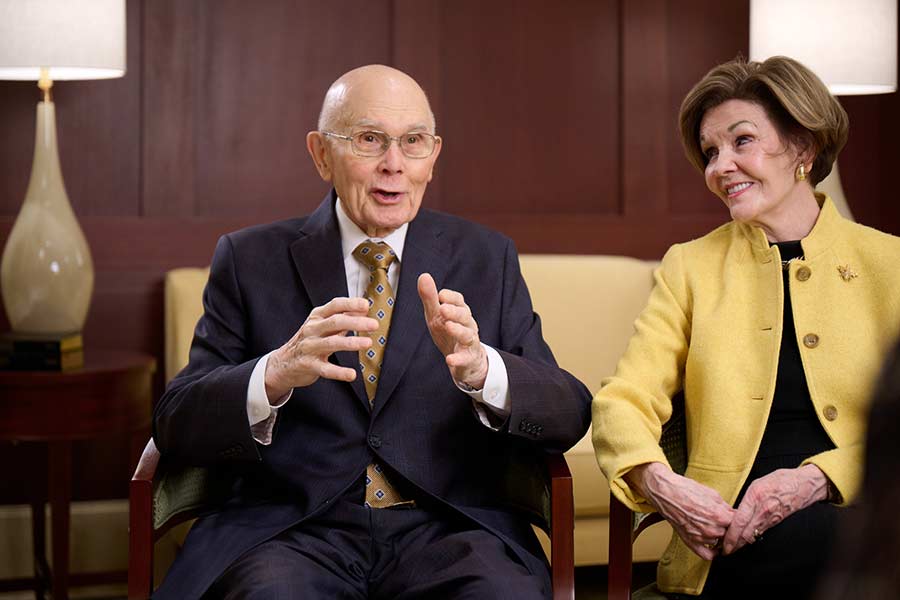
In an interview on Saturday afternoon, President Oaks, joined by his wife, discussed his transition to becoming the new president of the Church, reflected on lessons learned from past prophets and shared his hopes for the impact of new temples. He encouraged members to remain faithful and trust in the Lord during challenging times.
The questions and answers below have been edited for clarity.
You are now the president of the Church. That’s a position only 17 other people have held. How does that feel different than the years that you served as an Apostle?
President Oaks: It feels new to be the president of the Church. I never aspired to that position. I’ve never had impressions that I would occupy that position. I loved being a counselor to President Nelson after 34 years of sitting side by side in the Quorum of the Twelve. It feels new, and the way it feels new is that I feel the responsibility. There is reference to the mantle of the prophet. I’ve been used to seeing the mantle on other people, but now I’ve had the experience of feeling the mantle — and it’s heavy and continuous. It’s a very holy responsibility, and I’m trying to grow into it.
Sister Oaks: He’s so diligent in what he does, and so focused and so concerned about the kingdom. I have been aware of him being a different person.
What strengthened you to step into this role?
President Oaks: All my life, I have wanted to do what my Heavenly Father wanted me to do. I have not aspired to additional jobs. I’ve just tried to be sensitive to the Spirit of the Lord on what the Lord has prepared me to do. And that same answer applies to being president of the Church. I’m just sustained by the fact that the Lord has prepared me and now called me to do something. I don’t flinch from that responsibility.
Have you found yourself reflecting on the lessons you have learned from past prophets?
President Oaks: Definitely. I have been closely associated with eight presidents of the Church, beginning with my service at BYU. I have loved, admired, and learned from all of them — particularly from President Nelson, because my association with him goes back 50-plus years.
You recently announced that young women can serve missions at age 18 instead of 19. How do you think that will bless the lives of young women across the Church?
President Oaks: I think it will increase their time for planning their lives, whether they use their possibility to serve a mission or whether they plan their lives in other directions. It simply increases the options. I also hope that it will reduce the age of marriage. In the time that we have lowered the age for young men and for young women in the past, we’ve seen an increase in people who meet someone in the mission field and marry them, which is perfectly appropriate if it doesn’t start too early in their missionary service. I think it’s part of the Lord’s plan to overcome the tendency of waiting until the late 20s to have a first marriage. I think we will see a reduction in the age of marriages for Latter-day Saints.
You have promised people that more time in the temple will bless their lives. What happens when members of the Church spend more time in the temple?
President Oaks: I think it will support choices that are more harmonious with qualifying for and listening to the promptings of the Spirit in all of our temporal decisions and also lifting our eyes to the end of the covenant path. President Nelson gave us that wonderful analogy in his first talk as president of the Church. And I have loved the metaphor of the covenant path because it affects how we relate to one another. Sometimes we consider the commandments of the Lord and the experiences we could aspire to in this life as a checklist, and we check off different points. I think it’s much more wholesome to think of our mortal journey as a journey from birth to a return to where our Heavenly Father wants us to be and where it’s possible we attain because of His Son, Jesus Christ. The covenant path suggests a course of action and attainment in our journey through mortality. Covenants are the signposts that keep us on the covenant path. And the covenant paths suggests that there are people ahead of us on the path which we should model our lives upon. And there are people behind us on the covenant path not as close to the destination as we are, but part of our challenge is to help them. And that’s why I love that metaphor of the covenant path. It just fits my idea of the purpose of life and how we can stay fixed on our destination.
Sister Oaks, how has time in the temple blessed your life?
Sister Oaks: Since marrying him, I have felt how precious time is and that you have choices on how to use it. I go (to the temple) for comfort, instruction, revelation, and it makes me a better wife, a better mother. I know when I go, I’m more patient. I’m kinder. It’s made a major difference in my life.
President Oaks, you recently announced a temple for Portland, Maine, at a devotional, not in general conference. Why did you announce that temple?
President Oaks: That was a strong impression that came to me early in my knowledge that President Nelson had transferred to heaven. It has occurred to me for a long time that the best place to announce a temple is in that temple district. And the best person to announce it is the file leader in that area, which can be an Apostle on assignment to a stake conference or another meeting, or it can be the area president if there’s no Apostle in the district when a decision is made by the First Presidency to have a temple there.
So, this is a pattern we can expect to see again?
President Oaks: It’s a pattern that we will follow as long as I have influence in determining those things. This does not change the pattern of decision-making or gathering facts and determining the agreeable timing and the need. And all those things will continue to be analyzed. But when it comes to making a decision from all those facts, the First Presidency will continue to make the decisions. But they’ll assign someone else to make the announcement in the place where the temple will be built.
While you are sitting next to Sister Oaks, tell us what a blessing she has been to you in your life.
President Oaks: Sister Oaks fills a variety of needs that I have to learn to perform my responsibilities. For one thing, she’s a returned missionary. For another thing, she had a long period of time being single. Also, she is a convert to the Church. And in those three respects, she helps me see a whole host of responsibilities that I feel toward missionary work when it’s possible and not blocked like mine was because of the Korean War, and the great concern we have with singles, particularly single women, and the significance that it makes when you are converted to the Church and not raised in the Church. I’ve learned an immense amount from her in our 25 or so years of marriage that has helped me make decisions and think about subjects that are important to the Church.
In the last three months, you have had to say goodbye to two very close friends, both President Russell M. Nelson and President Jeffrey R. Holland. What can you share about how hard it has been to lose people so close to you?
President Oaks: One of the great blessings we have in the restored gospel of Jesus Christ is to look at mortality as a small slice of our identity and eternal progress. When my own father died [when I was] 7, when my mother died many years later, and when other friends have died, I have felt that it’s like a graduation from a course of instruction. Whether high school or college or later, graduation is a time to celebrate.
We are pained when we lose the association of a close friend, as I was when I lost my wife, June, the mother of my children. There’s an adjustment to be made in trying to go on with your life without their association and example. But basically, death is a graduation to be celebrated. It’s part of the purpose of life on earth — to do what we can with it, and then go on to another world, another set of associations, and another set of responsibilities and opportunities for growth that we know very little about.
We grieve as I grieved at the loss of President Nelson, as I’ve grieved at the loss of President Holland. I’m applying the same things that I grieve at the death of my first wife and many other relatives, parents and others. It’s not an occasion for prolonged grief. It’s an occasion for the kind of grief that helps us through a difficult time. But we get on with our life.
What is your message to people who are worried about the state of the world?
President Oaks: Be happy. Don’t be depressed. Trust in the Lord. It’s always been that life has terrible challenges. That’s what we’re put here on earth to learn how to overcome. As I was growing up, in my teenage years, we were in the years of World War II. Later on, there have been other challenges. I’ve just determined that the Lord gave us the gospel, the gift of the Holy Ghost, the scriptures, and the teachings of leaders to get us through these difficult times. And by all means, people shouldn’t be depressed because we’re surrounded with challenges, whether they’re economic or political or social. That’s part of what we were put here to experience. We don’t grieve over a textbook, and that’s what these challenges are — they’re a textbook of mortality. We are optimistic because we trust the Lord and know that He loves us and He set us up to succeed, not to fail.
What is your message to the youth?
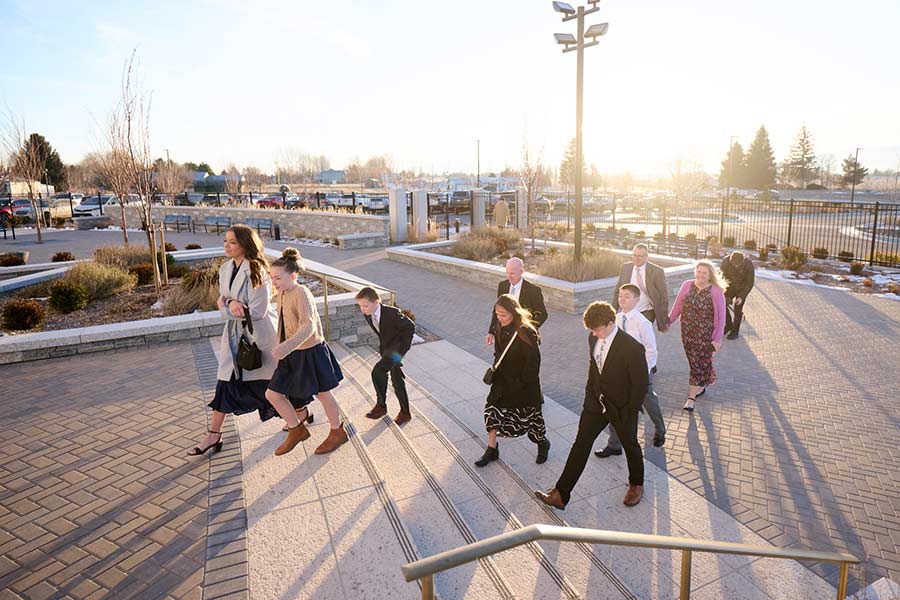
President Oaks: The same message, really. But with youth, we have to remind them that challenges are not unique. The Lord has provided us a way to get through all of this, and their parents and grandparents and predecessors have experiences that will help them counsel them on how to get through this. But they shouldn’t be pessimistic. We should be optimistic. That is a message the temple gives us. Temples dot the earth to remind people of what the gospel of Jesus Christ means to us. The visual image of the temple, like this beautiful temple we’re about to dedicate, is a powerful symbol for the youth. We’re thrilled that the youth are going to the temple in greater numbers and with increased efficiency.
Is there anything else you would like to tell members of the Church?
President Oaks: Be faithful, make covenants, keep covenants, stay on the covenant path, study the gospel, trust the Lord, and give thanks for His Only Begotten Son, our Savior and Redeemer, Jesus Christ.