



Great Salt Lake may hit historic lows this year, despite long-awaited snowfall
Published at | Updated at
Will Ruzanski, Utah News Dispatch

SALT LAKE CITY (Utah News Dispatch) — Despite this week’s heavy snowfall, conservationists warn Utah’s snowpack — which hit a record low earlier this month — is likely not enough to keep the Great Salt Lake’s water levels from hitting new record lows later this year.
“Utah is still facing major snowpack deficits, this doesn’t reverse months of snow drought. What we really need is sustained snowpack that lasts long into spring, so it can contribute to spring runoff,” said Samantha Hawkins, spokesperson for Grow the Flow — a conservation nonprofit dedicated to Great Salt Lake water conservation.
Hawkins told Utah News Dispatch water levels are on track to “see a record low by this coming fall,” as snowpack is vital to replenishing Utah’s waterways through dry seasons.
The current snowpack is still hovering near minimum levels, according to the U.S. Department of Agriculture’s Natural Resources Conservation Service. The agency’s Feb. 1 report — which revealed record low snowpack — gives Utah just a 10% chance to reach normal snowpack levels this year, and a 30% chance to end with record low snowpack levels.
“The Great Salt Lake relies on late-season runoff, and this (recent snowstorm) comes after months where lots of Utah’s precipitation fell as rain instead of snow,” Watkins said. “We’re playing catch up.”
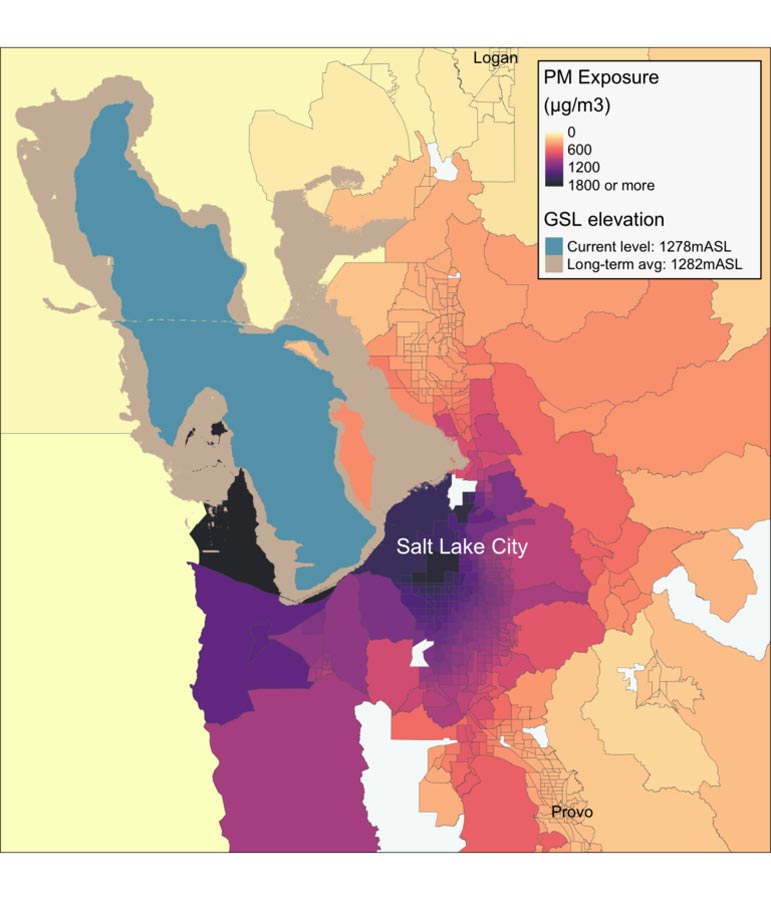
Great Salt Lake health tracker
One year after Grow the Flow launched a website to track the Great Salt Lake’s health, water levels sit at critically low levels.
The tracker shows Great Salt Lake is less than 36% full, with more than half of the lakebed — more than 1,100 square miles — currently exposed. The dry lakebed contains toxic dust and heavy metals that, when blown into the air, can worsen air quality and lead to severe health detriments.
“That’s really scary to people, they don’t want Great Salt Lake dust in their lungs,” Hawkins said. “It feels like people really care right now about the lake and the state it’s at.”
Long-term exposure to Utah’s dirty air can take years off one’s life, increasing risk of heart attack, asthma, congestive heart failure, pneumonia, and chronic obstructive pulmonary disease.
That’s according to a November 2020 Brigham Young University study that found “air pollution in Utah causes between 2,500 and 8,000 premature deaths each year, decreasing Utahn’s median life expectancy by 1.1 to 3.6 years.”
“We really need to make the most out of this legislative session because the lake is on track to exceed its historic lows,” Hawkins said. “The 2026 Legislative Session is one of those most consequential opportunities in years to remove barriers for sending water to the lake, and the consequences couldn’t be bigger right now to restore the lake by 2034.”
This weather-related story is brought to you by Pony Express Car Wash, Idaho's premier express car wash destination, renowned for its commitment to exceptional service and quality. Voted the No. 1 car wash company in Idaho for three consecutive years, we pride ourselves on delivering an unparalleled experience for every vehicle and customer. Our state-of-the-art facility utilizes name-brand soaps and cutting-edge equipment to ensure your car receives the ultimate clean. Established in eastern Idaho in 2019, Pony Express is proud to be a locally owned and operated company that caters to the unique car washing needs of our Idaho Friends and neighbors. We invite you to experience the difference at Pony Express, where your satisfaction is our ultimate goal.