




Tax credits, Harriman Park, and other takeaways: local lawmakers review the 2026 legislative session
Published at | Updated at
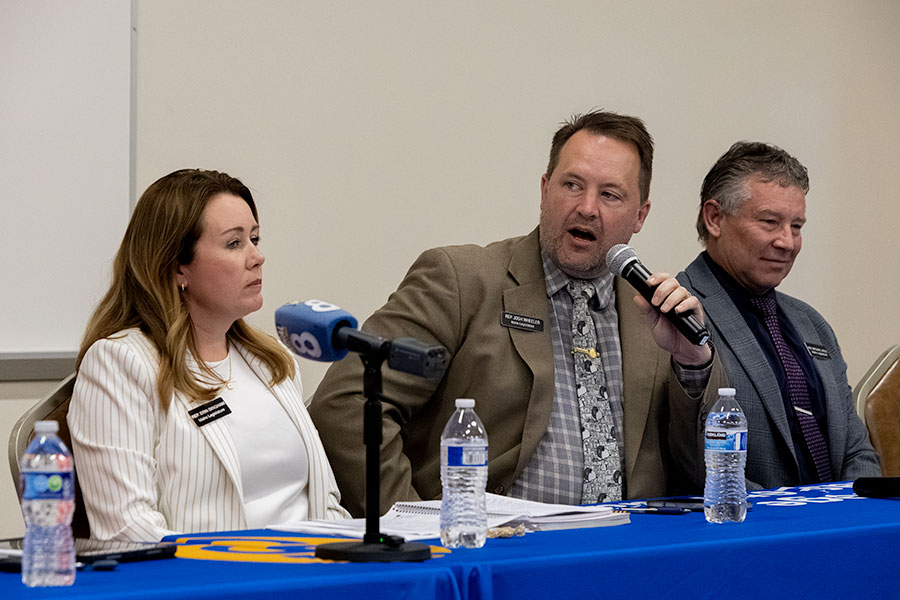
IDAHO FALLS — After announcing Sine Die on April 3, concluding 81 days of trips to Idaho’s Capitol, local legislators recapped the previous legislative session Saturday night ahead of the May primary.
The town hall, hosted by the Greater Idaho Falls Chamber of Commerce at the College of Eastern Idaho, featured constituents and the event’s host asking questions about the past legislative session.
Do over?
One of the questions asked during the session is what local legislators would do differently if the clock rewound to be back on day 1 of the legislature.
The budget cuts were a major highlight for legislators, who said the impacts on education were a concern.
Both Rep. Stephanie Mickelsen, R-Idaho Falls, and Sen. Dave Lent, R-Idaho Falls, said they should have fought more to retain the funding for education, specifically, the Idaho Digital Learning Alliance, when it came towards this year’s budget.
“The IDLA learning…was cut significantly this year, and that really affects our rural schools. So that’s when I would have fought a little harder on,” Lent said.
Another was on the impact on law enforcement. Rep. Erin Bingham’s, R-Idaho Falls, concern was the impact on Idaho’s Attorney General, which affected its Internet Crimes Against Children Task Force.
She said that House Bill 971, an appropriation bill for the attorney general’s office that cut its funding, impacted that task force.
“I think some of these things we could have fought for,” Bingham said.
For freshman Rep. Mike Veile, R- Soda Springs, said one of the more frustrating aspects of this session was the “radiator capping” that was done on the last days of the legislative session.
“You’re sitting there, and you walk onto the floor, and all of a sudden you’re given a paper, and you’ve got 26 bills, and you’ve never seen them. You’ve never seen any of these bills. They didn’t build your committee, and they’re crashing them in the next hour and a half, you have to vote on 26 bills you’ve never seen,” Veile said.
His concern was the short time given to learn what these bills are about and whether they will do good or harm.
Lack of accountability and hypocrisy on the tax credit for private education
One of the main topics of discussion during the town hall was House Bill 93, the Idaho Parental Choice Tax Credit, which provides Idaho families with a $50 million tax credit for private education.
While this bill was passed in the prior session, Lent considered it the pendulum swinging so hard, so fast, and so far. In contrast, other bills, such as Lent’s Senate Bill 1025, that he said would’ve completed the same task included measures to ensure some accountability in taking place with the $50 million.
RELATED | Idaho offering $50M in tax credits for private education, but you must apply quickly
“We felt that there should be a security check on teachers. I mean, some very basic things. The way House Bill 93 is done…. is a work around because it would not have come through the other way,” Lent said.
Mickelsen follows this train of thought on HB 93. For Idaho’s public schools, there are expectations for teachers, and school districts must meet for them to get funding. On the other hand, there really isn’t that same expectation for private schools.
RELATED | Idaho Supreme Court upholds private education tax credit
Bingham said that while the legislators’ mindset is that they are not opposed to school choice, there must be transparency and accountability when this much money is being spent on education.
Veile was the most critical about HB 93, where he said there is a level of hypocrisy he sees in those hardline advocates for this bill who argue that government funding should not go into private entities, are now demanding the thing they vehemently opposed.
“Why would we want to go and subsidize these private industries?” he asked.
He said there was a push in the legislature to amend Idaho’s constitution to enshrine parental freedom in how they educate their children.
He said the constitution already has enshrined that right. The issue is that they want there to be no government oversight or accountability for private education.
“That was put in there simply so that you can never have any type of accountability for these types of funds,” Veile said. “Now, fortunately, that amendment did not pass out of the house, but it was only a couple votes that it did not pass out of the house.”
RELATED | Private school choice advocate tops lobbying expenditures, again
Sen. Kevin Cook, R-Idaho Falls, who agreed with the other legislators on the issues with HB 93, said that when he’s spoken with constituents, they don’t see the issue. They tell him that money is theirs.
The issue is that when a person gets the $5,000 tax credit, they aren’t paying $5,000 in taxes.
“Who’s picking up the dime for you? Well, all of us are. And so it’s not a true tax credit. You’re getting more money out of it than what you would have been putting it,” Cook said.
Among the issues noted, Cook said that, as a member of the state’s Joint Financial Appropriations Committee, he can’t track where that $50 million is going.
“When the governor says, ‘I want a 3% hold back across the board, for everybody,’ it did not affect House Bill 93 because it comes out before it ever gets into the general fund, and therefore it’s not accountable. It’s not a good idea,” Cook said.
Joint concern over Harriman State Park
Another topic of the town hall was stakeholders’ concerns about Senate Bill 1300, which affects gubernatorial appointments and Senate confirmation for directors of the Idaho Departments of Transportation, Fish and Game and Parks and Recreation.
Gov. Brad Little visited Idaho Falls last week and said there will be no impact on the agreement between the state and the Harriman family that requires the park’s operations to be handled by professional park staff who are hired on merit alone.
RELATED | Amid drought and debate, Gov. Brad Little says Idaho is ready for what’s ahead
RELATED | Disputed Idaho bill signed into law despite strong opposition in eastern Idaho
Out of the legislators, Rep. Barbara Ehardt, R-Idaho Falls, and Sen Mark Harris, R-Soda Springs, were the only ones to vote in the bill’s favor.
Harris was not in attendance but Ehardt spoke on why she voted in favor of the bill. She said there are over 20 positions in Idaho’s Government that are appointed, which provides greater legislative oversight.
However, she does believe, in hindsight, that she would reconsider her vote if there had been more time in the legislature to hear more arguments.
“This was one of those that came towards the end, kind of fast and furious, so I would absolutely not want to lose it,” Ehardt said. “But also in reading the legal analysis, multiple legal analyses don’t even look like they come close.”
Lent said this bill is in direct contrast to the agreement between the Harriman family and the state that designates the park as a political appointment.
Mickelsen has issues with the bill overall, on top of the concerns about Harriman State Park, because it keeps adding more departments and directors that the governor will appoint to the list.
“What you have happening is now we’re going to have our roads politicized, and in other states… in other states, when they’re where they’ve politicized their directors, they end up spending a lot of money doing a lot of planning, until the next governor comes in and he appoints a new Director of Transportation, and then suddenly they’re spending a lot of money spinning their wheels, and it would be the same with the parks and with Fish and Game,” Mickelsen said.
She fears that Idaho will waste more money in the long run if there is a series of new governors or a Democratic governor is elected, and that Idaho’s infrastructure and departments will come to a standstill, developing new plans rather than implementing them.
“I didn’t see the benefit of changing that, and for sure, the risk of losing Harriman State Park was too great and not worth it,” Mickelsen said.