



In the Garden: Using artificial intelligence in horticulture
Published at | Updated at
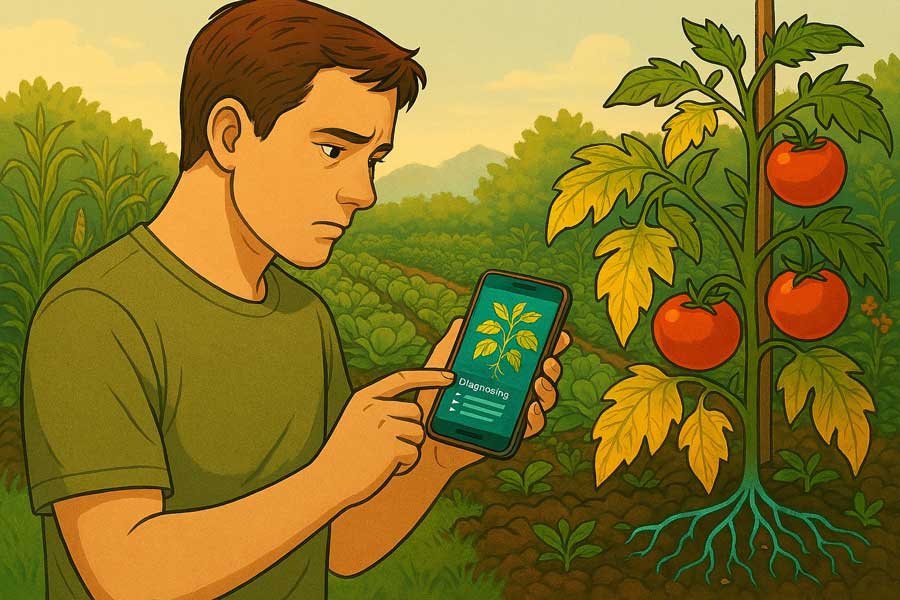
You’re standing in your garden, staring at a tomato plant with yellowing leaves. Is it too much water? Not enough? A disease? Instead of guessing — or calling your local University of Idaho Extension office — you pull out your phone and ask an AI chatbot.
Within seconds, you have an answer.
Artificial intelligence is quickly becoming one of the most fascinating and useful tools of the modern world. As spring gardening season ramps up, more people are turning to AI for quick answers to yard and garden questions. From diagnosing plant problems to planning vegetable beds, AI offers fast, convenient guidance.
The real question is: Can you trust it?
How AI works (in simple terms)
At its core, AI analyzes large amounts of information, identifies patterns, and uses those patterns to generate responses. Unlike traditional programs, it isn’t just following fixed instructions — it learns from data and adjusts over time to improve its answers.
That ability makes it incredibly powerful, but not perfect.
In many ways, asking AI a gardening question isn’t that different from asking an Extension educator. Both rely on existing knowledge, experience, and interpretation to provide answers. And in both cases, the answers provided can be correct or not.
The difference is that AI can process vastly more information in a fraction of the time. But more information doesn’t always mean better or more accurate advice.
When AI is helpful
AI performs well when acceptable answers are broad, descriptive and low-risk. It’s especially useful for summarizing general horticultural knowledge.
For home gardeners, AI can:
- Explain gardening concepts
- Suggest plant varieties
- Provide general planting or pruning timelines
- Help interpret common problems that may lead to yellowing leaves
Examples of effective questions include:
- “What vegetables grow well in southern Idaho?”
- “What are common causes of yellow leaves on tomato plants?”
- “How do I start a compost pile?”
These types of questions allow AI to draw on widely accepted principles without needing highly specific local information.
If you need more specific answers, you need to offer more detailed information in your questions. One thing I’ve found helpful when using AI is using the correct terminology. I’m not a mechanic, but I’ve used AI to diagnose and fix simple vehicle issues. That said, I couldn’t call the radiator fan a “spinning thingy” and expect a useful answer.
Horticulture works the same way. You’ll get much better results asking for research-based information on how to control Cirsium arvense (Canada thistle) than asking how to kill weeds in your lawn.
Where AI struggles (and why it matters)
AI systems often struggle with the very factors that matter most in gardening: location, timing and specificity.
AI-generated advice may be:
- Overgeneralized (ignoring soil type, elevation or microclimate)
- Outdated or incorrect
- Completely fabricated (“hallucinated”)
- Influenced by biased or commercial sources
For example, an AI tool might confidently recommend a planting schedule that works well in the Midwest — but fails in east Idaho due to very different frost patterns.
Even more concerning, AI cannot reliably distinguish between high-quality, research-based information and unverified content found online. It treats both as usable data.
Think of your own acquaintances who offer advice on every topic — whether they have experience or not. We all have an “Uncle Bill” or a “neighbor Betty” whose advice we’ve learned to take with a grain of salt.
AI doesn’t eliminate that problem; it scales it.
The growing problem of bad gardening advice
The rise of AI-generated content is also making it harder to separate good information from bad.
Gardeners are increasingly encountering:
- Images of plants that don’t actually exist
- Misleading or incomplete care instructions
- Viral “gardening hacks” with no scientific basis
In some cases, AI may recycle long-standing myths or recommend practices that are harmful to plants, pollinators and even people.
As AI use grows, so do the risks related to accuracy, data quality and unintended consequences.
Using AI wisely
AI can be a valuable starting point—but it shouldn’t be the final answer.
Best practices include:
- Cross-checking AI responses with research-based publications.
- Using local resources such as county Extension offices.
- Providing detailed context (location, soil type, plant species) when asking questions.
- Avoiding chemical or safety decisions based solely on AI.
The future: Combining AI with expertise
Just as an Extension educator improves with experience, AI tools will continue to improve as people learn how to use them more effectively.
Extension systems across the country are already exploring ways to integrate AI while maintaining accuracy and trust. Tools that combine AI with vetted, region-specific information show real promise.
AI is a powerful tool, and it’s not going away. For gardeners, it can provide quick answers and helpful guidance. But it works best when paired with something it can’t replace: local knowledge, experience and science-based recommendations.