First Native American astronaut recalls historic spacewalk during Fort Hall visit
Published at
FORT HALL – During a stop at the Shoshone-Bannock Casino Hotel and Event Center on Wednesday afternoon, John Herrington shared with locals his memories of walking in space.
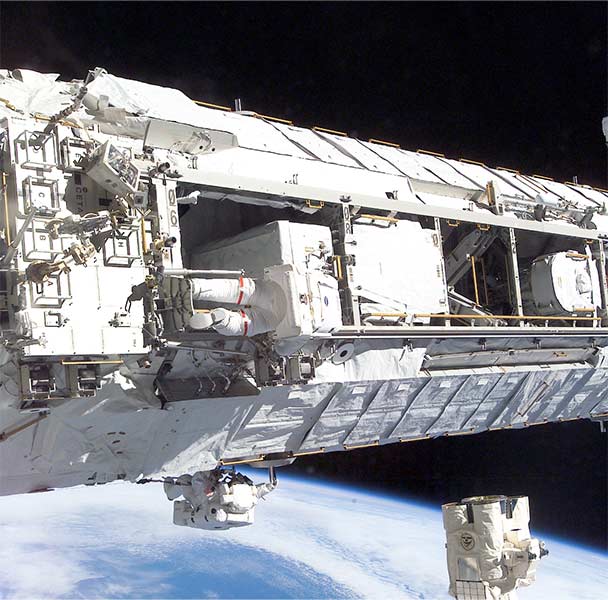
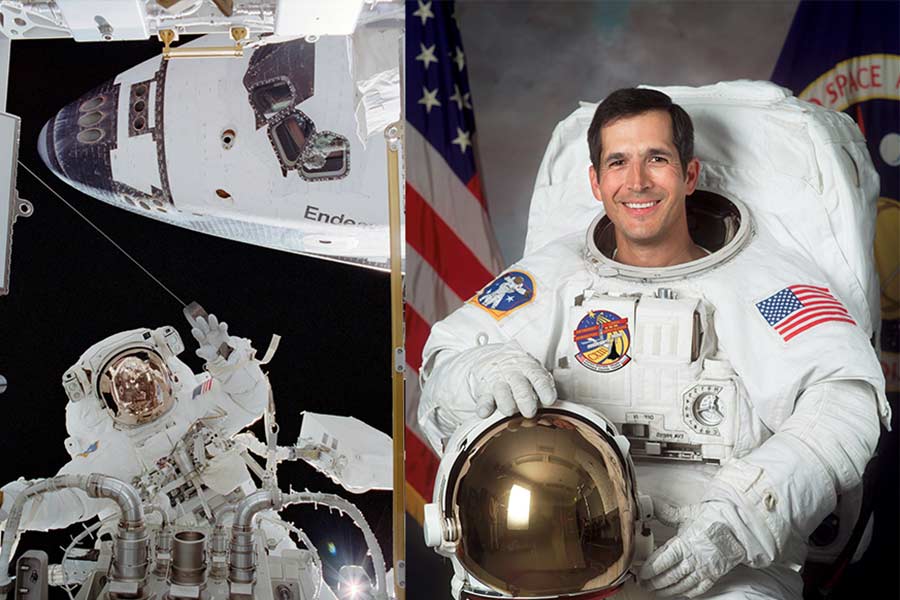
The 67-year-old former NASA astronaut with ties to Idaho made history in 2002 when he became the first enrolled citizen of a Native American tribe to fly in space. He was the mission specialist aboard the USS Endeavor for a 13-day mission. The Endeavor launched from the Kennedy Space Center on Nov. 23 for its 16th mission to the International Space Station. He and his crew delivered the P1 Truss segment, which provides structural support for the Space Station radiators.
“We built one of the trusses on the left side of the space station. It was about the size of a school bus,” Herrington tells EastIdahoNews.com. “We put up the robotic arm, drove four bolts, and got to walk all over it.”
During the mission, Herrington says he spent about 20 hours in a space suit outside the shuttle, floating in space.
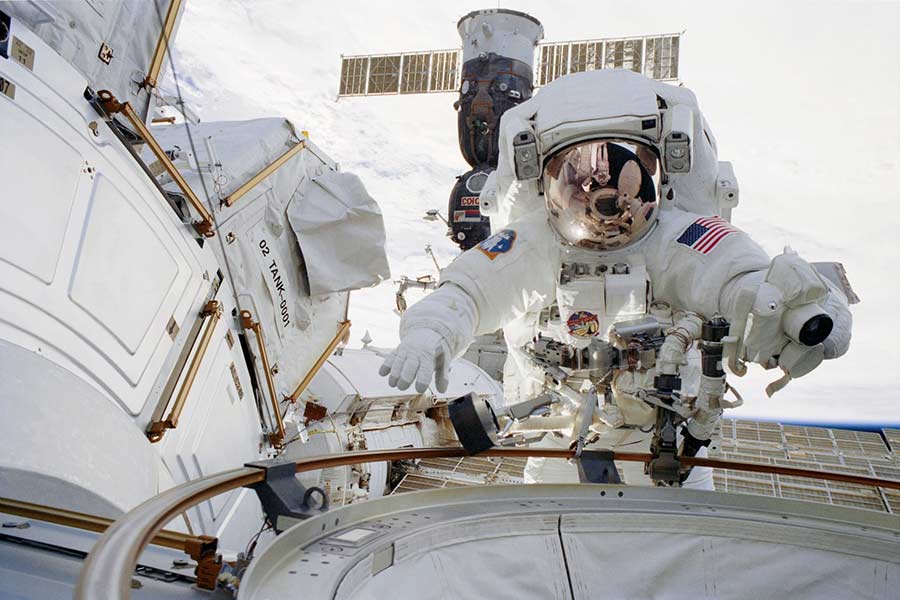
Herrington, a member of the Chickasaw Nation, was a kid at the height of the space age when the Apollo missions were happening. Watching Neil Armstrong walk on the moon is something he remembers vividly, and that inspired him to become an astronaut.
He says it was a great honor, decades later, to represent his people on another historic NASA mission and to carry a flag presented to him by Chickasaw Nation Governor Bill Anoatubby.
“I’m very proud of the fact that I got to honor my ancestors (in doing something no one else of my race had ever done),” Herrington says.
Following the successful completion of Artemis II’s lunar flyby more than two decades later, Herrington notes the diversity of the crew — among them, Reid Wiseman, the first commander of African-American descent, and mission specialist Jeremy Hansen, the first Canadian to leave Earth’s orbit.
“All these folks from different backgrounds did something remarkable and gave us something to look up to,” Herrington says. “They showed humanity what we can all do together (and that) we all have something to offer.”
Herrington’s journey to space
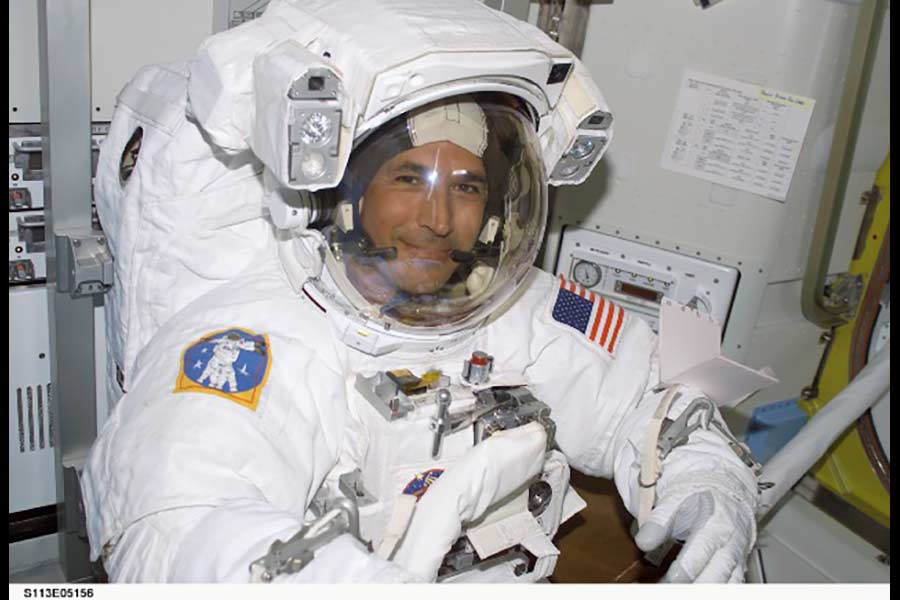
Herrington was born on Sept. 14, 1958. Although he was born in Wetumka, Oklahoma, he grew up in Colorado Springs, Colorado; Riverton, Wyoming; and Plano, Texas.
His journey to the sky began as a kid. During Wednesday’s presentation, Herrington said his parents, James and Joyce Herrington, were aviation enthusiasts. James was a pilot, and John often went to airshows with his mom. As a result, John started flying airplanes as a kid.
“I didn’t realize how fortunate I was to do that. I thought everybody got a chance to fly airplanes (at that age),” Herrington recalled.
Herrington also remembers launching model rockets with his dad in Colorado and was an avid rock climber.
After graduating from high school, Herrington became a Navy test pilot. While attending the Naval Air Station in Pensacola, Florida, he saw plaques of former aviators on the wall. Among them were Alan Shepard and Eugene Cernan, both of whom were astronauts. Shepard was the first American in space, and Cernan was the last man to walk on the moon, and that was further inspiration to pursue that path.
Over the next 13 years, Herrington received a Navy Commendation Medal and numerous other accolades. He applied to NASA and was selected in 1996. Among those in his group of recruits were Mike Massimino, who later had a recurring role on “The Big Bang Theory,” and Mark and Scott Kelly, the latter of whom gained international fame in 2015 for his 340-day mission aboard the International Space Station.
Herrington says he grew up working on cars, and that became one of his selling points during his evaluation with NASA.
“I think the space station is the ultimate construction program. I would love to turn a wrench in space,” Herrington remembers telling the recruiters. “I walked out thinking that was a stupid answer. I grimaced over that for a few months.”
After two years of training and evaluation, Herrington qualified for a flight assignment as a mission specialist.
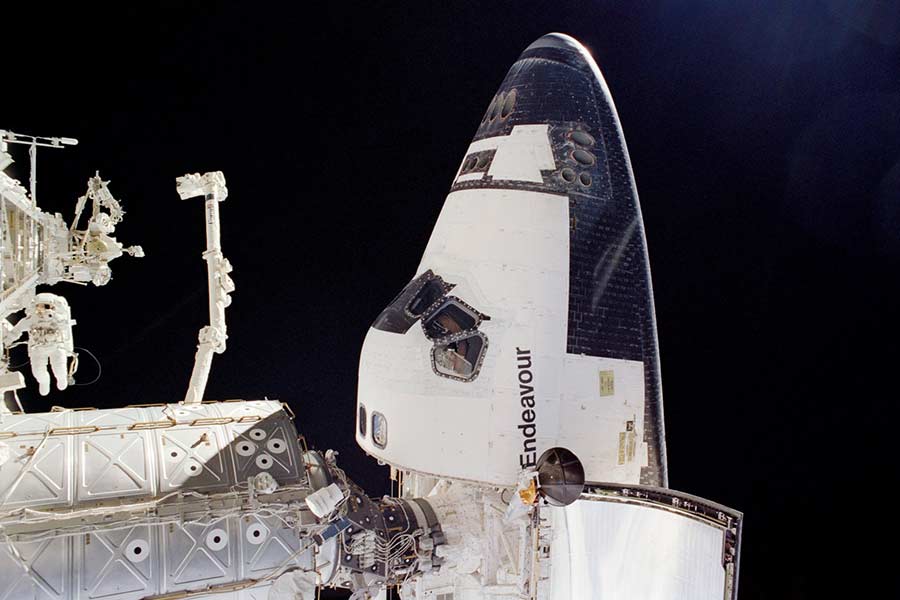
After his 13-day space mission in 2002, Herrington worked as an astronaut for three more years and retired in 2005.
During a cross-county bicycle trip in 2008, he met Margo Aragon, a former broadcaster with KLEW-TV in Lewiston. They were married the following year and lived in Idaho for a time. Herrington later obtained a doctorate degree at the University of Idaho in Moscow. Aragon passed away in 2018 after a battle with colon cancer.
Embracing diversity
Herrington now lives in Kalispell, Montana, and does speaking engagements all over the country. While he says it’s cool to talk about zero gravity and the technical aspects of space travel, the thing he misses most is the human aspect.
“You’re working with your friends, and you’re having fun. That’s what I enjoyed most about it,” says Herrington.
Before going into space, Herrington says he viewed astronauts as superhuman. His perspective now is that they are regular guys who are successful because they work with colleagues of different backgrounds.
While Herrington says being the first Native American in space was historically significant, the daily work “was not about the color of your skin or your religion. It was about accomplishing a common goal.” He points to the crew of Artemis II as an example of that.
“They’ve got a humanity about them. I think they did a really a good job of getting people’s interest because of that,” says Herrington.