




‘Idaho is not for sale’: Why Democrat Ellie Gilbreath thinks it’s time for change in the state’s 2nd congressional district
Published at
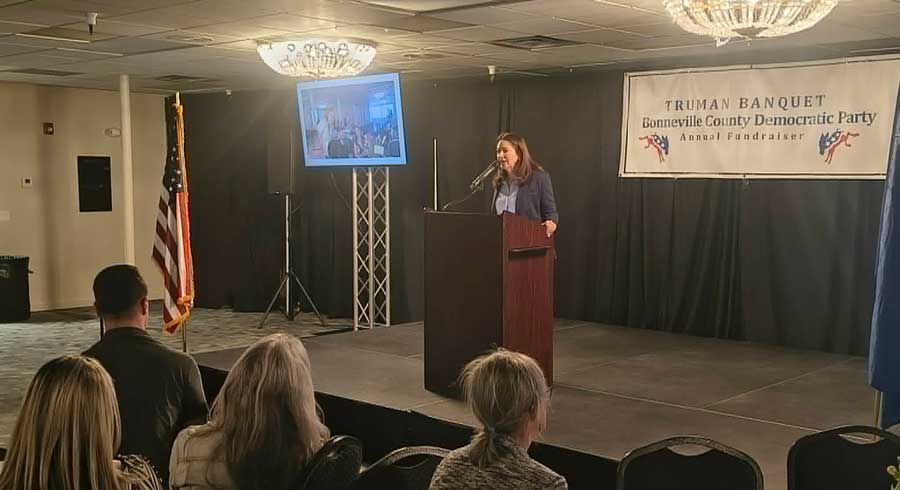
IDAHO FALLS — Idaho’s sense of community and the constitutional principles that define America are both at risk, according to congressional candidate Ellie Gilbreath.
That’s why she’s looking to unseat longtime U.S. Rep. Mike Simpson, who’s held the office for nearly 30 years.
Though running as a Democrat, Gilbreath describes herself politically as a centrist. She says her campaign is rooted in concerns about division, affordability and what she sees as growing outside pressure on Idaho’s resources and identity.
Gilbreath attends Truman Banquet
Gilbreath visited Idaho Falls last weekend for the annual Truman Banquet, a fundraising event put on by the Bonneville County Democrats. Idaho attorney general candidate Lori Hickman and U.S. Senate candidate David Roth were also featured guests at the event.
Dan Barker, chairman of the Bonneville County Democratic Central Committee and one of the organizers of the Saturday event, spoke of the prospects for Democratic candidates like Gilbreath, Hickman and Roth in the 2026 election cycle.
“I think there’s a ton of energy right now when it comes to Democratic campaigns,” Barker said. “There’s more registered candidates this election than ever before; there’s an appetite for change, and I think that’s great for Idaho. As we go into this primary, (Idahoans) have a great opportunity to vote for someone that’s truly going to represent them.”
When she spoke, Gilbreath highlighted her campaign against Simpson, a Republican who has held onto Idaho’s 2nd Congressional District seat for over 27 years, beginning in 1999.
Becoming an Idahoan
“I think people come to Idaho for the beauty and they stay for the community,” Gilbreath told EastIdahoNews after the program.
She said her family moved to Idaho in 2003, initially intending to stay only briefly. Instead, they built their lives in the state and now consider themselves Idahoans.
“We were one of those families that came for a week with our 18-month-old daughter in tow and our station wagon packed up to the hilt, and we ended up staying 23 years,” she said.
Over that time, Gilbreath said she’s witnessed Idaho communities come together during floods, avalanches and wildfires, and those experiences shaped her understanding of the state’s culture and values.
“No one’s asking who you voted for (in those situations),” she said. “No one cares if you are red or blue. We are a community and everyone is part of that community.”
According to Gilbreath, the political polarization that has intensified in recent years does not reflect Idaho’s true character.
“That polarization, that division, that was false,” she said. “It was a narrative that was being constructed for the benefit of a certain group of people, but it wasn’t who Idaho is.”
Waiting for the right moment
Gilbreath, a trained attorney with a background in mediation and conflict resolution, said her career has centered on bringing opposing sides together through effective communication and practical solutions rather than simple compromise.
Those experiences ultimately led her to enter politics.
She officially entered the race shortly before the filing deadline and later received the endorsement of fellow Democratic candidate Julie Wiley, who suspended her campaign after the withdrawal deadline had passed.
While Gilbreath is running as a Democrat, she believes her views overlap with conservatives, independents and libertarians, so she describes herself as a “political centrist.”
“I think I could have run under any political banner,” she said. “I think if you’re a centrist, it’s that middle of the Venn diagram where we’re all in there.”
Gilbreath also argued that many of the principles underlying the U.S. Constitution align with conservative values.
“The values of the framers are conservative values,” she said. “The rule of law, fairness, state sovereignty — we are an independent people.”
She said she chose to run as a Democrat because she still associates the party with working-class Americans. “When I grew up, the Democratic Party was the party of the working people,” she said.
‘Idaho is not for sale’
One of the central themes of Gilbreath’s campaign is her belief that “Idaho is not for sale.” She expressed concern about outside financial interests purchasing land and influencing the state’s future, particularly regarding water use and proposed data centers.
She also pointed to the state’s moratorium on large data centers as an example of what she considers a measured approach to development. “We’re not going to give our resources away without really having due diligence around it,” she said.
Gilbreath argued that Idaho must carefully manage its water supply, especially as drought conditions worsen across the region.
“We are going to be in the worst drought in history this summer,” she said. “We can’t have some outside interest coming in because they made some deal with special interests who are going to make a huge profit and take our resources.”
“The job of a congressman is very clear,” Gilbreath said. “It is to represent the voice and interest of your district. It’s not your own biases, it’s not your party, it’s not the donors.”
Gilbreath said her background in mediation has taught her the importance of identifying shared interests rather than escalating conflict.
“The reality is, we have shared interests,” she said. “We’re actually on the same side.”
As her campaign continues, Gilbreath said meeting voters across Idaho has been one of the most rewarding parts of running for office.
“My husband said something that made my heart really full,” she said. “‘You’ve been training your whole life for this job.’ And I thought: He’s right.”