




Long-serving state senator and national guard officer face off in District 28 race
Published at | Updated at
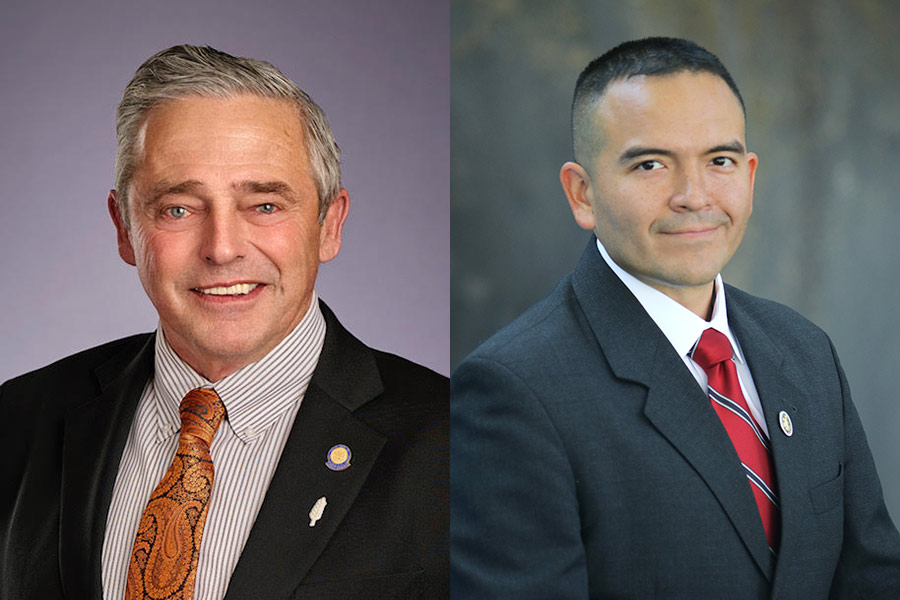
CHUBBUCK – A challenger is running against an incumbent who has served in the Idaho Legislature since 2010.
Sen. Jim Guthrie, R-McCammon, is seeking reelection from his constituents, who first voted him into office 14 years ago. His challenger in this year’s primary election is David Worley, an officer in the Idaho National Guard.
Prior to being elected to the Senate in 2012, Guthrie served in the Idaho House of Representatives for two years.
EastIdahoNews.com sent a questionnaire to each candidate. Their responses were required to be 250 words or fewer. Guthrie’s and Worley’s responses are included below, edited only for minor punctuation.
The candidate who wins the primary will be on the general election ballot on Nov. 3. The primary election will be held on May 19.
For more candidate questionnaires and further information on this year’s primary election, check out East Idaho Elects.
Tell us about yourself — include information about your family, career, education, volunteer work, and any prior experience in public office.
Guthrie: I was born in Pocatello and have lived in the Marsh Valley area within a 15-mile radius my entire life. I have two sons, one daughter, ten grandchildren, and one great-grandson, all of whom I am extremely proud of. I was raised on a farm and still farm and ranch in the Marsh Valley area where I raise beef cattle and hay. I am fortunate to have great parents who taught me the value of hard work that has served me well throughout my life.
While building up my farm and ranch operation, I worked for many years in construction and heavy industry. I worked for several years as a union journeyman carpenter and for over a decade at Ash Grove Cement in Inkom. I have been in the Idaho Senate for fourteen years, and prior to that served two years in the House of Representatives, six years as a Bannock County Commissioner, and six years on the Marsh Valley school board. I have spent time as a youth coach and served on numerous boards, including the Portneuf Medical Center board of trustees.
Worley: I was born and raised in Pocatello. My mother is a legal immigrant from Peru, and my father’s family history in Idaho dates back four generations. I joined the Idaho Army National Guard after graduating from Pocatello High School. I am an Iraq War veteran and have deployed to the Middle East three times, including two tours to Iraq. I have served as an enlisted soldier and an infantry officer, with 23 years of service. My wife and I met in high school, and we have five children.
I started my bachelor’s degree at Idaho State University and completed it at George Mason University, earning a degree in Government and International Relations. I also have a master’s degree in National Security Affairs from the Institute of World Politics. I am a small-business owner and a project manager.
Why are you seeking political office within your community? Briefly explain your political platform.
Worley: I am running because Idahoans deserve a Legislature that operates with integrity, in daylight, and with real accountability. Too often, the people’s business gets distorted by procedure, gatekeeping, and political gamesmanship. I believe public service should be serious, transparent, and worthy of the public’s trust.
My platform is straightforward. Uphold immigration law and oppose state-issued privileges that reward illegal immigration. Defend Idaho family values by protecting children, respecting parents, and keeping public institutions focused on what is good, true, and beautiful. Restore honest government so bills receive public hearings and elected lawmakers must take recorded votes, yes or no, with no hiding behind process.
Guthrie: It has been an honor to serve my community, school district, county and legislative district in several different capacities. Each opportunity presents unique challenges, and I have grown as a decision-maker because of that diversified service. I believe those experiences, coupled with my commonsense approach to problem solving, position me to be a strong advocate for this part of the state.
As for my platform, I have great respect for local control and understand the importance of our elected officials at all levels. One size does not fit all because local jurisdictions have differing personalities, needs, budgets and economies. I am very appreciative of the rural nature of Idaho and, as such, place a high value on our agriculture, timber, mining industries and, maybe most importantly, protecting our water. I believe in the least possible regulation and a fair, stable and predictable tax structure. I have always been a proponent of public schools and our higher education systems. I have great respect for those who dedicate their careers to teaching our next generations. I am pro-life and understand the importance of doctor-patient relationships as difficult decisions are considered in life-saving situations affecting both mom and baby. I am a strong supporter of our Second Amendment rights and our ability to hunt, fish and enjoy all the outdoor wonders that Idaho has to offer. As such, I do not support selling off our public lands.
What are the greatest challenges facing people in your district? What is your plan to meet and overcome those challenges?
Guthrie: The issues I hear most about are inflation, coping with growth, property taxes, and concerns about education and water. Certainly, there are many other issues. For many years the political battle cry has been: We need to bring more jobs and people to Idaho. We offer huge tax incentives for business and industry to come here. In my opinion, that is a narrative that needs recrafted. Let’s not sell Idaho short by giving away the farm at the risk of losing our farms.
At the state level, we have appropriated money to help mitigate ever-increasing property taxes, but they remain an issue. I believe we have placed too much focus on cutting income tax rates and instead should have placed more importance on the property tax dilemma. Our children and even many middle-aged citizens cannot afford housing, and single-family dwellings are giving way to apartment complexes. Incentives for affordable housing development may help soften that sticker shock. The growth cycle we are in has put incredible pressure on Idaho’s water, education systems, and every aspect of our infrastructure. We need to get back to a more methodical growth trajectory and make sure those coming in pay their fair share. In time, this will help stabilize prices, but there is no silver bullet.
Worley: Families in District 28 are dealing with rising costs, frustration with government that does not listen, and deep concern about the direction of our culture and institutions. People work hard and they want a fair system that rewards responsibility, protects children, and respects local communities.
My plan is to focus on three priorities. First, uphold immigration law and remove incentives that drive illegal labor and unfair competition. Second, defend Idaho family values by protecting kids from explicit content and ideology, and by strengthening parental rights in education and health decisions. Third, restore honest government, meaning transparent calendars, public hearings, and recorded votes so citizens can see who is doing the work and who is blocking it.
How will you best represent the views of your constituents – even those with differing political views? How do partisan politics play into your role as an elected leader?
Worley: I will represent the district by listening first, communicating clearly, and staying faithful to the promises I make at home. Even when I disagree with someone, they deserve respect, a fair hearing, and an honest explanation of my vote. People can handle disagreement. What they cannot accept is being misled.
Partisan politics matters less to me than constitutional limits, the rule of law, and the well-being of Idaho families. I am a Republican and I will govern as a conservative, but I am not interested in political theater. My job is to do the people’s work openly, take responsibility for my votes, and deliver results that strengthen families, protect children, and keep government within its proper role.
Guthrie: Talking with constituents at various venues and meetings helps me understand things that are important to my district. I try to reflect on that directive and what is best for Idaho overall as I decide on supporting or opposing legislation. One thing I have found is that I might think something is a great idea and begin working on a legislative solution. When I share the draft with parties that could be impacted by a statute change, it puts everything out in the open for discussion before the idea is pushed forward.
As I hear concerns, I might decide on changes that are needed or dismiss the idea altogether. Interaction and education on both sides of the political aisle can be beneficial not just for the issue at hand, but as we build relationships and trust going forward. I even look for opportunities where I can co-sponsor legislation with a Democrat colleague. I remind myself that regardless of political affiliation, we are all there to represent our constituents and make the best decisions possible to move our state forward in a positive direction. The media sometimes exploits political differences, but most of the time common ground among political counterparts is an important element in our public service capacity.
What parts of the Legislative budget could use more funding? Where are places in the budget where cuts could be made?
Guthrie: We hear all too often that education is always wanting more funding. As we consider those requests, we should keep in mind, we are near the bottom nationally in funding per pupil. That said, Idaho schools do an excellent job with the funds given to them, but we can ill afford to ignore the importance of education.
Failing is not an option because by educating those who in the future will be our next political and industry leaders, will drive our economy, help feed our nation, invent the next big thing, care for our medical needs, and so much more we create the best chance for continuing generational success. And to make the circle complete, it is them who will educate those who follow. Besides keeping our financial commitment to K-12 and higher ed, one area needs additional attention. Special needs students require, in some cases, the expenditure of district resources far more than any reimbursement they receive. We must develop a different funding model to mitigate this disparity.
As for cutbacks, an interim committee met this summer to identify places where cuts and efficiencies could take place with some success. I expect that effort to continue. Because of the holdbacks the Governor issued by executive order in July last year and the subsequent cuts for the FY 2027 budget, we are at a moment where we need to recalibrate our entire revenue, expenditure, budget process prior to future budget reductions.
Worley: We should prioritize funding that directly supports core public obligations and produces measurable results. Special education is one example where districts are under real pressure, and the state should focus resources where students and classrooms benefit. We should also invest wisely in water management and infrastructure that protects the long-term viability of eastern Idaho agriculture and growth.
Cuts should start with administrative bloat, redundant programs, and spending that does not show results. Idaho should not build permanent government around one-time money, and we should scrutinize agencies that keep expanding headcount while service quality does not improve. I support budgeting that is transparent, outcome-driven, and disciplined, so taxpayers can see what is funded, why it is funded, and what they receive in return.
Do you believe ethics investigations in the Idaho Legislature should be kept secret from the public, or do you believe they should be open and transparent? Why or why not?
Worley: Ethics investigations should be open and transparent once a complaint reaches a formal stage. Idahoans do not trust a system where powerful people police themselves in secret, then declare the matter closed. Sunlight is a safeguard, not a threat. If the Legislature wants the public to respect law, it must model integrity, accountability, and an open process when serious allegations arise.
Guthrie: In the spirit of fairness to those accused, I believe any ethics investigation should be kept confidential until there is a finding of guilt. People’s lives and careers can be irreparably harmed by accusations and hearsay. Once guilty, any action taken or sanctions levied is fair game for public disclosure.
Water availability and management are critical for eastern Idaho agriculture and growth. What specific strategy or legislation would you support to protect groundwater and surface water resources, and what is your timeline for measurable improvements?”
Guthrie: Water management and pressure put on that resource by growth is a critical issue in Idaho, exacerbated by the drought cycles we seem to find ourselves in, perhaps this year more than ever. During my time in the Idaho Legislature, I have consistently voted for funding for recharge projects, cloud seeding and other efforts to conserve water. I am in favor of raising dam levels where it makes sense for more storage capacity, including looking into rebuilding the Teton Dam if proven it can be done safely.
As most are aware, the contention between surface and ground water users has a multi-year history. Currently, there is an agreement in place to keep most users in water, but I predict those efforts will need constant attention. As a country boy, I have watched a state grow faster than my comfort level would suggest. I would like to see Idaho be a little more discriminating on when and where we use tax incentives to lure businesses to our state. We have so much appeal, and the nation is becoming more aware all the time that Idaho is a great place to live and do business. It begs the question: Do we really need to pay people to come here? My thought is you are welcome, but we need you to pay your fair share. Everyone else here is paying theirs. Idaho is a rural wonder; I would like to preserve some semblance of that heritage.
Worley: Eastern Idaho needs a serious, measurable strategy to stabilize the Eastern Snake Plain Aquifer and protect surface water supplies. I support expanding managed aquifer recharge, investing in infrastructure that increases flexibility, and strengthening water measurement and enforcement so everyone plays by the same rules. Idaho’s own planning documents point toward a state-supported recharge goal on the ESPA, and we should follow through with disciplined funding and clear benchmarks.
I also support regional water sustainability projects that reduce conflict between users by creating practical tools, recharge projects, conversions, efficiency upgrades, and shared solutions. The goal is fewer emergencies, fewer courtroom fights, and more predictability for agriculture and growth.
Timeline: Within one year, set clear performance targets and fund the highest impact recharge and infrastructure projects. Within two to three years, show measurable improvements in recharge volumes, measurement compliance, and conflict reduction, with public reporting so citizens can track progress.
In March 2026, the Idaho House passed House Joint Memorial 17, requesting the U.S. Supreme Court to overturn the 2015 Obergefell v. Hodges ruling that legalized same-sex marriage nationwide. Do you agree with the majority opinion of the Idaho House? Do you oppose same-sex marriage in Idaho?
Worley: Yes. I agree with the Idaho House that marriage is a foundational institution, and that states have a legitimate interest in preserving and strengthening it. House Joint Memorial 17 reflects the view that marriage is the union of one man and one woman, and I support that definition.
Section 24 of the Idaho Constitution states that “the first concern of all good government is the virtue and sobriety of the people, and the purity of the home. The Legislature should further all wise and well-directed efforts for the promotion of temperance and morality.”
The government should never promote sexual immorality and must protect the family as the fundamental unit of society. No nation can survive the calamities that come from the disintegration of the family.
My opponent, Senator Guthrie, used his position as Chairman of the State Affairs Committee to block Joint Memorial 17, preventing it from receiving a hearing or a vote. It is time for change. I will not use procedure to hide my views on issues. We need more accountability in Boise, not less.
Guthrie: The Obergefell decision was handed down by the United States Supreme Court nearly eleven years ago, legalizing same sex marriage across the nation. Regardless of opinion, it is now the law of the land as decided by the highest court in the nation. Subsequently, there have been requests that the Supreme Court revisit the case and reverse the 2015 ruling, but those requests have been denied. Further, the president of the United States cannot overturn a decision of the Supreme Court. It can be said that the optics of HJM 17 passed by the House of Representatives have political appeal, but the reality is it becomes an exercise in futility, likely costing Idaho time and money in court. Because of that landmark decision, for more than a decade, many Idaho citizens — hard working, tax paying, decent citizens — have built their lives based on that ruling. It seems to me that the collateral damage in passing HJM 17 for political theater is those that would be left with a feeling that they are not wanted in Idaho. As Americans we are free to disagree, and that’s what makes our country so unique and great. I don’t always agree with decisions made by those in power but feel the importance of respecting those laws and the citizens affected by them.