



Man injured in motorcycle crash meets his ‘guardian angels’
Published at | Updated at
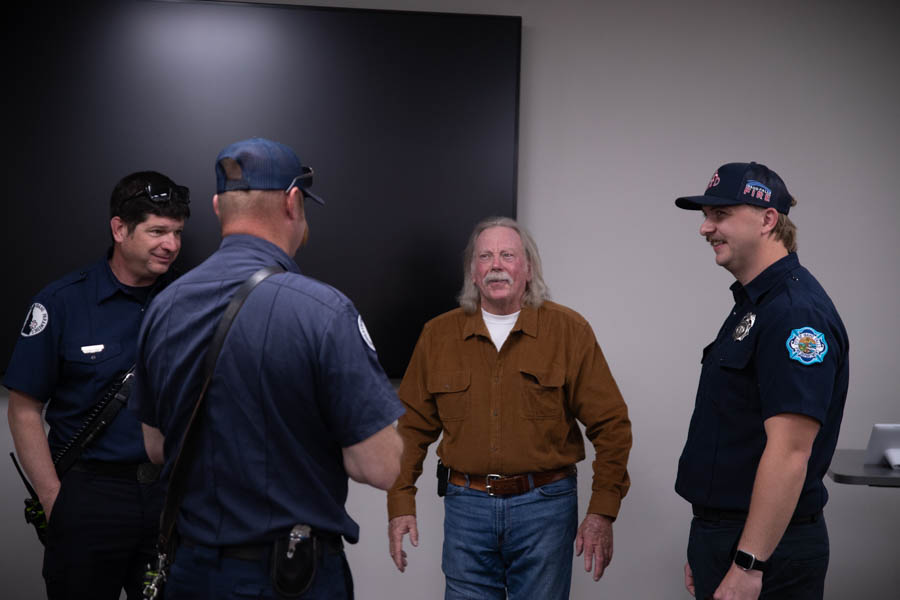
IDAHO FALLS — Almost two years ago, Fred King was in a grisly motorcycle accident in Idaho Falls. If it weren’t for some knowledgeable bystanders and fast emergency responders, who he calls “guardian angels,” he might not have made it.
But now Fred is back on his bike, and on Monday he got to meet those guardian angels during an event at Eastern Idaho Regional Medical Center.
“(It) means a lot,” King told EastIdahoNews.com. “I was happy to be here. And the guardian angels, they put me here. And they said, ‘Take notes. We don’t want to have to do this again.”
The motorcycle accident happened on July 17, 2024, on Broadway and Dale Drive. King was in the left lane on his Harley-Davidson, and a car suddenly came off a side street and turned the wrong way into his lane. The only thing King could do was lock his brakes.
“I played astronaut, and the landing was a little rough,” King would go on to tell EIRMC officials. “When I came to, I was face down in the street. My first concern was for my bike, of course, which was wadded up like tin foil. Then I saw my boot with bones sticking out of it. I rolled over and saw that my leg was gone.”
“I said a few choice words, passed out, and woke up the following Tuesday in ICU,” he said.
RELATED | Broadway open, motorcyclist ‘significantly injured’ after crash with Mustang
Among King’s guardian angels that day was Jake Allred. A decade prior to the crash, Allred had witnessed another serious incident where people were injured. He recalled that time he was frozen in fear, and never wanted to feel helpless again.
So, Allred enrolled in a Stop the Bleed class at EIRMC. Stop the Bleed classes are courses for community members to learn how to stop bleeding, such as by using tourniquets and applying pressure.
On the day of King’s crash, Allred was driving by and stopped to help. Another bystander had already used his belt as a tourniquet on King, but Jake knew a real tourniquet would be better and got one out of his first-aid kit. He and the bystander were able to secure it on King’s leg and remove the belt.
“My training from Stop the Bleed automatically kicked in, and I knew what to do. I didn’t even need to really think about it,” Allred told EIRMC officials. “The real hero is the guy with the belt. He knew what to do and did it; he just didn’t have the right equipment. He had the knowledge and skills.”
EIRMC officials said almost 7,000 community members have gone through Stop the Bleed classes locally.
As King shook hands and hugged Allred and his other guardian angels on Monday, he got choked up thinking about how they saved his life with that tourniquet.
“If it wasn’t for that, I wouldn’t be standing here right now,” King said.
After the accident, King said he spent eight weeks in the hospital. He lost his leg, but because he’s been riding a motorcycle since the 1960s, King decided he wouldn’t let this accident stop him. As soon as he could, he bought another Harley-Davidson — then he bought a second to keep as a spare.
At first, he was only able to start up the bike and hear the engine rumble.
“Just seeing it parked where my old bike used to be made the depression go away; it brought me back to life,” King told EIRMC officials. “I practiced moving my leg over and sitting on it, and about five months later I rode it for the first time. I had to get the hang of using it with my prosthetic leg. I joked with my friends that it’s like having an extra kick stand.”
King said he is about to be fitted with a new prosthetic leg and, if he can, he’d like to make it up to the annual Sturgis Motorcycle Rally in South Dakota this year. While working with a prosthetic leg can be challenging, King told the audience that he’s grateful to be alive.
“It’s really a never-ending road — it’s always going to keep going, but it’s a good one. It’s a good one,” King said.
For information on Stop the Bleed classes, look at EIRMC’s online calendar.