



How much water do lawns need? Could xeriscaping ease Idaho’s water woes?
Published at | Updated at
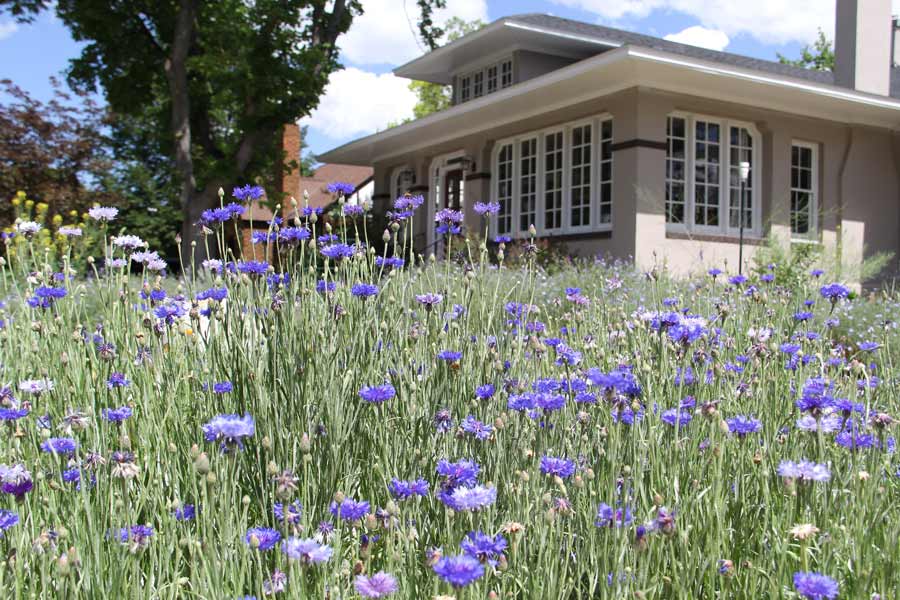
POCATELLO – As eastern Idaho and the Pacific Northwest as a whole experience near-record drought conditions going into the summer months, some people are wondering what they can do to help conserve water.
This led EastIdahoNews.com to ask: Should we still be watering our lawns?
We found that the answer to this question is not all-or-nothing, one way or the other.
But the way Brian Miesch, owner of Scout Mountain Landscaping, sees it, it’s important for everyone to take part in conserving Idaho’s most vital natural resource.
“Our aquifers are not bottomless. … It’s just short-sighted thinking. It’s not sustainable,” Miesch said.
RELATED | Water supply stress ahead for east Idaho, NWS says
How much water do we put on our lawns?
In the larger picture of water consumption in Idaho, municipal water use is relatively small compared to that of agriculture.
According to a written statement from Steve Stuebner, spokesman for the Idaho Department of Water Resources, agriculture accounts for roughly 86% to 97% of all water withdrawals in the state.
To learn how much water the city of Pocatello uses, EastIdahoNews.com contacted the city’s water superintendent, Justin Armstrong.
When looking at the city’s five-year average monthly water use, there’s a clear difference between winter and summer months, and between non-irrigation and irrigation seasons.
During the non-irrigation season, October through April from 2021 to 2025, the average monthly water use was around 7 million gallons. And during the irrigation season, from May to September, the average was 22 million gallons, resulting in an average difference of 15 million gallons between the two seasons.
As for how much water farmers need per acre to grow their crops, it varies by crop. But on average, Idaho farmers apply 1.5 to 2.5 acre-feet of water, “per irrigated acre of cropland,” in a season, Stuebner says.
RELATED | Curtailment order targets 924 groundwater rights across eastern Idaho
How many gallons is 1.5 to 2.5 acre-feet? It’s roughly 490,000 to 814,000 gallons for just one acre.
“Spread across a typical 160-acre farm, this equates to roughly 139,000 to 185,000 gallons per day, though actual agricultural consumption varies based on the crop, soil, and weather,” Stuebner says.
There are five months in the irrigation season, and if Pocatello were able to save 15 million gallons of water for all five of those months, it would save 75 million gallons.
This amount would cover almost all of a typically sized farm if 1.5 acre-feet of water were applied per acre, at 153.4 acres. If a farmer applied 2.5 acre-feet per acre, it would cover 92.1 acres.
Armstrong said that the city does not currently have mandatory restrictions on how much water citizens use. The city utilizes a tiered water conservation plan, which goes from voluntary restrictions to mandatory restrictions and then to emergency restrictions.
People shouldn’t be watering their lawns more than two to three times a week, Armstrong said, or more than 1.5 to 2 inches per week during the summer and 1 inch during the spring. Watering sessions should use around a half inch of water at a time, and shouldn’t be done during the hottest hours of the day.
Sprinkler heads should also be focused on the yard, and not run into the street or onto the sidewalk.
“We’re always asking that people conserve water. … We’re currently in our voluntary restriction phase, but we’re simply asking people just to be water-wise and use conservation measures,” Armstrong said.
Can xeriscaping make a difference?
While it’s the most popular, green grass isn’t the only kind of foliage people can plant in their yard.
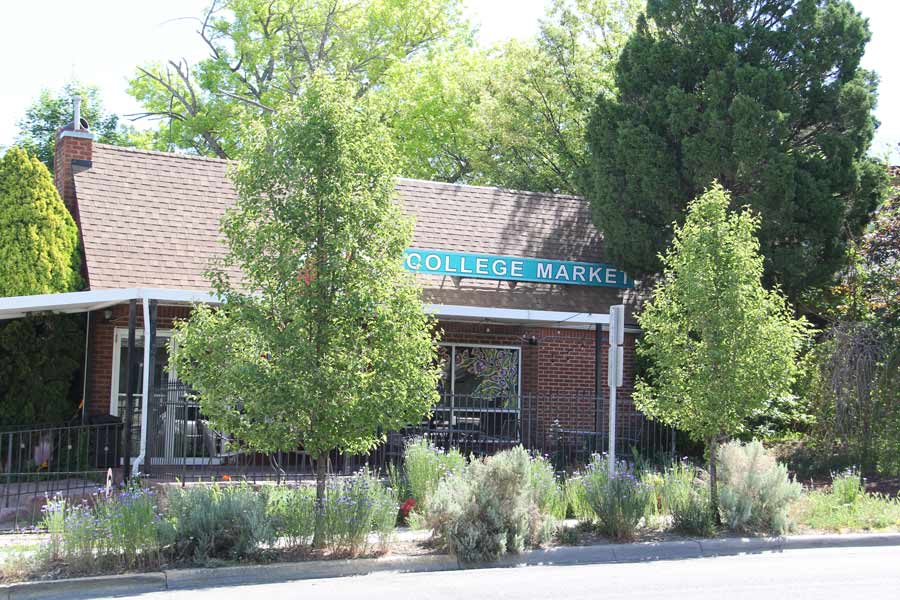
The College Market is a coffee and sandwich shop in Pocatello, located in the Historic University Neighborhood at 604 South 8th Avenue. The business is less than a block away from the Idaho State University campus, and is surrounded by medium-density single-family homes.
While there is space in front of the business for grass, that space is instead occupied by a wide variety of drought-tolerant vegetation. People walking up to or past the coffee house will see a mix of wildflowers, as well as Russian Asters, Sage and Bachelor’s Buttons. There’s also clover and thyme — which can both be mowed down and used as a replacement for Kentucky Bluegrass.
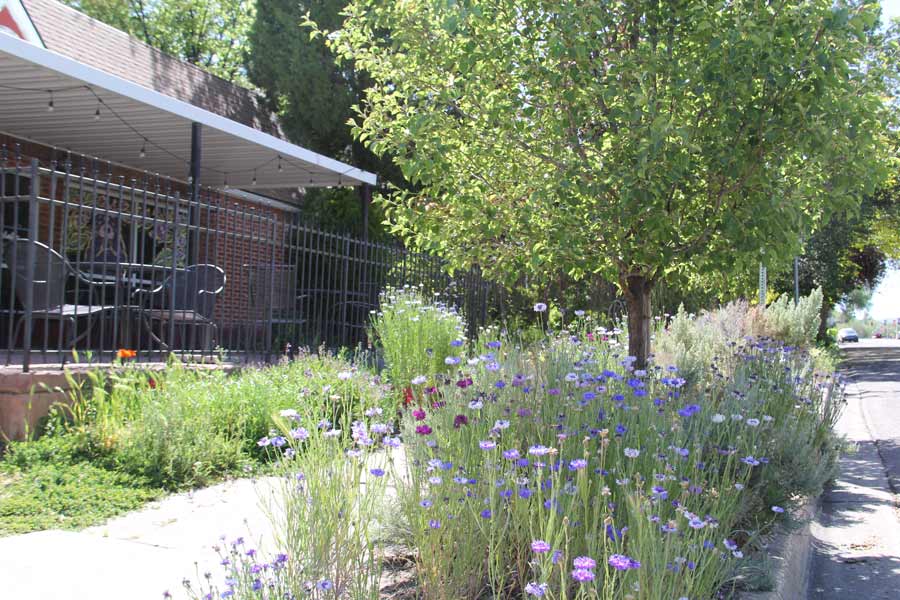
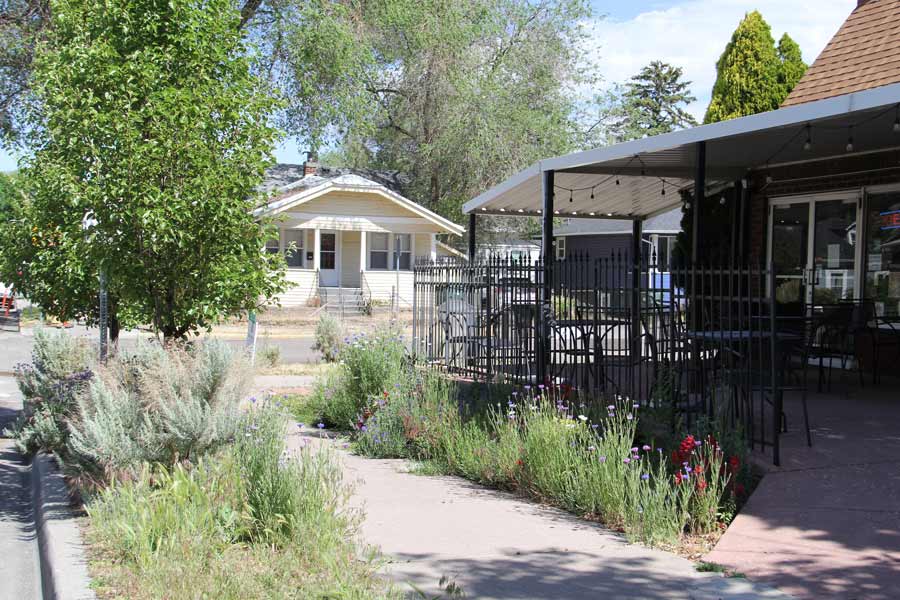
Using drought-tolerant plants in place of green grass is a form of landscaping called xeriscaping.
Kate Baker, general manager of the College Market, xeriscaped this space in one part because the property does not have an exterior water system. But more than that, Baker said it came down to a personal preference.
“I couldn’t say where that preference came from, other than I like to be aware and conservative about the environment in terms of how I’m affecting it, and I’ve just kind of grown up that way,” Baker said.
Miesch lives in the university neighborhood, and his front yard is completely xeriscaped, both with plants that he chose to be aesthetically pleasing as well as ones that will grow food, like tomatoes, kale and asparagus.
The way Miesch sees it, growing a traditional Kentucky Bluegrass lawn in eastern Idaho’s semi-arid continental climate doesn’t make sense.
“It’s pretty apparent you’re in the high desert when you step outside of Pocatello, up in the benches in the hills, so water conservation has always been top of mind,” Miesch said.
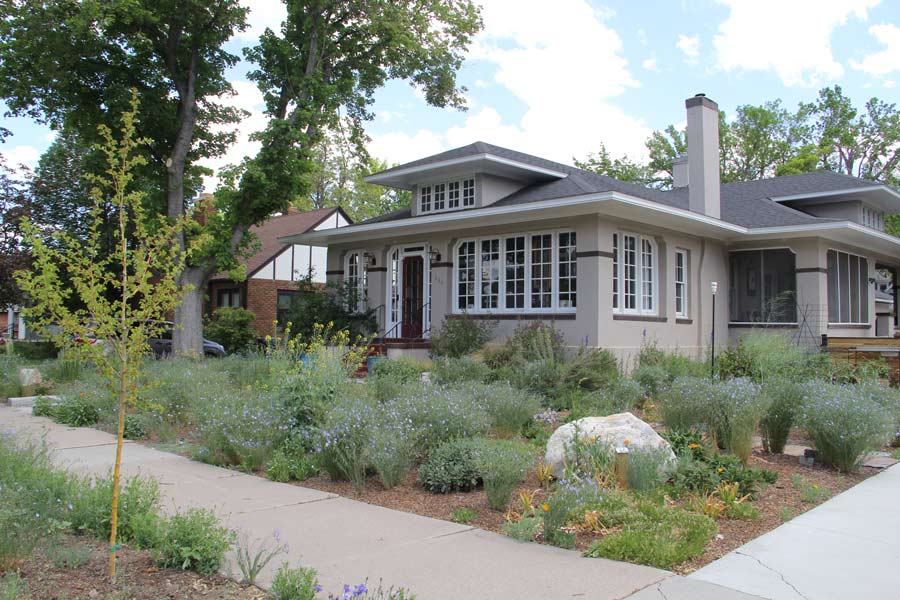
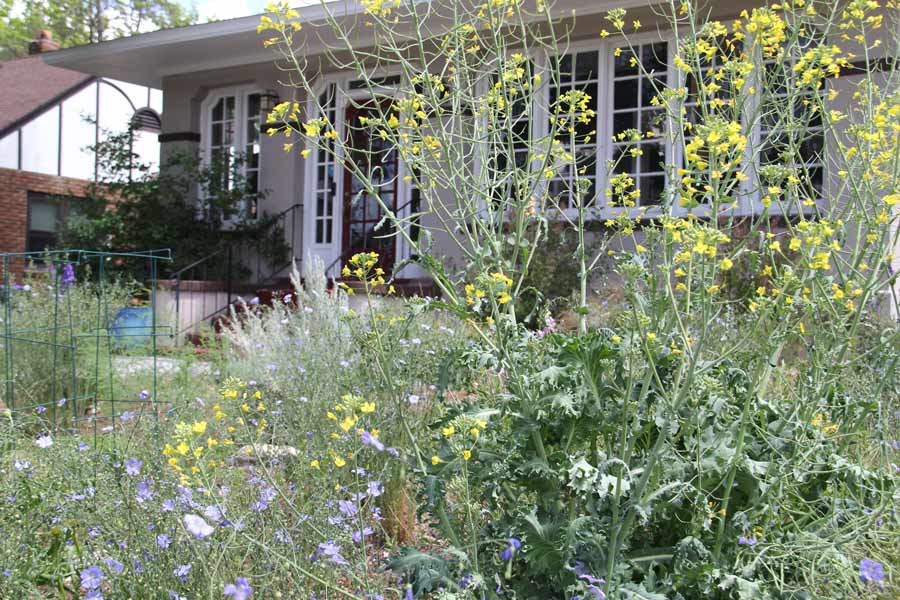
Both Baker and Miesch water less than they would need to with a grassy lawn.
Miesch waters his yard, which is in its fourth year of being xeriscaped, every ten days. He waters for long enough that the moisture can percolate through the mulch and infiltrate the root zone, but not so long that the soil becomes oversaturated.
For the College Market’s xeriscape, Baker said that she doesn’t have to water it at all.
“I didn’t have time to water at all last summer, and I still got full coverage in bloom,” Baker said.
How could someone get started?
Miesch’s landscaping company does xeriscaping for clients, and they can do everything from set up someone’s yard completely, or just do parts with a heavier workload, like removing the existing grass.
“We’re happy to work with homeowners and landowners to do whatever they need us to do. Some people love gardening, and they just need a jump start,” Miesch said.
For anyone looking to xeriscape their yard, whether they’re hiring the job out or doing it all themselves, it starts with assessing the needs of the yard. Starting out, people should figure out if they want to implement any hardscaping, like rock beds or pathways, what kinds of vegetation they want to plant and what kind of sprinkler system they want to use, if any, to water those plants.
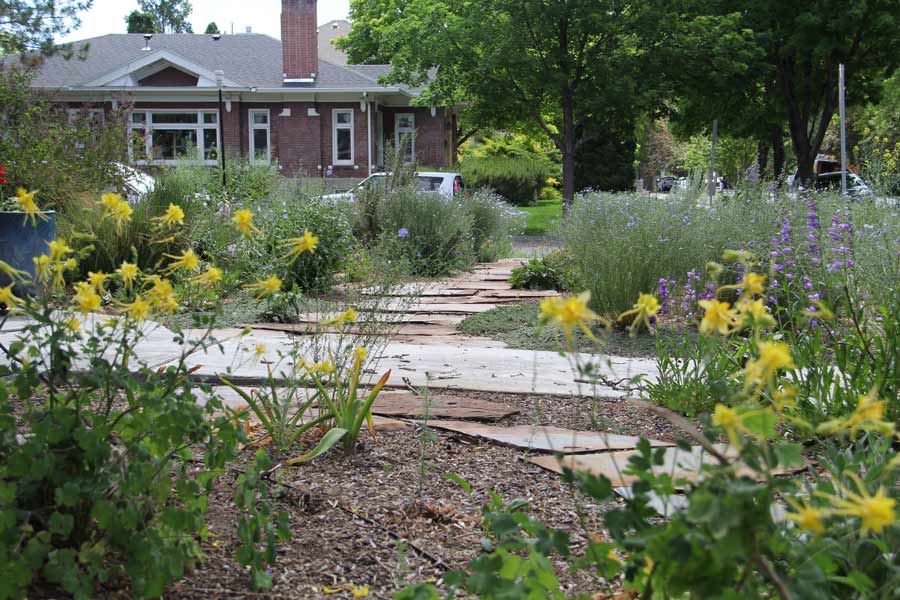
People also have the choice of whether or not they want to keep some of their traditional lawn.
“We tell customers all the time, you don’t have to give up all of your lawn. We have a lot of customers who go from 100% to 30% lawn,” Miesch said.
The next step is to scrap the existing lawn in order to get the root system of the grass removed, so that it’s not competing with new plants, and then check the health of the newly-exposed earth to determine if new topsoil is needed.
After that, it’s time to apply a mulch layer to feed the soil, reduce evaporation and help keep weeds down. Then, they should install their watering system if they decide to, making sure to keep sprinkler heads on the plants and off the sidewalk, roads and hardscape.
When planting their chosen vegetation, they should organize them into zones with similar watering needs. Once planted, the mulch should be refreshed to lock in moisture and protect the soil.
Miesch said that typically for around the first two years of a xericaped lawn, it needs to be watered more like a traditional lawn to help it “get established.”
“But once all those roots are down in there and it’s a healthy xeriscape, that’s when you start cutting back,” Miesch said.
Baker, who is currently xeriscaping at home, is in the process of scraping her yard. After that, she plans to plant vegetation that “will not need that much,” from her in terms of watering. She plans to water as needed, when the temperature goes above around 95 degrees.
The way she sees it, doing away with a traditional lawn just makes sense, and is her choosing to “function” where she lives.
“The problem is people haven’t made the choice to function where they live. … We plant things that don’t grow here. That’s the biggest problem, is that there’s not a mindset that’s like, ‘well, I’m here, what goes here?’ and then to use that,” Baker said.
This weather-related story is brought to you by Pony Express Car Wash, Idaho's premier express car wash destination, renowned for its commitment to exceptional service and quality. Voted the No. 1 car wash company in Idaho for five consecutive years, we pride ourselves on delivering an unparalleled experience for every vehicle and customer. Our state-of-the-art facility utilizes name-brand soaps and cutting-edge equipment to ensure your car receives the ultimate clean. Established in eastern Idaho in 2019, Pony Express is proud to be a locally owned and operated company that caters to the unique car washing needs of our Idaho Friends and neighbors. We invite you to experience the difference at Pony Express, where your satisfaction is our ultimate goal.