



Why east Idaho’s record-warm winter is a gardener’s warning
Published at | Updated at
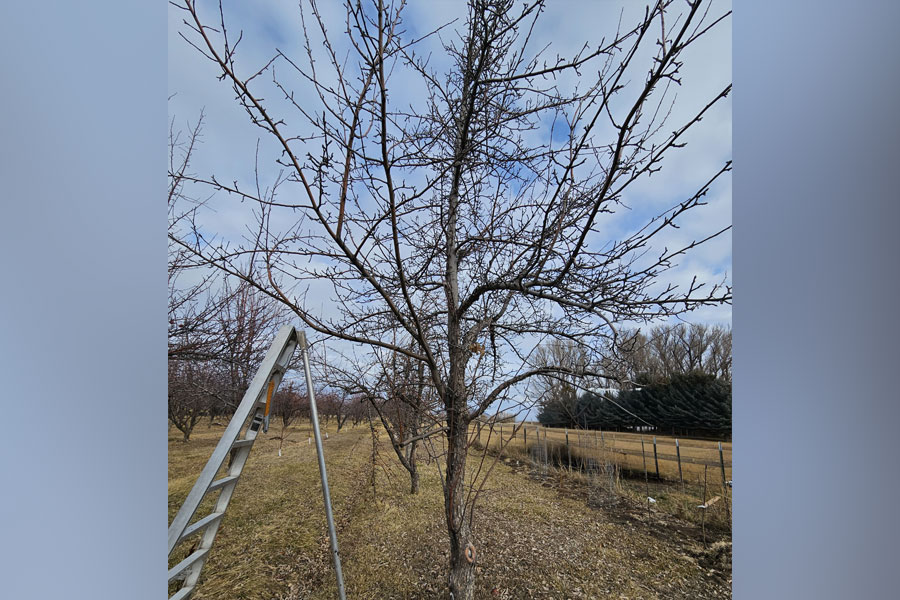
POCATELLO — If you’ve lived in east Idaho for more than a season, you know: Don’t trust a warm spring or a warm winter.
This year, we’re experiencing one of the warmest winters in recorded history. While it’s tempting to start gardening, historical data shows that a warm winter doesn’t guarantee an early spring, as recent cold weather and snow accumulation remind us.
Currently, east Idaho is facing a “snow drought,” with total precipitation above average for warm winters — at over 4 inches — but snowfall nearly 50% below normal. Much of the moisture has fallen as rain or mixed slush.
Normally, 1 inch of liquid equals about 12 to 15 inches of snow, but this year it’s only producing about 5 inches, highlighting the season’s warm and wet nature.
For summer, the lack of a frozen snowpack means water will run off into the Snake River too early, rather than melting slowly through June. This puts fruit growers and gardeners at risk, as the warm weather can prompt early bud break, leaving plants vulnerable to late frost.
Across the Snake River Plain, temperatures are spiking, with Pocatello and American Falls generally enjoying longer growing seasons than the Rexburg bench.
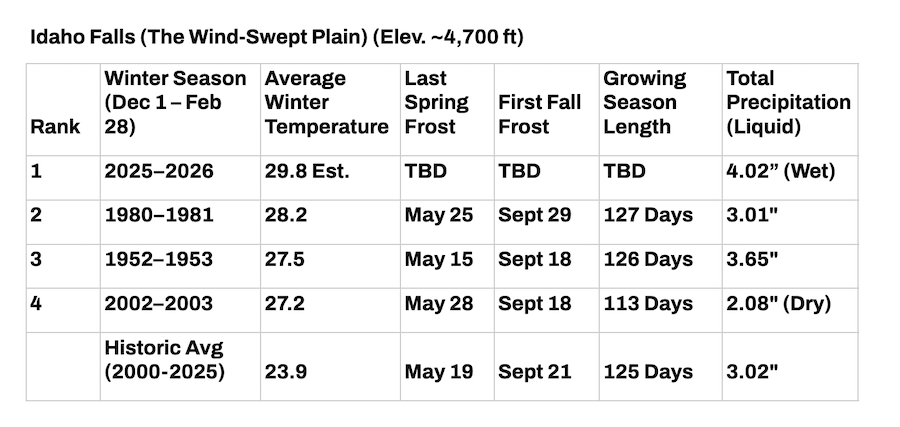
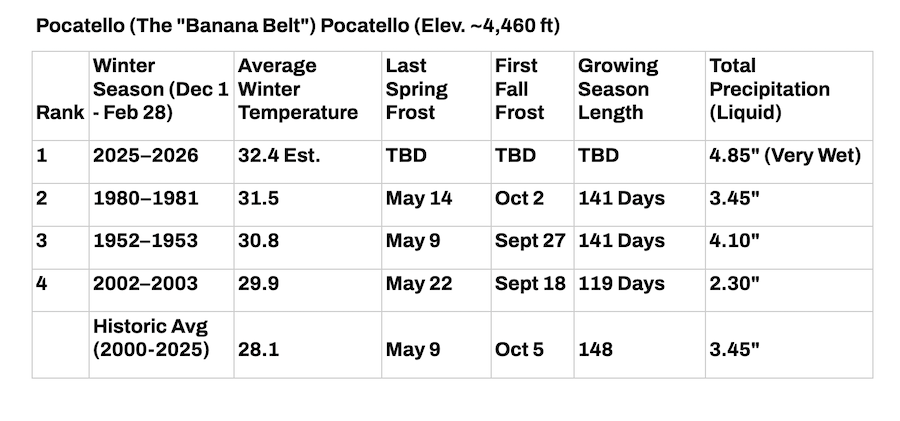
I analyzed the four warmest winters (December to February) on record in our region. Even during these warmest years, the last spring frost date still aligned with the historic average.
Below is the climate data for the four warmest winters, along with the corresponding spring and fall frost patterns for Idaho Falls and Pocatello.
Summary of the ‘big picture’
1. The record doesn’t change the date
Despite being labeled as “warm,” record-breaking years like 1981 and 2003 had later spring frosts than the current 25-year average. For instance, the last frost in 2003 occurred on May 29 in Rexburg, more than a week later than average. Over the past 30 years, the average last frost date in east Idaho has only changed by about two to three days due to our high elevation.
2. Fruit tree danger
Fruit trees, including apples and peaches, need “chill hours” to stay dormant. If winters are too warm, these trees may wake up early during warm spells, making them vulnerable to late cold snaps, which can kill buds or damage the tree.
3. Growing season irony
Interestingly, warmer winters have resulted in shorter growing seasons, contrary to the expectation of longer summers. Currently, the season is the wettest among warm winters, with liquid precipitation nearly 40% higher than in 1934 and 2003, benefiting soil moisture as spring approaches.
Specifics for fruit production
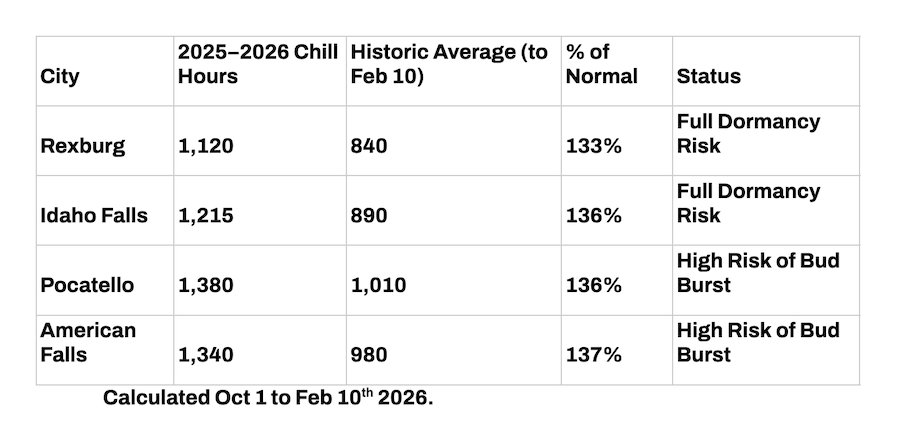
Chill hours are the currency of winter. For a tree to produce fruit, it must accumulate a specific number of hours between 32 degrees and 45 degrees Fahrenheit while dormant. In this record-warm 2025–2026 winter, the total chill hours have been attained at a much faster rate than usual because we have spent more time in that “sweet spot” (32 to 45 degrees) and less time in the “deep freeze” (below 32 degrees), where chilling actually stops.
What this means for your trees
Most fruit trees common to east Idaho have a chilling requirement of 800 to 1,000 hours. As you can see from the table, every city in the region has already met its full requirement for the year.
- The “Ready to Bloom” state: Your trees are now effectively “off the clock.” They have finished their winter sleep and are simply waiting for a string of days above 50 degrees to begin pushing sap and swelling buds.
- The vulnerability window: Usually, we don’t hit 1,000 chill hours until late February or March. By hitting it in early February, we have extended the “vulnerability window” — the time when a tree is awake but the weather is still lethal — by nearly three weeks.
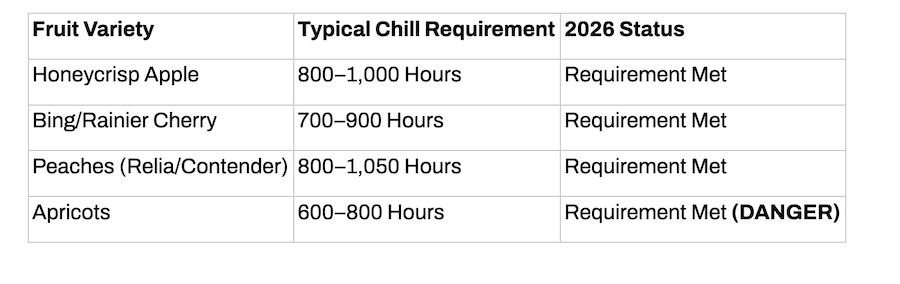
Apricot warning: Apricots are notorious for waking up the earliest. Because they only need about 700 hours, they have been “ready” since mid-January. If we get a warm week in early March, these trees will attempt to bloom, almost certainly leading to a total crop loss when we have more freezing temperatures in March and April.
Gardener’s action plan for 2026
The ‘Pocatello anomaly’
Pocatello has been seeing daily average temperatures above freezing all winter, which is rare and leads to plants prematurely thinking it’s spring, even more so than other areas.
Mulch heavily
Keep the cold soil around your perennials and trees insulated. Thick mulch helps keep the ground frozen longer, tricking the roots into staying dormant even if the air is warm.
Apply 4 to 6 inches of wood chips or straw over the root zone now. This keeps the ground temperature lower for longer, delaying the signal to the roots that spring has arrived.
White trunk paint
If you haven’t already, paint the south-facing side of young tree trunks with a 50/50 mix of white interior latex paint and water. This reflects sunlight and keeps the tree tissue from heating up on sunny winter afternoons.
Don’t cheat the calendar
Regardless of how nice the weather looks in April, the average last frost dates (May 9 to May 21) are grounded in decades of data. Keep your frost blankets ready.