



Disputed Idaho bill signed into law despite strong opposition in eastern Idaho
Published at | Updated at

IDAHO FALLS – The passage of SB 1300 is making waves throughout eastern Idaho.
On Wednesday night, Gov. Brad Little signed the legislation, which arrived on his desk on March 26. The bill provides gubernatorial appointment and Senate confirmation for the directors of the Idaho Departments of Transportation, Fish and Game, and Parks and Recreation.
It passed with significant opposition in both chambers. On March 2, the Senate approved it with a vote of 21-14. It passed in the House on a 41-29 vote on March 24. Sixteen eastern Idaho lawmakers voted against it. Sen Mark Harris, R-Soda Springs, and Rep. Barbara Ehardt, R-Idaho Falls, were the only local legislators who voted in favor of it.
Sen. Doug Okuniewicz, R-Hayden, sponsored the bill. He previously explained to EastIdahoNews.com that the directors of most state agencies are appointed by the governor and subject to Senate confirmation. The goal of this bill was to bring these departments in line with all the others to make it more consistent.
Okuniewicz was not available for comment Thursday, but in an email to EastIdahoNews.com, he reiterated his position.
RELATED | Controversial bill raises questions about Harriman State Park’s future
Opponents of the bill have said it violates an agreement that led to the creation of Harriman State Park in Fremont County and, if enacted, could transfer ownership of the park back to the Harriman family.
“As I have said all along, S1300 does not even come close to violating the Harriman agreement,” Okuniewicz writes.
In 1963, the Harrimans gifted the 11,000-acre property that now comprises Harriman State Park to the state, on the condition that the Legislature establish a “professionally staffed career park service whose personnel shall be chosen on the basis of merit alone.”
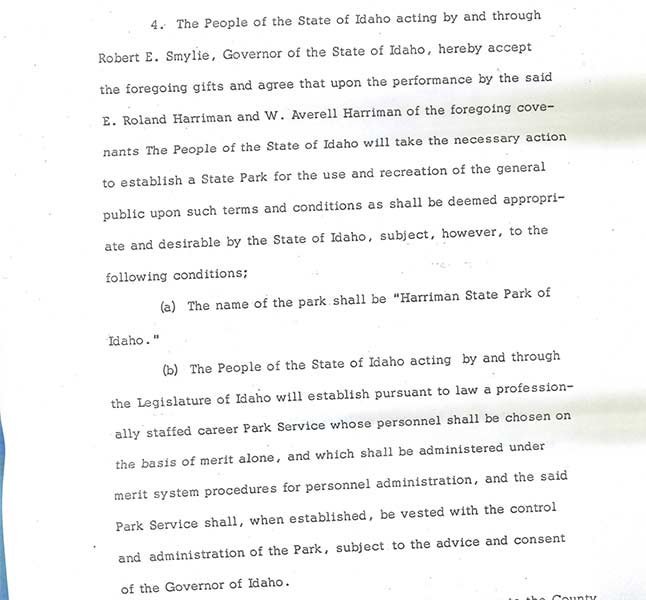
The Parks and Recreation department was created two years after this agreement was codified in state law. Since then, it’s been governed by a six-person board, with each member representing a different geographic area of the state. Under Chapter 42 of Title 67, the board had the power “to appoint a director to serve at its discretion.” That’s no longer the case.
Once the bill becomes law on July 1, Susan Buxton, who was selected by the Idaho Department of Parks and Recreation board in 2020 to serve as its director, will be subject to gubernatorial appointment. She may or may not be out of a job, depending on who the governor appoints for this position.
The same is true for Idaho Department of Transportation Director Scott Stokes and Fish and Game director Jim Fredericks.
In a letter to Lt. Gov. Scott Bedke Wednesday night, Gov. Brad Little said the board members and commissioners of these agencies “provide invaluable insight to the governor.”
“I look forward to working with them in evaluating agency leadership,” Little said.
Members of the Harriman family, along with many legislators who voted against the bill, have interpreted the line about a professionally staffed park service being selected “on the basis of merit alone” to mean that its directors cannot be political appointees.
RELATED | Bill could put the future of Idaho’s oldest state park at risk
Legal analysis from Attorney Elizabeth Bowen in the Idaho Legislative Services Office disagrees with that notion. In a written document, Bowen says, “there is no inherent conflict between S.B. 1300 and the conveyance instruments.”
“While the conveyance instruments require the merit-based selection of department personnel, the selection process itself is left to the discretion of the Legislature. As long as the director is appointed on the basis of merit, the State is in compliance with the conveyance instruments,” says Bowen.
Gov. Brad Little expressed a similar sentiment in his letter.
“The confirmation process and the separation of powers provided therein ensure that agency directors are selected on the basis of merit to carry out the mission of their respective agency,” Little writes. “These professional qualifications are not only an expectation, but statutory requirements. Senate Bill 1300 does nothing to alter the statutory qualifications; it simply amends the appointment process.”
Tom Dixon is the grandson of Roland and Gladys Harriman, who entered into the agreement with Roland’s brother, Averell, and Gov. Robert Smylie, in 1961.
He was one of numerous people who spoke in opposition to SB 1300 before the House State Affairs Committee last month. In a phone call with EastIdahoNews.com, Dixon says the hearing was “a joke” and that the bill’s passage was a “foregone conclusion.”
He says Harriman State Park is the reason Idaho has a Parks and Recreation Department, and he is disappointed with Gov. Little and state lawmakers.
“I am very disappointed that our present legislators, including our governor, do not have the honor or integrity to abide by the great gift to the state of Idaho. The passing of this bill does not honor the legislators or Gov. Smylie, who accepted Idaho’s biggest park for the people of Idaho,” Dixon says.
The future of Harriman State Park remains a bit unclear. Opponents have argued there is a clause in the original agreement that reverts the park back to the Harriman estate if the family determines there is a violation. But Bowen says in her legal analysis that a 12-page supplemental gift agreement in 1976 between the Harriman family and the state of Idaho creates some ambiguity about the Harriman family’s intent and sentiments.
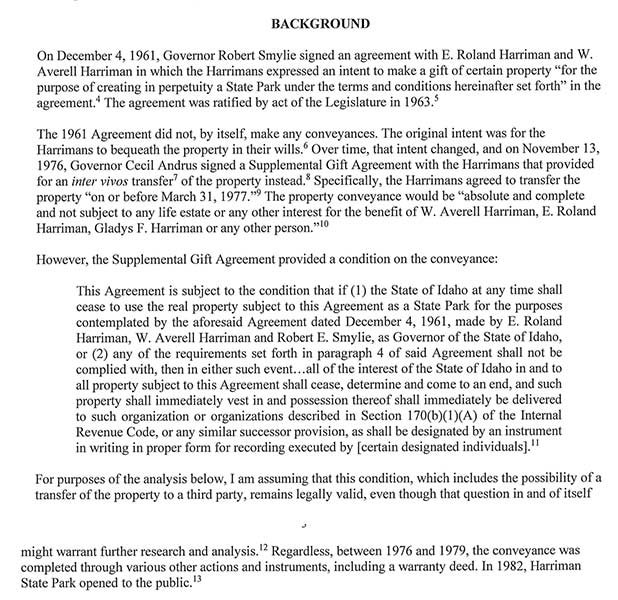
That document, according to Dixon, creates some legal challenges.
“To get the property to revert back (to the Harriman estate), the family would have to get together and sue the state,” says Dixon.
At this point, Dixon says they’re trying to determine the next course of action. They’re meeting with an attorney to discuss legal options. Ultimately, Dixon says the family’s response will depend on the advice and options presented by legal parties.