




Three candidates challenge Risch in Republican primary election for U.S. Senate
Published at | Updated at
Laura Guido, Idaho Capital Sun
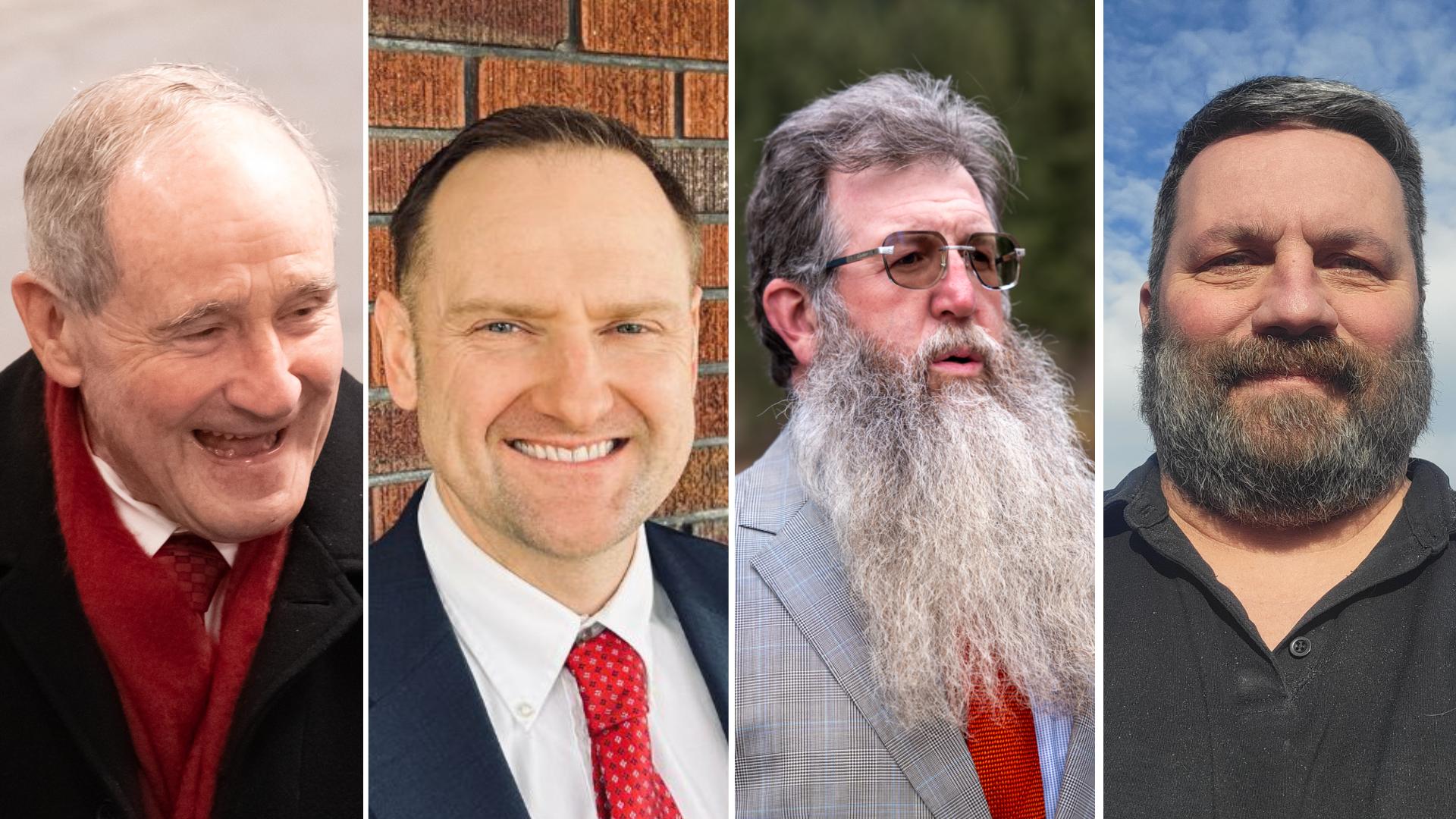
BOISE (Idaho Capital Sun) — Three Republican challengers are seeking to unseat incumbent Idaho U.S. Sen. Jim Risch.
Joe Evans, Denny LaVé, Josh Roy and Risch will all appear on the May 19 Republican primary election ballot. The winner of this primary contest will face the winner of the Democratic primary election, as well as Libertarian candidate Matt Loesby, and independents Todd Achilles and Natalie Fleming in the November general election.
Risch, 82, lives in Boise and is in his 18th year as a U.S. senator, after previously serving as an Idaho state senator, lieutenant governor, and Idaho governor.
Roy, 44, is a Lewiston resident and engineer in the pulp and paper industry. LaVé, 49, lives in Worley and is an ironworker and owner of an ironworking construction company. Evans, 57, is an Army combat veteran who works in data analytics and lives in Boise.
LaVé told the Idaho Capital Sun in the 2026 Primary Election Voter Guide that his top priorities would be border security and immigration, restoring affordability by “Ending Reckless Spending,” and ending “Forever Wars” and foreign influence over the U.S.
Evans said he’d focus on reining in lawmaking authority from federal agencies and improving affordability through “lower taxes on working people, domestic production, supply-chain security, and ending regulations that drive up the cost of living.” Evans also said he would focus on securing the border “while protecting civil liberties.”
Roy said he would prioritize pursuing “policies to protect the nuclear family by fighting social media and other anti-family policies, institutions and trade groups,” term limits for members of Congress, and reducing federal regulations that affect Idahoans.
Risch did not respond to the survey for the voter guide. On his campaign website, the incumbent includes as his top issues “fighting for Idaho farmers,” cutting taxes and wasteful spending, and supporting law enforcement.
Risch’s challengers open to bipartisan agreements on issues like the farm bill
Amid narrow party majorities, Congress has shut down the government multiple years in a row because of a failure to pass a budget, and failed to reach an agreement on issues such as the agricultural and food assistance bill called the farm bill.
The candidates who responded to the survey each expressed interest in finding common ground across the aisle to solve such issues.
“Bipartisanship does not mean surrendering principles,” Evans said. “It means finding concrete agreements that help the people we represent. Shutdown politics hurt families, contractors, producers, and local communities. I will work with anyone serious about passing budgets on time, updating the Farm Bill, and ending the cycle of governing by last-minute panic.”
RELATED | Two GOP challengers will face longtime incumbent U.S. Rep. Mike Simpson in May election
LaVé said that, as a conservative Catholic, it would be difficult to find common ground on social issues but “when it comes to all the other issues, I think there is room for collaborative solutions and even agreement.”
“America should be able to provide a strong social safety net and high wages for American workers, and it can,” he said. “But the key word there is American, we don’t have the resources to also provide that for tens of millions of illegal immigrants.”
Roy said his advantage would be that he’d come to the position with “no past baggage” and a private-industry approach to getting things done.
“I will be able to approach relationships and legislation differently than my predecessor,” he said. “After 20 years of heavy industrial manufacturing experience, I have learned not to underestimate the value of a fresh perspective.”
Candidates vary on public lands approach
All of the candidates said they supported protection of Idaho’s vast public lands.
LaVé said he would oppose the sale of public lands to “mega corporations,” especially any that would want to use them for data centers.
“Idaho is the most beautiful state in the country,” he said, “nowhere else does the landscape compare, and I will not allow us to lose that.”
Evans said he also wouldn’t support a broad selloff and he would be “skeptical of simply dumping federal lands onto the state without a serious funding and management plan. That can become a backdoor path to liquidation.”
He said he would support more input and more active management of the land, including more forest management, wildfire mitigation, improved access for grazing, timber, recreation, hunting and “less red tape” from “distant bureaucracies who do not live with the consequences.”
“Idahoans should have a bigger voice in how these lands are managed, but they should remain public, productive, and accessible for future generations,” he said.
Roy said the federally owned land in Idaho, which is managed by the Bureau of Land Management and U.S. Forest Service, should be under state control. He also supported some development on the land.
“Developing a few acres of snake infested sagebrush outside Boise or Idaho Falls into starter priced homes and lots of young families would be a great idea,” Roy said. “I think there should be a 5 year residency requirement to be eligible. Any land sales must be done for the benefit of the citizens of Idaho and not out of state developers. Our pristine river frontage and mountain valleys are not for sale at any price.”
Risch has long expressed support for keeping Idaho’s federal lands open to the public. Amid an attempt this summer to add to the “Big Beautiful” law an amendment to sell off swaths of public land, Risch publicly opposed the proposal.
During a hearing in February for President Donald Trump’s nominee to head the Bureau of Land Management, former Republican New Mexico Congressman Steve Pearce, Risch directly questioned Pearce on the issue of selling off land.
“… There is no authority for you, for that matter, for the president, to sell off public land,” Risch said. “Do you agree with that?”“
Risch went on to say it was a “98% issue in Idaho.”
“In all my decades of serving the state, I have never received such passionate, unified messages as I have on this particular topic,” he said. “Idahoans do not want their public lands sold. Period. Full stop.”
All candidates support voter ID requirements in SAVE Act
The U.S. House recently passed the “Safeguard American Voter Eligibility Act” or “SAVE Act,” which would require proof of citizenship to register to vote and photo ID at polls. The bill, a top legislative priority for President Donald Trump, is still under consideration in the Senate.
It is illegal for non-citizens to vote in federal elections, and most other elections across the U.S. States vary in requirements for showing photo identification or proof of citizenship.
RELATED | Fulcher to face 2 GOP opponents in 2026 Republican primary election on May 19
The bill has drawn criticism from some saying it would make it harder for people to vote who don’t have access to documents proving citizenship.
Risch recently said on the local conservative podcast The Ranch about the bill, “We Republicans are saying, look, if you’re going to vote, it’s fair that everybody knows that you are who you say you are and you are qualified to vote. Is that asking too much?”
Roy said voter identification and showing proof of citizenship are “common sense” and an issue that has support among members of both political parties.
LaVé said that voter identification is already a requirement in many states and “we just need to make it national law and ensure that it is enforced.”
Evans said he supported the premise that only American citizens should vote, but noted that some “Critics argue the SAVE Act could burden some eligible voters, especially if documentation requirements are rigid or if states are forced into unfunded mandates.”
“My position is this: I support proof of citizenship for federal voting, but it must be implemented in a way that is workable, uniform, and fair.” he said. “That means clear standards, a cure process for errors, no games with lawful married-name voters, and no federal overreach that turns election administration into chaos.”
Candidates support changes to make private healthcare affordable
Evans and LaVé both said there should be price transparency requirements for healthcare costs and that access in rural areas needed to be improved.
LaVé said he also supported capped markups on costs and expanding acute trauma centers in Idaho, as well as clinics and hospitals.
Roy said lawmakers needed to address issues such as monopolization of hospitals and “arcane” Food and Drug Administration regulations “that make the start-up of new production facilities for generic drugs nearly impossible financially.”
Risch and his fellow Republican U.S. Mike Crapo late last year voted against a Democratic-led plan in the Senate to extend the federal healthcare premium tax credits, which were reduced premiums for those who purchase health coverage through the state marketplace. The credits expired at the end of 2025, and 24,400 Idahoans dropped marketplace coverage this year, the Idaho Capital Sun reported.
Risch campaign raises more than $2 million
Risch’s campaign, including his political action committee, or PAC, has collected more than $2.7 million since the beginning of 2025, according to data from the Federal Election Commission. About $1.7 million of that came from individual donors, and over $736,000 from other PACs. He has spent over $1.3 million as of May 7.
LaVé’s campaign has a total of nearly $161,000 in total, $148,000 of which came from a loan from himself, according to FEC reports. He has reported spending around $1,600.
Roy has collected more than $27,300 in total, $9,117 of which came from individual contributions and $17,862 came from the candidate himself. He’s spent nearly $15,000 so far in the campaign.
Evans has garnered $7,741 in total, $850 of which came from individuals, and $6,800 came from a loan from himself. Individual donors contributed $6,200 of that total. He’s spent around $7,650.