



Idaho Supreme Court to decide if former clerk overcharged and violated open records law
Published at
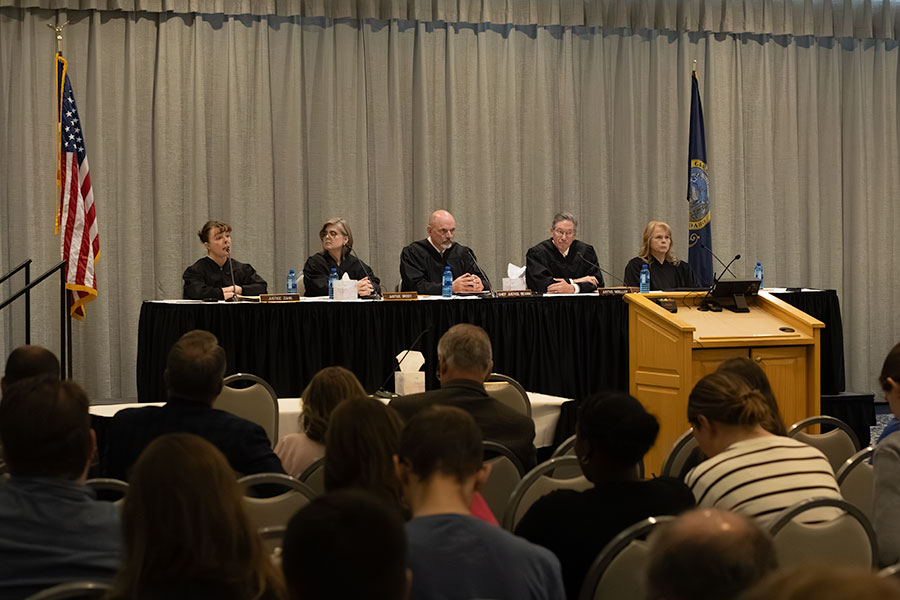
REXBURG — The Idaho State Supreme Court heard arguments this week at Brigham Young University-Idaho in a case involving Idaho Falls attorney Bryan Smith and former Bonneville County Clerk Penny Manning.
Smith, with Smith Driscoll & Associates in Idaho Falls, is representing himself in the lawsuit. He claims that in April 2025, he filed a public records request with Bonneville County and was charged $352. He states that the county clerk used a 2017 Administrative Order to charge him that rate, but Smith claims the fees were excessive and not allowed under Idaho Code § 74-102.
RELATED | Idaho Supreme Court upholds law shielding patients from surprise medical collections
Idaho Code § 74-102 allows the public to examine and obtain copies of public records from local and state agencies. Depending on the request, a fee can be applied, but there are some guardrails to this where the first two hours are free, and the lowest paid employee who can fulfill the request must be used.
Quasi-judicial immunity?
While the main issue at hand concerns allegations that the former clerk violated the Idaho code, the initial lawsuit never reached a conclusion, as a question of whether a county clerk has immunity led to dismissal in the lower court.
District Judge Steven Boyce, in a summary judgment, determined that Manning had absolute quasi-judicial immunity, which protects Manning as she was acting on behalf of the court, and dismissed Smith’s lawsuit.
“I just wanted my money back,” Smith said. “It cannot be the law in the state that a government can overcharge you, and then when you try to get your money back, they say we’re immune from suit, we’re not even going to get to the issue.”
During his argument, Smith told the justices that Manning was never engaged in any form of judicial function but was merely performing her duties as a clerk following an administrative order.
Smith also said that the 2017 administrative order was superseded by changes to Idaho Supreme Court Rule 32 governing public records a few years later.
“The district court ruled that the county had immunity, and he wasn’t going to get to the ultimate issue of whether it was going to be decided under Idaho Code § 74-102, the public records law, or whether it was going to be decided under this court’s rule Idaho Court Administrative Rules 32 (k)(6),” Smith said.
Immunity and other defenses
Bonneville County Prosecuting Attorney Randy Neal argued that this case falls under the Tort Claims Act, as he alleges Smith is seeking financial damages for Manning’s performance of her duties, whether administrative or ministerial, that quasi-judicial immunity applies.
However, Justice Gregory Moeller pushed back on Neal’s argument that, when the case went to summary judgment in the lower courts, it ultimately boiled down to an individual seeking a refund. Neal countered that the Tort Claims Act does allow immunity to government entities and is not limited to individuals who are part of a government entity.
Moeller told Neal that, by this logic, no individual could ever sue the government, and asked whether there is a case to be made for sovereign immunity for clerks who overcharge individuals in Bonneville County.
Neal clarified that the issue at hand is whether the county clerk correctly charged the correct amount.
Justice Robyn Brody told Neal that the real issue isn’t about overcharging but about whether county clerks have quasi-judicial immunity.
Brody said the question in today’s hearing about immunity is how clerks assist in the adjudication of individuals’ rights by processing public records.
“I’m struggling with how answering a public records request and looking at an administrative order to say this is how much you need to pay is assisting in the adjudication of litigants’ rights in a court case,” Brody said.
Neal argues that Manning is, in turn, functioning as an arm of the court when she is implementing the administrative order and charging individuals. However, Brody said that her actions of charging an individual, following the administrative order, are just an administrative or managerial function, not her acting as an extension of the court.
Moeller interjected that county clerks are not elected to interpret the law but to follow it, which means they should know how it works.
“We’re just calling upon them to follow the law, and if they’re not, it probably is a training issue and not a quasi-judicial issue,” Moeller said.
Neal argued that if the administrative order issued in 2017 was wrong, it should’ve been an issue for the Idaho Supreme Court, not for a county clerk to decide. Moeller countered that no one has said the order was wrong until today, because of changes to the Idaho Supreme Court Rules.
Asking the justices whether there was an issue with the administrative order, Neal said, “Why wasn’t it brought to the Supreme Court’s attention? This lawsuit should’ve been about the order.” Moeller told Neal that it should’ve been up to him to realize the order was wrong when the lawsuit was first filed.
“It was brought to your attention as the county attorney, when (Smith) filed the suit,” Moeller said. “You could look at that and say, well, yeah, he’s right, let’s just give him his money back.”
Doubling down, Neal said that if there was any issue with how the order was made, it fell to the judge who issued the administrative order and to the Supreme Court to address it. “We got the wrong defendant,” Neal said.
“I just don’t understand how you can wash your hands of this. You are an attorney, you are an officer of the court. You can see the date on the administrative order, you can look up the date on the administrative rule, and you can see that one came after the other. Yeah, the judge missed it, but you missed it too,” Moeller said.
While no decision was made during Wednesday’s hearing, the matter is under advisement. EastIdahoNews.com will update once a decision has been made.