



Idaho Supreme Court weighs appeal of Pocatello man’s domestic battery conviction
Published at
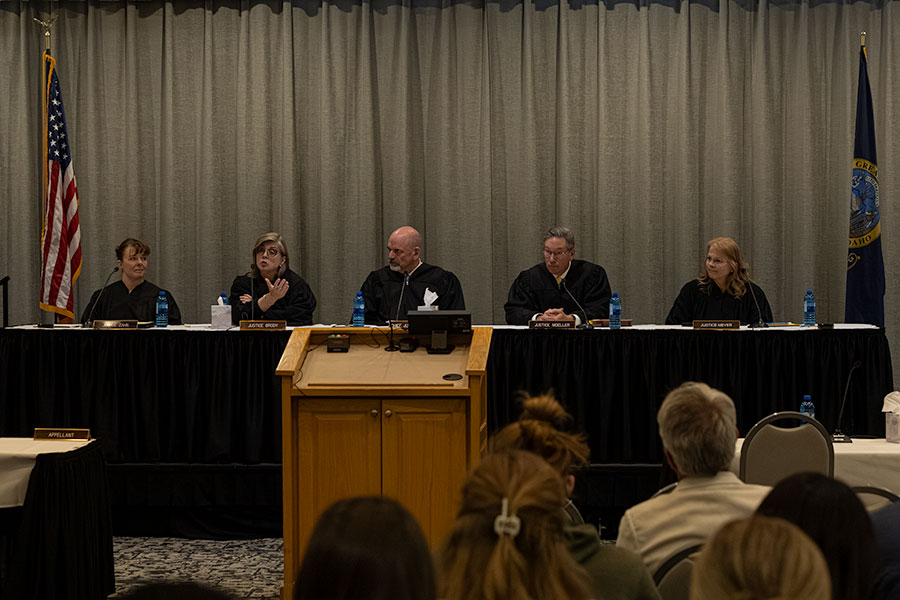
REXBURG — In an effort to vacate a conviction, an attorney for a Pocatello man argued before the Idaho Supreme Court on Wednesday that his conviction was done in error due to an instruction given to the jury and the inclusion of an enhancement.
The justices heard arguments during a hearing at Brigham Young University-Idaho in Rexburg.
Tony Rapley Crombie was sentenced in 2023 after a jury found him guilty of felony domestic battery with traumatic injury, a lesser charge after acquitting him of an attempted strangulation charge. They also convicted him with a persistent violator enhancement.
He was given a five-year fixed and five-year indeterminate sentence on Oct. 12, 2023.
Defendant’s argument
Opening the arguments, representing Crombie, Idaho Appellate Public Defender Stacy Donohue first argued against the lesser charge given to Crombie and how the case revolved around a different charge.
She said that Crombie’s understanding was that there were going to be instructions listed for attempted strangulation and a misdemeanor domestic battery, but later learned it was a felony domestic battery.
Donohue said that during the trial, the jury did acquit Crombie of the attempted strangulation charge, but found him guilty of the felony, which was meant to be a lesser charge.
The main point of her argument against the lesser charge of domestic battery was that the situation did not meet the standards for the charge, given the facts of the case involving Crombie and the victim.
She said Crombie and the victim did not live together, and that the injury that took place, which was discussed during the trial, was faint bruising.
“Crombie’s fundamental rights were so seriously, so seriously compromised, he was convicted of a crime, which includes the element of household membership, which, by my count, there are at least 10 places in the trial transcript where Crombie and (the victim) confirm they were not household members at the time of offense,” Donohue said.
Justice Gregory Moeller asked Donohue about the sentence Crombie got, looking at the maximum potential punishments, where attempted strangulation would’ve given 15 years total, compared to the 10 years he got from his conviction, asking her if he got a lucky break?
Donohue said no, due to the fact that Crombie was acquitted of the initial charge, attempted strangulation, the standard for that charge does not require injury. She claims her client was not given notice that if he was acquitted of attempted strangulation, he could still be charged with domestic battery.
Getting pushback from the justices, Moeller said the jurors had asked the judge overseeing the case multiple questions about the two charges and how to resolve them.
“Some thought he was guilty of one, and some thought he was guilty of the other. If he’d only been facing one, you’re asking us to assume, well, they would have acquitted him of that, because they acquitted him, but here, when they had a choice,” Moeller said.
Donohue said her view was that the judge was confused about what the jury was asking. However, the fact of the matter is that Crombie’s defense attorney pointed out multiple contradictions and showed the jury that he did not meet the standards for the charge for which he was convicted.
State’s response
Representing the state, Neil Peterson, deputy attorney general for Idaho, told the justices that this case doesn’t meet the state’s standards for keeping the appeal alive, as Crombie did not cite any legal theory to support it.
Moeller questioned Peterson as to whether Crombie’s defense attorney met the state’s standard when he questioned the legitimacy of the lesser domestic battery charge.
Peterson maintained that Crombie’s attorney never advanced any legal theory to support preservation of an appeal.
Moeller argued that Crombie’s attorney was on the right track but didn’t complete his argument.
“How strict are our preservation rules that we’re going to fault an attorney for meandering in his analysis?” Moeller said.
Peterson said that the Supreme Court found there was enough to preserve the case for appeal, as Crombie’s attorney incorporated enough of the standard.
However, the state still reaffirmed that this wasn’t the case.
Persistent violator issue
Part of the argument for dismissing Crombie’s conviction was the incorporation of the persistent violator enhancement into his sentence.
Donohue claims that the state’s incorporation of the enhancement was in error, as it had been dismissed in a prior drug offense committed by Crombie in 2013 when a judge dismissed and discharged that case.
Peterson argued that the relief granted to Crombie did not nullify his conviction, as the state’s leniency statute defines final dismissal as allowing for the restoration of an individual’s civil rights.
Moeller asked Peterson whether Crombie could vote and own a firearm, which Peterson said was correct.
Looking at two separate Idaho Code provisions governing the dismissal of convictions, the justices continued to question Peterson’s position on behalf of the state.
Justice Colleen Zahn said that under Idaho Code 19-2604, when Crombie received a dismissal and discharge from probation, there had to be some significance to the dismissal of the drug conviction. She asks Peterson if that, in turn, means the Crombie’s conviction is gone.
Peterson argues that it truly doesn’t mean the record is completely wiped under State v. Glenn, which holds that a prior guilty plea would still enable Crombie to receive a persistent violator enhancement.
Justice Cynthia Meyer agreed with this argument regarding DUI and drug statutes, but this wasn’t the situation with Crombie. She agrees that Crombie did plead guilty in the past, but how does persistent violator apply in a separate charge, that’s not related to DUI or drugs?
“This isn’t enhancing, because it’s another drug crime, it isn’t enhancing, because it’s yet another DUI. It’s a different situation altogether,” Meyer said.
While no decision was made during today’s hearing, the matter is under advisement. EastIdahoNews.com will update once a decision has been made.