



Why summer tree pruning is the best way to manage excess growth
Published at | Updated at
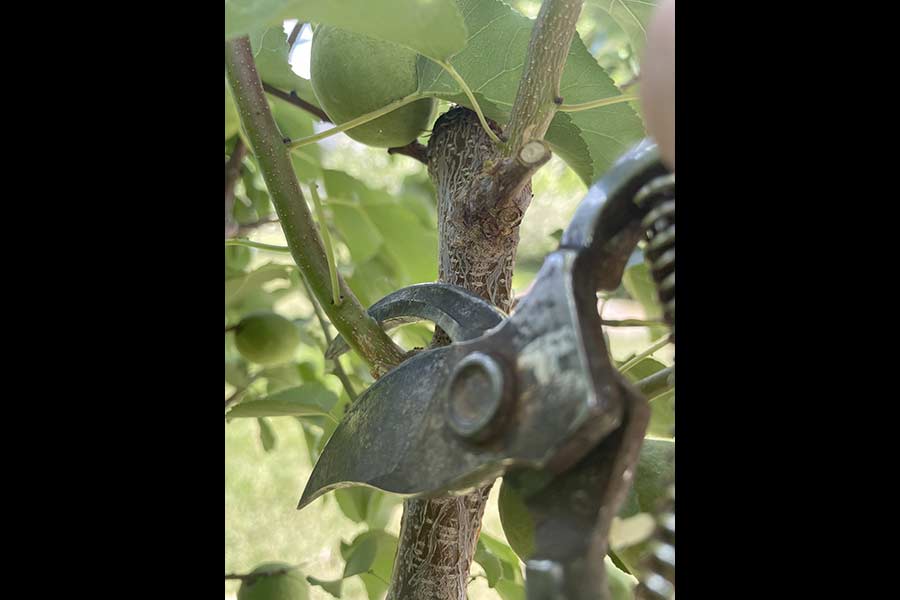
Over the years, we have been conditioned to believe pruning, while there are leaves on trees, is a capital offense. Consequently, it has probably never crossed the minds of most home orchardists to break out the pruners while battling the heat and keeping things watered.
While it is NOT the time to do any major pruning, this is the BEST time to manage excess growth.
Stop those suckers
Managing suckers and water sprouts is best accomplished with summer pruning. Suckers are fast growing vertical shoots that arise from adventitious buds on the roots or at the base of the tree. Water sprouts are the same except that they grow higher in the tree, usually from horizonal branches or where large branches were removed earlier.
The reason we DON’T want to conduct major pruning during the summer is the exact reason we DO want to prune suckers and water sprouts at that time. Pruning while the tree is actively growing is harder on the tree. Since suckers and water sprouts are excess and undesirable, pruning those during the summer means it is less likely for the tree to respond by regrowing new ones. It will instead redirect resources to elsewhere in the tree. This applies to both fruit and ornamental trees.
Not all trees will respond the same to sucker and water sprout removal. Some rootstock are notorious for suckering, and some tree species are always going to send up shoots (think quaking aspen).
Remove the bad stuff
Another reason to prune during the summer is if you have broken or dead branches or if you see diseased growth. Removing dead and broken branches allows the tree to begin regrowing to fill the void. If there are diseases present, their removal prevents spread further into the tree. A common example of this is fire blight infection. Erwinia amylovora, the bacteria that causes fire blight, can travel through the vascular system of the tree. If you cut well below (8-12 inches) visible symptoms of infection, you can stop it from penetrating further into the tree. Be sure to sterilize pruners between cuts when removing diseased branches. If you don’t, you run the risk of contaminating your pruners and spreading the disease to other parts of the tree and orchard. As a note of caution, if your irrigation method involves getting the tree canopy wet, (i.e. sprinkler) don’t summer prune. You are much more likely to invite infection to the fresh pruning cuts.
Make minor growth corrections
A third reason to summer prune is to conduct minor growth redirection. Codominant leaders on young trees can be removed, especially if the branch being removed is of current year’s growth. The same is true if you need to redirect a branch that is growing dominantly in an undesirable direction. The emphasis for summer pruning is for only minor and occasional cuts. You may be able to simply pinch off the undesired growth. If you’re thinking of getting out loppers and saws, it’s probably too much for summer pruning. Always have a plan for where the redirected growth will occur. The goal is to minimize problem growth while it is young.