



GOP chair on public schools: Money ‘cannot fix a broken system’
Published at
IdahoEdNews.org
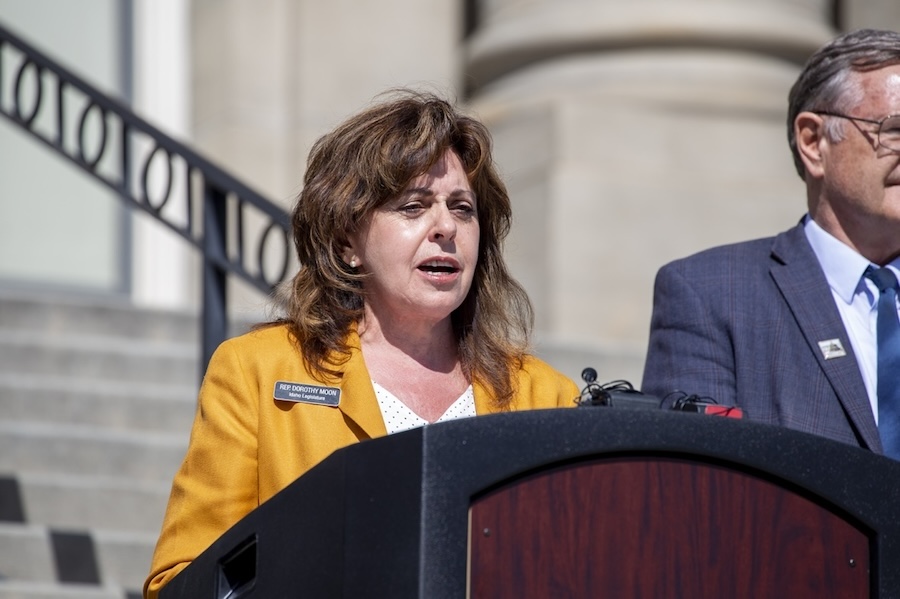
BOISE (Idaho Ed News) — The Idaho Republican Party’s chairwoman said Thursday that additional spending on Idaho’s public schools won’t “fix a broken system,” prompting strong reactions from public school advocates, including the state superintendent.
In a column advocating for private school choice — and admonishing Republicans who oppose it — GOP Chairwoman Dorothy Moon questioned whether Idaho’s public school system is “fulfilling its purpose.” She pointed to standardized test scores that show failing proficiency in math and reading, even though the state spends nearly $3 billion on K-12 education each year.
“Yet if you ask school districts, teachers’ unions, or perhaps Rep. (Stephanie) Mickelsen, they’ll tell you — with a straight face, I’m sure — the problem is simply not enough money,” she wrote. “It will never be enough, because all the money in the world cannot fix a broken system. The best way to improve public schools is to let them face competition.”
Moon chided Mickelsen, a Republican from Idaho Falls, for joining the statewide teachers’ union and a public school district in an ongoing lawsuit challenging the Parental Choice Tax Credit. The refundable tax credit, enacted this year through House Bill 93, offers non-public school students state funding to offset private school tuition and other expenses.
“It is unconscionable that anyone would try to stand in their way,” Moon wrote.
Mickelsen did not immediately respond to a voicemail requesting comment.
Moon clarified that she believes “there is a place” for public schools, but they “should not have a de facto monopoly on education.” She cited the latest results from the National Assessment of Educational Progress (NAEP), a federally administered standardized test, which showed 31% of Idaho eighth graders were proficient in math and 32% were proficient in reading.
Idaho beat the national average in NAEP scores, Moon noted, but “that’s not saying much,” and the scores are “unacceptable” considering the state’s K-12 investment.
(Recipients of the Parental Choice Tax Credit aren’t required to take standardized tests.)
State superintendent Debbie Critchfield shot back Thursday. The Republican leader of the Idaho Department of Education acknowledged that public schools “still have work to do.” But suggesting that parents choose private education because “‘all public schools are failing’ is simply not accurate,” she said.
“It’s unfortunate the conversation about supporting parent choice — something foundational to student success — has, at times, come at the expense of the work happening in our public schools,” Critchfield said by email. “Public schools are also a choice, and they remain the choice for the vast majority of Idaho families. I hope we can continue to discuss this issue without downgrading or dismissing those who choose public school for their children’s education.”
The Republican sparring over education comes one month before next year’s legislative session, when the Statehouse’s GOP supermajority will consider budget cuts. The state faces a projected $40.3 million deficit for the current fiscal year, according to the Legislative Services Office. And next fiscal year’s agency budget requests exceed projected revenue by $555.2 million.
K-12 public schools, so far, have been shielded from the budget crunch. This summer, Republican Gov. Brad Little ordered 3% “holdbacks” that excluded public schools. But K-12 isn’t immune from legislative cuts. Altogether, lawmakers may have to find $1 billion in savings, about 17% of the state’s general fund spending, and K-12 represents about half the state budget.
Democrats, meanwhile, have argued in recent months that savings could easily be achieved by repealing the $50 million Parental Choice Tax Credit. The majority of Idahoans “reject school voucher schemes” that siphon tax dollars from “already underfunded” public schools, said Lauren Necochea, chairwoman of the Idaho Democratic Party.
“For years, traditional Republicans in Idaho agreed that public money belongs in public schools,” Necochea said in a text message Thursday. “What we see now is a new, extreme party whose chair, chosen by party bosses not voters, uses that office to bully lawmakers instead of letting them listen to their constituents and their conscience.”
State K-12 spending has doubled over the last decade. But Idaho still consistently ranks near the bottom in public school support compared to other states. For two consecutive years, Idaho was dead last in per-pupil spending, according to National Education Association annual reports.
The state also faces a roughly $100 million gap in special education funding. Critchfield plans to propose a $50 million grant program next session to partially address it.
Mike Journee, spokesman for the Idaho Education Association, said Thursday that “thoughtful investments” in public education can be successful. He pointed to a nearly $50 million hike in literacy funding over the last six years that led to improved reading scores. IEA is a plaintiff in the lawsuit challenging HB 93.
“The simple truth is that Idaho has chronically underfunded the education of our children for decades while those who want get rid of a public education system that educates nine out of 10 Idaho children gleefully crow about failures,” Journee said by email.