




About 30% of Idaho voters turned out for 2026 primary election, early data shows
Published at | Updated at
Kyle Pfannenstiel, Idaho Capital Sun
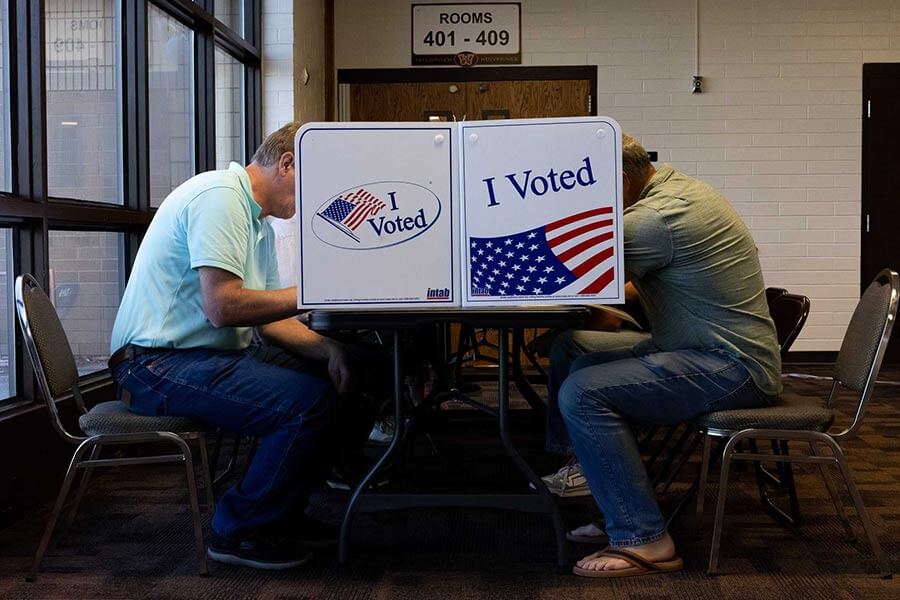
BOISE (Idaho Capital Sun) — Roughly 30.3% of Idaho’s registered voters cast ballots in Tuesday’s primary election for state legislative, statewide, congressional and county officials, according to initial figures from state election officials.
That is slightly above the median voter turnout for primary elections since 2000, which was about 28.1% voter turnout, according to the Idaho Capital Sun’s analysis of turnout data reported by the Idaho Secretary of State’s Office.
RELATED | Primary Election 2026 results
This year, no statewide incumbent constitutional officers besides the governor faced Republican primary challengers. Two-term Gov. Brad Little won an eight-way primary election Tuesday, and Idaho’s incumbent congressional Republicans all fended off challengers. But dozens of legislative races were competitive, and nine incumbent Republican lawmakers lost their re-election bids, including five members of a conservative group of lawmakers that pushed for budget cuts.
Boise State University political science professor Jaclyn Kettler called this year’s turnout impressive given the lack of primary challenges for statewide offices, which tend to drive turnout higher. But she said the competitive legislative primaries and local races helped contribute to the higher turnout levels.
“It’s possible this year that they’re starting to feel some energy building, that there’s some people … getting more engaged in politics that are paying attention, that are … motivated to turn out,” even if races at the top of the ballot weren’t that competitive, Kettler said in an interview Wednesday.
Idaho Secretary of State Phil McGrane called the turnout “really good,” especially when many races were uncontested or called early. He said he saw regional hotspots of higher turnout across the state.
“Considering there wasn’t a lot of activity in certain parts of the state, 30% for a primary feels good,” McGrane said in an interview Wednesday. “Of course, we’d always love to see more people participate in the primaries. We know the general election will be a higher turnout. But 30%, I think, should feel really good for everyone.”
Idaho primary election voter turnout, by the numbers
Idaho’s initial 30.3% primary voter turnout rate this year surpassed most primary elections since 2010, besides the 2022 and 2018 primaries. Those years also featured statewide office primaries but had higher turnout, at over 32%.
This year’s voter turnout rate is likely to decline from here, as local election officials tally up how many voters registered to vote on Election Day. But the early data shows that 312,460 of Idaho’s more than 1 million registered voters cast ballots on Tuesday.
A little more than 87,000 of those ballots were cast early or through absentee voting. About 40,800 people voted early in-person, and more than 86% of absentee ballots, or 46,000 out of roughly 56,000 absentee ballots issued, were returned, according to the Idaho Secretary of State’s Office.
Tuesday’s primary election results won’t become official until they are certified by the State Board of Canvassers, which is scheduled to meet on June 9.
Primary elections — when candidates compete for political party endorsements — tend to have lower turnout than general elections, when voters cast final votes for races. But in Idaho, where Republicans have long controlled statewide offices and the state Legislature, primary elections often decide the winners of major elections.
Republicans make up 62% of Idaho registered voters, or more than 631,000 people, according to the Idaho Secretary of State’s Office. Unaffiliated voters make up 25% or more than 257,000 of Idaho’s registered voters. Over 120,000 Democrats comprise 12% of Idaho registered voters.
At the county level, turnout varied widely — up to as high as nearly 51.9% in Bear Lake County in eastern Idaho, down to as low as almost 21.8% turnout in Teton County, the early results show.
McGrane spotlighted high turnout in southeastern Idaho counties, such as Bear Lake and Power counties, along with high turnout in the Magic Valley, where several incumbent legislators were unseated.
“Across the board, the Magic Valley turned out a lot, and I think that … played a big factor in some of the outcomes,” McGrane said.
Bear Lake County Clerk Amy Bishop said the county, which has around 3,700 registered voters, tends to have a higher voter turnout. But she said this year there were some high interest local races, like two open county commissioner seats, a contested race for her office, along with a levy for a fire district and a permanent override levy.
The county, she said, is one of few in the state that hand counts — so it was a long night for poll workers there.
“We’re really proud of Bear Lake County and our community for being involved and shaping their future. And we work really hard to run elections that can represent the voters,” she said in an interview Wednesday.
The election results could shake up the Idaho Legislature’s budget committee
The election comes on the heels of a legislative session marked by steep spending cuts to avoid a budget shortfall. This year’s budget decisions might have shaped voter attitudes, along with other issues, Kettler said.
“There’s also been some issues where the ideological differences within the Republican party have really played a key role in shaping outcomes. … It’s a little early yet to see the broad effects … of some of those but the spending cuts, things like that, that were done in the session. But voters may be concerned about or paying attention to how some of those budget decisions got made,” Kettler said. “But there are also issues like immigration enforcement that were major points of debate within some of the ideological wings of the Republican Party.”
And though this year’s losses of incumbent Republicans is still less than in 2024, Kettler said the election could shake up votes on budgets and immigration bills next year. Three of the incumbents who lost their primaries — Sen. Glenneda Zuiderveld, Rep. Steve Miller, and Sen. Jim Woodward — served on the Legislature’s budget committee, called the Joint Finance-Appropriations Committee.
“On both budget and immigration-related bills, we saw some really close votes, so just a few — even just a handful of seat changes — could make a difference in the types of bills being passed in a future session,” Kettler said.
In Twin Falls County, officials sent an election pamphlet to all voters
In the Magic Valley, Twin Falls County also had high turnout — with 38% of the county’s more than 41,000 registered voters casting ballots, according to the state’s data. The county also had a lot on the ballot — contested legislative races, school bonds and plant facility supplemental levies — that drove turnout, said Twin Falls County Clerk Kristina Glascock.
But there was also an effort by the county to bring information directly to voters.
For the first time in Twin Falls County, officials mailed every registered voter a pamphlet with information that candidates could submit about themselves, Glascock said in an interview Wednesday. She said she’d requested that in her election budget because she knew that the Idaho Secretary of State has unsuccessfully attempted to get funding for a state-issued voter guide in the Legislature.
In talking to voters, Glascock said she has seen a need for information about elections.
“We’ll have voters come in, even if it’s just when city council or school board trustees are on the ballot, and they cannot find anything. They’ll search the internet. They’ll try and find any source where they can find information about the candidate, and they can’t. There’s nothing out there,” Glascock said. “And then, so they won’t vote, or they will leave a contest blank, because they don’t feel like they have any information to cast a vote for that in that contest.”
She’s hoping to continue sending out the pamphlet in future elections.
Idaho Capital Sun is part of States Newsroom, a nonprofit news network supported by grants and a coalition of donors as a 501c(3) public charity. Idaho Capital Sun maintains editorial independence. Contact Editor Christina Lords for questions: info@idahocapitalsun.com.