



LIVE UPDATES | Day 7 of Kouri Richins murder trial
Published at | Updated at
Kouri Richins, a Utah mother of three boys, is accused of fatally poisoning her husband, Eric Richins, in 2022. She is on trial in Summit County, Utah, on charges of aggravated murder, attempted aggravated murder, insurance fraud and forgery.
Today is the seventh day of the trial. It is scheduled to begin each day at 8:30 a.m. East Idaho News will be posting live written updates all day. Please excuse typos. You can watch the livestream here. The most recent updates are at the top of this page.
4:06 p.m. Attorneys ask to approach judge to discuss scheduling. Sidebar is over. Judge says we are going to recess for the day. Court will begin tomorrow at 9:30 a.m. Jury dismissed. Join me tonight at 7:30 p.m. for “Courtroom Insider” live from Park City, Utah on the East Idaho News YouTube channel. We’ll break down what happened today in court.
4:05 p.m. All of Eric’s life insurance policies were term-life policies. Nester has nothing further. Karrington is done testifying. She is released after being on the stand since 8:30 a.m.
4 p.m. Nester asks about a Fox Lake investment. Karrington says Kouri was not involved in the Fox Lake investment. Nester asks if Kouri was listed on Fox Lake paperwork. Karrington doesn’t believe so and Kouri is not a signer on the Fox Lake bank account. Nester asks of Karrington accounted for cash on hand. Karrington says she understands there was a safe in the garage that had a large amount of cash. That amount is not accounted for in Karrington’s investigation. Karrington mentions she heard there was $10,000 in a backpack.
3:58 p.m. Kouri Richins owed $3.8 million at the time the house foreclosed and the amount continued to grow. Bloodworth has nothing further. Nester has follow-up questions.
3:54 p.m. Bloodworth asks if there was any money from C&E or Eric Richins helping out Kouri Richins and her business. There was one time with a particular property, but no others, Karrington says. Bloodworth asks when the Midway mansion was foreclosed on. May 2023. Between purchase on March 5, 2022 and May 2023, the $3.2 million in debt did not sit still on the property, Karrington says. The debt was due on Sept. 4, 2022. Because it was not paid, there was a 2% default fee (around $50,000) and then every month, there’s another 2% fee. It’s still accuring interest too, Karrington testifies.
3:52 p.m. Nester has nothing further. Bloodworth will now follow up with additional questions.
3:50 p.m. Nester asks if Karrington is aware that Eric ingested fentanyl. Judge tells Nester the question has been asked and answered when Karrington says she doesn’t know anything about Eric’s death. Karrington says there is an email between Kouri and Matt Strong where they talk about the inconvenience of being married.
3:48 p.m. Nester asks if Karrington’s job was to look back at the past of Kouri’s finances. Yes – that’s true. She’s not looking to the future. Nester asks that not everyone in financial hardship looks to murder to solve their financial problems. Bloodworth objects based on speculation. Judge sustains.
3:45 p.m. Nester asks about the Midway mansion and if it was worth $2.9 million. Karrington says Matt Strong foreclosed on the mansion and it was filed four days after Kouri was arrested. Karrington said Kouri had defaulted on the home many months before and there were indicators this was coming. Around 18 months after Kouri bought the property, the current owners bought it for $3.4 million, but they bought it from themselves because they owned the note, which was the right to collect on the property.
3:43 p.m. Judge sustains the objection. Nester asks of Karrington’s understanding is that Kouri never planned to do a lot of renovations on the Midway mansion. Karrington says that’s where it seems Kouri ultimately ended up.
3:42 p.m. During sidebars, white noise is played in the courtroom. I use white noise to fall asleep at night and I’m wondering if it’s time for an afternoon nap. Just saw one of the jurors yawn. Maybe he agrees. Sidebar is over. No nap.
3:39 p.m. Nester wants to admit an exhibit. Bloodworth objects on hearsay. Nester asks for sidebar.
3:36 p.m. Nester says in all of the hundreds of thousands of documents she’s reviewed, did Karrington see anyone helping Kouri out with her finances? Karrington says no – other than someone who did her taxes…but that person was given wrong information from Kouri, Karrington says. Karrington believes Kouri was so busy running her company and acquring houses that the tracking of finances was not on the priority list.
3:34 p.m. Nester asks if the average person who is not a financial expert would consider themselves financially successful based on their tax returns – if they made money or lost money. Karrington says she would look at her day-to-day spending – if they can fill their car up, get groceries, etc.
3:31 p.m. Greg White prepared Kouri’s taxes. Nester asks if Karrington was aware Greg is a Richins’ family member. Karrington was not aware of the family relationship. Nester asks Karrington if she knows how Kouri got the C&E bank statements. Karrington says she does because she spoke with Cody Wright. Karrington says the family computer at the house was a C&E laptop and that’s likely how Kouri got the bank statements.
3:29 p.m. Nester asking about taxes and Kouri inflating the numbers. Nester says she “way overreported her taxes and paid too much taxes.” Karrington says whether or not she paid them is a question, but she did have high numbers. Karrington doesn’t know if Kouri’s 2019 taxes were ever filed.
3:25 p.m. Nester asks about the HELOC loans and references the graph. There is no evidence that Eric ever made a payment on the HELOC, Karrington says. Nester says Eric could have looked at the HELOC statement and paid it any time.
3:22 p.m. Nester following up with questions about Kouri shopping all these loans. The $45,000 from Chelsea was given to Kouri. Nester asks if Kouri was arrested before the closing of Chelsea Barney’s house. Chelsea gave Kouri the money in January 2022. Eric died in March 2022. Kouri was arrested in May 2023 coming out of the title company in which she borrowed $95,000 using the Barney home as collateral.
3:17 p.m. Nester back to questioning. The balance on the C&E account was routinely in the six figures. Nester asks about the Barney house and the $45,000 down payment Chelsea sent Kouri for the down payment on the house. Kouri Richin Realty had already purchased the home and was trying to refinance for better terms.
3:10 p.m. Nester asks how much money was in Eric’s personal account. Karrington says around $10,000-20,000. She doesn’t recall it bouncing checks or going into the negative. Karrington also looked into C&E accounts. She says Kouri didn’t have any access to the C&E accounts. Nester wants to go down the road of the business account, prosecution objects. Judge asks for sidebar.
3:08 p.m. Nester says she didn’t see any of Eric’s accounts during Karrington’s testimony. Karrington says the family account was consistent, always had a balance, that’s where Eric’s paycheck went in and there were distributions that came in from Eric’s work. Kouri put a lot of money into the account, but not more than Eric, Karrington says.
3:03 p.m. Nester asks about the bank keeping open accounts with $300,000 worth of bounced checks. Karrington says financial institutions don’t look at just one account – they look at the relationship. There are also accounts with Eric, C&E Masonry and they have other business with the Richins. “They will look at the totality of the relationship and they want to honor that relationship.”
3:01 p.m. Nester asks Karrington if she did any analysis on the average length of time Kouri held onto the properties before flipping them. Karrington did not. Nester asks if prior to Eric’s death, did all of the hard money lenders get their money back from Kouri? Karrington says in one of her early projects she ended up $28,000 in the hole.
2:57 p.m. The goal is to hold on to a home you’re flipping for as short an amount of time as possible. Hard money lenders are often used by people who flip homes because you get the money fast and then can repay it quickly once the home sells.
2:54 p.m. Nester asks Karrington how much she’s been paid by the county. She says around $200,000, “which is a lot.” Nester asks about flipping homes. How you buy a house, make repairs, then flip them and hopefully make a profit. “If you want to make money, the goal is to do as little rehabbing as you need to flip the property. Is that fair?” Nester asks. Karrington says that’s fair.
2:51 p.m. Kathryn Nester will cross-examine Karrington. Nester asks Karrington how she became involved in the case. Karrington was hired by Eric Richins’ attorney after Kouri filed a lawsuit. Karrington was assisting Eric’s family in the litigation. The trust ended up getting new lawyers who went with another forensic accountant.
2:38 p.m. Bloodworth finishes his questions. We are taking a 10-minute recess and Nester will begin cross-examination after the recess.
2:36 p.m. There were five transactions to the Utah State Tax Commission – one for $50,000. There is also a payment to Robert Josh Grossman for $25,000. Grossman was Kouri’s boyfriend.
2:34 p.m. Bloodworth admits a transaction list showing where over $1,000 was spent in the months after Eric’s death. Karrington put this exhibit together. The list shows that all of the life insurance money was spent. She had around $800 left in her accounts on Sept. 19, 2022.
2:29 p.m. Next exhibit shows what Kouri did with the money. The first deposit for $1 million was made on June 16, 2022. Half of it was gone by June 24. She got $250,000 on June 25 and $101,000 on Sept. 2. She received the money and spent it all within a three month period.
2:27 p.m. Around $1.3 million in life insurance money was paid to Kouri after Eric died. Karrington traced how Kouri used that money.
2:24 p.m. Eric had $2.2 million in life insurance policies when he died, Karrington says. We see an exhibit showing Eric’s life insurance policies. This does not include the $2 million life insurance policy that benefited Eric’s business partner.
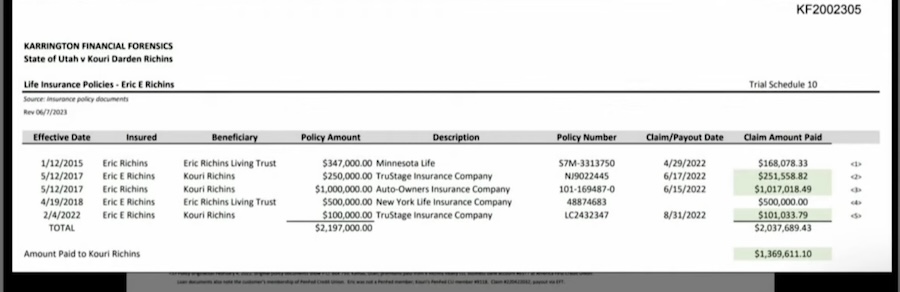
2:23 p.m. When Eric died, Kouri’s financial situation was imploding, Karrington says. Even if Kouri had sold everything she had, it would not have been enough to get back to zero.
2:20 p.m. Karrington’s assets were $6.3-6.4 million in the months leading up to Eric’s death. She had loans on each of her properties, and the loans were worth more than the properties themselves. Kouri Richins’ liabilities were around $8 million on March 5, 2022, after she closed on the Midway mansion. Her net worth was -$1.6 million.
2:17 p.m. Bloodworth asks if Karrington found any evidence that money flowed to the Midway project. Karrington says it’s possible she invested maybe $3,000 into the mansion. Kouri tried to sell the mansion on March 12, 2022 – the week after she acquired it. It was a week and a day following Eric’s death. Kouri did not sell the property. Seven or eight offers were made before Kouri’s note was due, but all of them fell through. The foreclosure process then began.
2:12 p.m. Karrington says Kouri did not have the ability to repay the $3.2 million in loans within six months of closing.
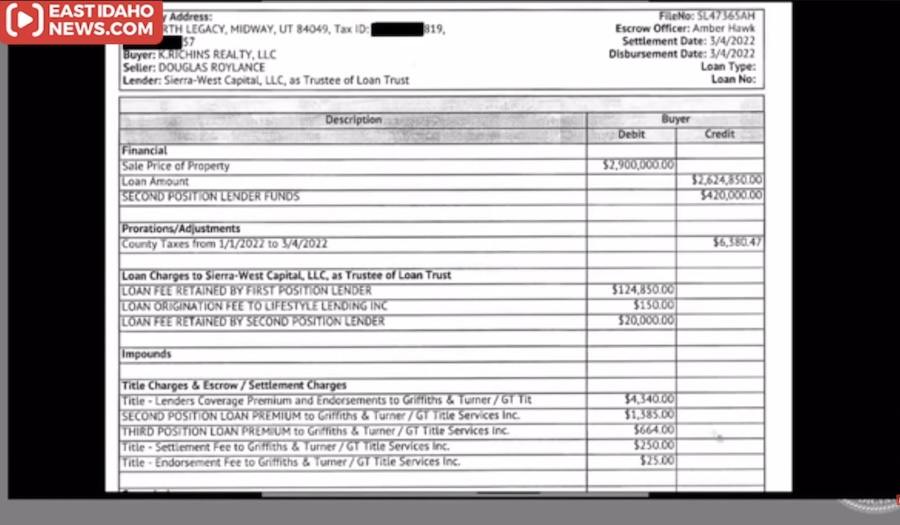
2:09 p.m. Next exhibit is a loan agreement between K. Richins Realty and Sierra-West Capital for the Midway mansion. Sierra West loaned Richins $2.6 million for the mansion. Bloodworth shows part of the email that says $3 million was needed for renovations of the mansion. Karrington says Kouri did not have $3 million to pay for renovations.
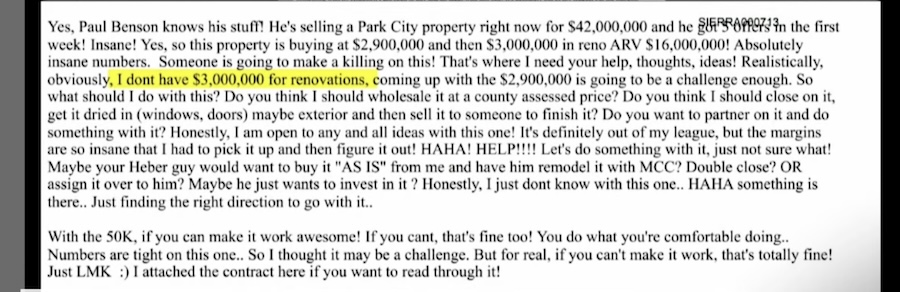
2:07 p.m. Kouri borrowed $3.2 million from other people to close on a $2.2 million home and she walked away with $87,000 that day. The home was worth $2.9 million on the day it closed, Karrington says.
2 p.m. Karrington continues to read through the contract. Bloodworth now pulls up the settlement statement for the Midway mansion property. This is the buyer’s version of the statement. Karrington steps down from the stand to explain the statement to the jury.
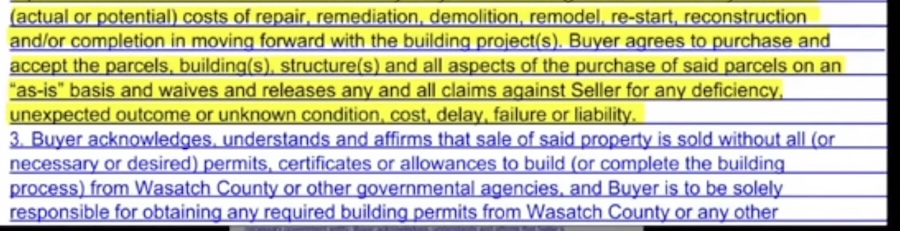
1:56 p.m. Bloodworth asks about the “warts and problems” with the home. Here is part of the contract that Karrington is reading:

1:53 p.m. The deal needed to close by March 4, 2022. That’s the day Eric Richins died. Kouri purchased the home on March 5, 2022.
1:50 p.m. We now see the real estate purchase contract for the Midway mansion. The offered purchase price was $2.9 million with a $50,000 deposit. The balance would be paid at settlement. The deal was accepted as there were initials and dates on both the buyer and seller section.
1:49 p.m. Karrington obtained home inspection records, interviewed current and former owners, drove by the properties, checked ownership history, etc. Bloodworth wants to talk about the Midway mansion property.
1:45 p.m. Karrington traced the check. It was deposited into Kouri’s account, which had a balance of 83 cents. A $25,000 deduction was made the same day from Kouri’s account. It was money wired to Stewart Title Company.
1:42 p.m. Next exhibit is a check payable to Eric Richins dated April 29, 2021, for $36,000. The check is from C&E Stone Masonry.
1:41 p.m. Karrington says Kouri and Eric had about $70,000 in state tax liens and at least $80,000 in federal tax liens. They were joint liabilities.
1:39 p.m. When asked why a business would want to pay more taxes, Karrington says to make the business appear more successful. An accurate tax return would have shown a loss to Kouri’s business in 2021. In November 2021, Kouri acquired three new properties, adding $1.1 million to her debt. She didn’t pay anything to the acquisitions – she borrowed everything. In December, she then put the offer in for the big house.
1:35 p.m. Karrington says the tax returns are missing the majority Kouri’s loans – $400,000 of obligation left off all the tax financial records. Karrington says a business that understates the expenses inflates the net income – makes it look like there is more profit than there actually was. There is a tax advantage to having a lower net income or having a loss, Karrington says. Bloodworth asks why a business person would want to inaccurately report their expenses and pay more taxes. “I don’t know,” Karrington says.
1:33 p.m. Jury is back in the courtroom. Judge tells jurors they are about to hear testimony that Kouri’s tax filings were not accurate. Judge says the evidence is being presented for the limited purpose of determining whether the defendant had a particular motive. Bloodworth continues questioning.
1:22 p.m. Nester says this is all speculation and has zero relation to whether Kouri killed her husband. Nester says filing false tax returns is a crime and this is prejudicial. Judge tells Bloodworth to frame questions so the witness does not need to speculate.
1:19 p.m. Judge excuses jury so he can discuss legal issue with the attorneys. Judge asks Bloodworth where he is headed when it comes to questions related to tax returns. Bloodworth says Karrington will testify that Richins’ tax returns were unhelpful because Kouri’s expense reporting to her accountant was inaccurate. Bloodworth says during this time frame, Kouri was trying to attract funding and a tax return showing a profit would help her get loans.
1:15 p.m. Bloodworth asks if Richins’ tax returns were helpful in understanding Kouri’s financial situation. Karrington says yes and no. “Things that things she reported to her tax preparer …” Nester objects, judge asks attorneys to approach the bench for sidebar.
1:11 p.m. Bloodworth says we are turning to tax analysis. Karrington analyzed the Richins’ tax returns for 2019, 2020, and 2021 – their joint and business tax returns.
1:06 p.m. Bloodworth admits a revenue purchasing agreement as evidence. Kouri obtained a loan for $60,000 and promised to repay $87,000 with a weekly payment and 15% interest. It was dated Dec. 9, 2021. The loan company filed a lawsuit against K. Richins Realty for failure of payment.
1 p.m. Bloodworth asks what receivables Kouri or K. Richins Realty had. There were properties that could be sold – future receivables. The next exhibit we see shows loans Kouri took out. Karrington explains what UCC filings are – uniform commercial code filings. They are public records. Karrington pulled up all of Kouri’s filings and put together a lot of information. This is a list of her loans.
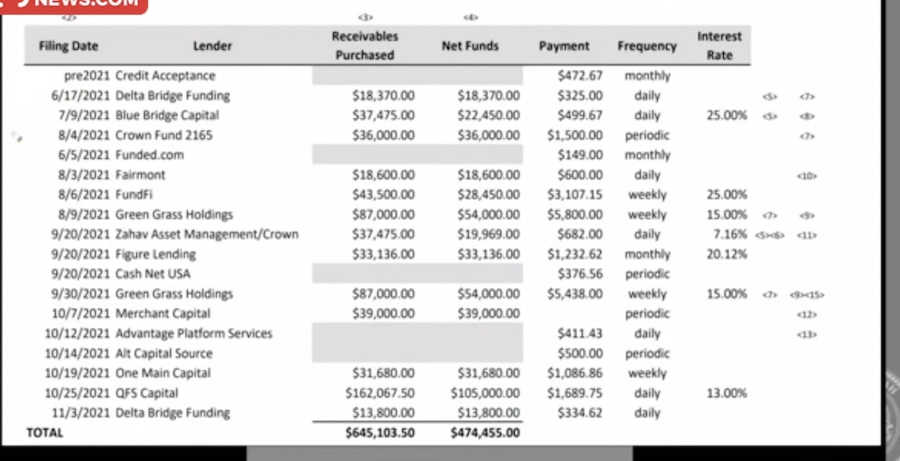
12:58 p.m. In early 2021, Karrington says Kouri sold the last significant project she was going to sell for a while. There was not a lot of new funding activity, except for the Legacy Way House/Midway Mansion – the house she signed on the day after Eric Richins died. She used a lot of lenders to buy the house and didn’t have any money left over for rehab expenses.
12:55 p.m. Karrington has not been able to locate any funds that came in from Doreen Kouri, Kouri Richins’ aunt. Her credit is used for Excel Financing and she is a guarantor on a lot of the payday loans. Her name and credit as used but she is not a funding source as a source of cash, as far as Karrington can tell.
12:51 p.m. Bloodworth admits a document that has information showing funding options for Kouri Richins over the last few years. As time went on, Karrington says the proportions changed and so did the funding sources. Kouri was using her own cash at the beginning but then things changed. The chart looks like this:

12:48 p.m. Bloodworth begins by admitting more bank statements from America First Credit Union. They are for Eric’s business, C&E Stone Masonry, and K. Richins Realty.
12:42 p.m. We are back in the courtroom. Jurors are in their seats – many with caffeinated soft drinks in hand. Testimony continues with forensic accountant Brooks Karrington. Prosecutor Brad Bloodworth is questioning her.
11:56 a.m. Lunch break until 12:40 p.m.
11:51 a.m. The money in the family account was then transferred to Fundfi, a payday lender. Bloodworth asks about the Iron Bridge loan that was due on Jan. 8, 2022. Kouri did not make the payment. She extended the loan for two weeks. During this time, she tried to get a new loan from Excel Financial. Excel asked for a lot of documentation that Kouri sent in. The loan then became Doreen Kouri’s loan as the principal of K. Richins Realty. The Iron Bridge loan remained unpaid and was extended to March 8, 2022.
11:49 a.m. None of the money went to the mortgage on the Barney home. Bloodworth moves to show the family bank account information.
11:46 a.m. Karrington was able to track the $45,000. The money was wired to Kouri’s account from Chelsea on Jan. 12 in two separate transactions. The balance was in the negative when the money hit the account. Almost half of the money was then transferred to Kouri’s family joint checking account, Karrington says. The rest of the money was used to pay debt.
11:41 a.m. Chelsea says she needs to count her cash. She has 40. She needs to do her taxes. Kouri responds that if she can do 45, the rest can be wrapped up in the loan. Chelsea says she can do 45 – then follows up and says she has $45,000. Kouri tells her to deposit it into her bank account and then wire it to Kouri. Kouri will then wire it to the title company, she says. Kouri sends her the bank info. so Chelsea can wire the money. Then writes, “I’m kinda nervous. ha!” Chelsea responds, “I’m so excited but I’m scared as hell.” Kouri writes back that it’s “sooo much money.”
11:37 a.m. We now see a text stream between Chelsea and Kouri. It’s from early January 2022. They are talking about finances and down payment. Kouri asks what she wants to put down as down payment. Kouri says she needs $59,000 even though Chelsea only has $47,000. Kouri says they will be seller financing it from her. The home will be in Kouri’s name and then in two weeks, they will close to put it in Chelsea’s name.
11:34 a.m. Bloodworth asks Karrington about wire transfers in January 2022. Karrington says they were from Chelsea Barney to Kouri Richins for the purpose of buying the 299 Barney House. Defense objects to the exhibit. The judge is allowing the exhibit in.
11:31 a.m. There is some confusion over an exhibit number. Spotted another juror taking a sip of a Diet Coke. Benches in the courtroom are padded. Someone tell Ada County (where the Daybell trials were held. No padding – just solid wood pews.)
11:25 a.m. More bank statements are admitted as evidence. Kouri is taking notes at the defense table. Some jurors taking notes, one is having a drink (looks like a Dr. Pepper), they all seem attentive and focused.
11:22 a.m. Next exhibit is the operating agreement of K. Richins Realty. It shows Doreen Kouri owns 81% of the company, Kouri owns the rest. Next exhibit is a bank account statement for Kouri’s personal account.
11:21 a.m. Judge asks Nester and Bloodworth to approach the bench before this next exhibit is admitted.
11:17 a.m. Next exhibit prosecutor wants to admit is a document from Excel Financial Service and its principal. It’s Kouri’s resume of sorts and she says she has 147 employees. Kouri’s bank statements are around $1,500-$2,000 – not enough to pay 147 people. Bloodworth asks Karrington if she found any evidence that Kouri ever profited $1 million on her deals combined. Karrington says no.

11:13 a.m. Next exhibit is America First bank statement showing C&E Stone Masonry information.
11:11 a.m. The next exhibit is the America First bank account statement from July 2021. The three accounts in the summary statement shows she had around $630,000 at the end of the month. Next exhibit is another America First bank account statement. Defense objects to all of these exhibits. Judge allows them in.
11:06 a.m. The emails are shown on the screen for the jury. There is back and forth about Kouri’s credit score and amount of money in her bank. Bloodworth admits an exhibit showing a promissory note showing she had monthly payments on a loan. She had to refinance or pay it off by Jan. 8, 2022. Kouri tried to refinance the loan, Karrington says.
11:04 a.m. Bloodworth introduces an email string between Iron Bridge Financial and Kouri Richins. Defense objects – one reason is hearsay. Judge tells jury they about about to see an email string. Says they can consider what Kouri says, but can only consider the other parts of the email for the effect they had on the listener, not for the truth of the matter.
11:02 a.m. Next exhibit is a bank statement from C&E Stone Masonry. It’s the account statement for May 2021. Ending balance of three accounts is around $210,000.
10:59 a.m. Kouri applied for a loan from Iron Bridge Financial. We see an exhibit on the screen showing an America First Credit Union bank statement. We see another exhibit showing a bank statement for K. Richins Realty using a PO Box in Kamas. There are two accounts listed on the bank statement.
10:56 a.m. Jury is back in the courtroom. We are now hearing about the 299 Barney property. Karrington analyzed the purchase transaction. Bloodworth asks Karrington if she is familiar with Iron Bridge Financial. They are a hard money lender – “the terms are hard, the interest rates are higher than conventional loans, they also have very strict default clauses.” They are usually used for shorter-term lending, Karrington says, and the terms are defined at a certain interest rate. Upon default, there is exponential growth.
10:48 a.m. Bloodworth says he has six inconsistent bank statements related to the Barney property. “They show an evolution between Kouri Richins and the lender who is asking for bank statements,” Bloodworth says. Prosecutor says there is relevance to the case. Nester objects to the information coming in at all.
10:43 a.m. The attorneys are discussing the Barney property. In June 2021, Kouri submitted a bank statement to get a loan showing a certain bank balance, Bloodworth says. But the actual bank statement shows a different balance. Defense objects to having the information brought in.
10:40 a.m. Back in the courtroom. Kouri Richins is wearing ankle shackles that are not visible to the jury. Attorneys arguing an issue outside the presence of the jury regarding one of the homes Kouri purchased.
10:23 a.m. We are now taking a morning recess until 10:40 a.m.
10:18 a.m. Bloodworth brings up one more example – the Millcreek house. She bought it for $650,000. Borrowed money for the home three times. She was $228,000 in the hole. She had expenses on the home, including closing costs and interest, and ended up losing around $-155,000. She lost “at least that, maybe more.”
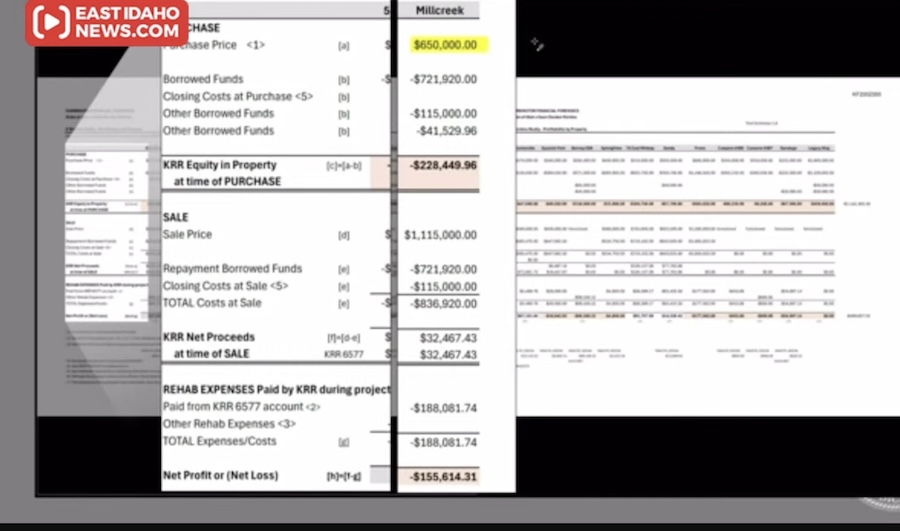
10:16 a.m. Bloodworth uses one home as an example to explain how the chart works – how much Kouri paid, how much she spent on rehab, and what she ended up selling the home for. She ended up making around $47,000 in profit, but “so much of the HELOC funds were used for this property,” Karrington says.
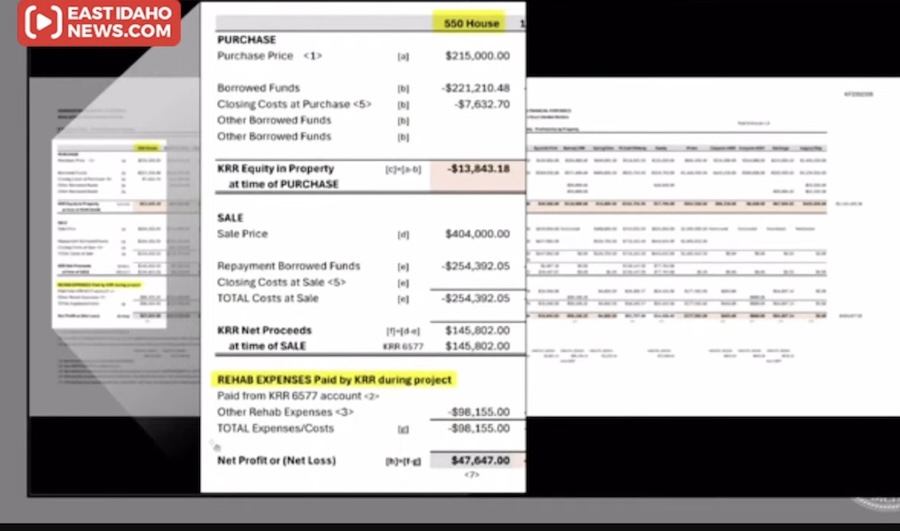
10:13 a.m. Sidebar over. Karrington says going through all of Kouri’s financials was a “sorting exercise.” In 2021, there was $400,000 of expenses that went to vendors or subcontractors, but Karrington couldn’t tell what specific homes that money went to. Many of the checks Kouri wrote included the name of the property the money was for.
10:12 a.m. Bloodworth asks Karrington why she didn’t use the documents Kouri prepared for her accountants about the properties. Karrington says, “Because they were incorrect.” Nester objects. Judge holding sidebar with Nester and Bloodworth.
10:07 a.m. We see an exhibit showing the property transactions. They show the purchase price of the home, closing costs, net proceeds at time of sale. We also see rehab expenses. Karrington compiled reports like this for each property.
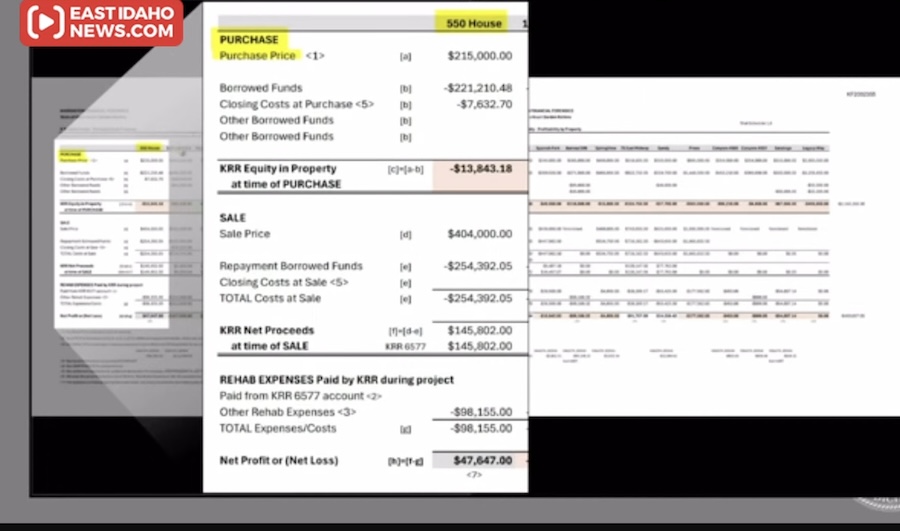
10:04 a.m. We now see an exhibit showing a purchase timeline showing a purchase timeline of K. Richins Realty. It shows how many homes Kouri purchased over the years.

10:02 a.m. Sidebar is over. We see Kouri’s personal bank account statement from April 2019. It shows that on March 29, there was a deposit of $60,000 in the account. The money came from the TCF National Bank account check made out to Eric Richins.
10 a.m. Bloodworth moves to admit another exhibit. Nester objects. Judge asks attorneys to approach the bench for sidebar. White noise is played in courtroom.
9:57 a.m. Bloodworth admits an exhibit showing a $60,000 check from TCF National Bank made payable to Eric Richins on March 22, 2019.
9:55 a.m. Money was used from the HELOC to pay for rehab projects. There was no evidence or sign that Eric ever withdrew any money from the HELOC – it was always Kouri, Karrington says.
9:52 a.m. Bloodworth admits an exhibit showing the balance limit on the HELOC loan. At the time of Eric’s death, the loan was over its limit of $250,000. The payments on the account were interest-only payments with the exception of one payment made of $50,000 in October 2020.
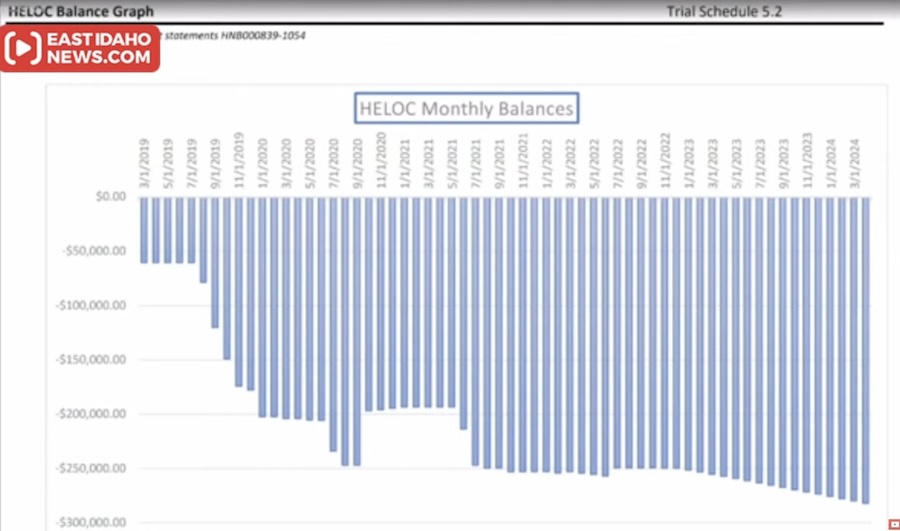
9:48 a.m. Judge will allow the exhibit in. We see the home equity line of credit agreement on the screen. It outlines the terms of the loan. Eric Richins is the borrower. The credit limit on the loan is $250,000. The borrower is signed as Eric Richins and it’s signed by Kouri Richins.
9:45 a.m. Bloodworth admits an exhibit showing a warranty deed showing Eric’s sister and brother-in-law originally owned the property but transferred it to Eric and Kouri. Bloodworth moves to admit an exhibit. Kathryn Nestor says she objects based on 404b and objects to “all testimony that may flow from it.” Judge asks attorneys to approach for sidebar.
9:44 a.m. Kouri took out a home equity line of credit in March 2019. It’s an open line of credit and is based on whatever equity you have put into your home. The home equity line of credit was based on Kouri and Eric’s home.
9:42 a.m. Most of Kouri’s real estate deals did not require monthly payments, Karrington says. The total debt owed seems to flatline in October 2021. Bloodworth asks why. Karrington says there are a lot of reasons. “It looks to me that she’s exhausted her funding sources and there are very few new funding sources coming in.”
9:37 a.m. Bloodworth admits exhibit showing total debt Kouri owed on properties, credit cards, payday loans and lines of credit. In March 2022, Kouri owed approximately $7.5 million and paid around $80,000 a month toward that debt.
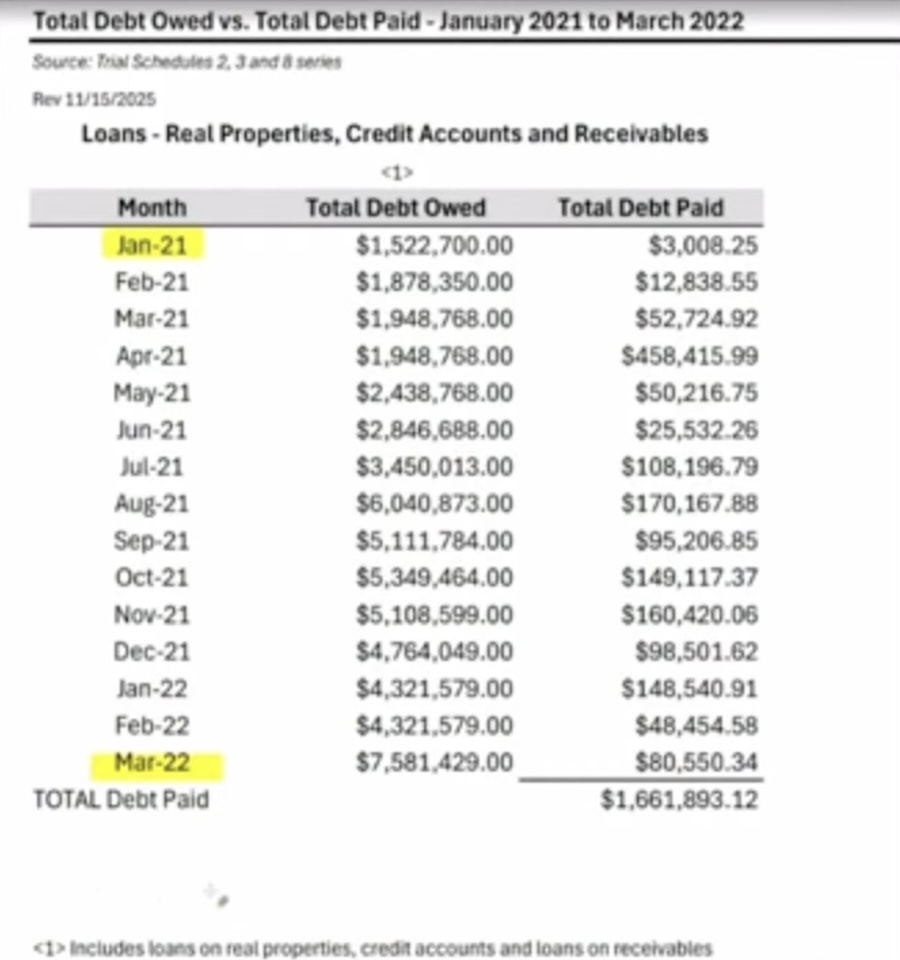
9:34 a.m. Karrington tried to figure out where the money was coming from, where it was going, and what the end game was for Kouri. We just saw the October statement, and Karrington says the following months were very similar. Whenever she received funds into the account, she would deplete the money quickly.
9:30 a.m. The balance history on the account fluctuates greatly depending on the day and week. One day there is $2,000 in the account and then it jumps to $19,000 and two days later it jumps to $70,000 but then there are big withdrawals every day. She uses a lot of the deposits to pay debt and new payday loan vendors are introduced. On Oct. 22, she had $77,000 deposited into the account after Kouri sold a property. That money did not last. It went to pay vendors and she incurred more and more debt, Karrington says.
9:29 a.m. Jurors are looking at the screen during this explanation. Many are taking notes – looking up from the screen and back to their notebooks in their laps. Karrington explains money going in and out of the account. Every week Kouri has to come up with money to stay current and avoid default to the payday lenders. They have high interest rates but if they go into default, the interest rate almost doubles.
9:24 a.m. We see a list of transactions. Delta Bridge, Bluebridge, Fairmont and Zahahva are four payday lenders that Korui was committed to pay $2,100 a day, Karrington says. There are debits daily on her account.
9:22 a.m. Karrington walks through her process. She begins by looking at the header then scrolls down and sees a negative balance. She then goes through the transactions and checks the posting dates on the transactions. Kouri is taking notes as Karrington speaks.
9:18 a.m. Karrington says between October 2021 and March 2022, there was an increase in overdraft transactions. Bloodworth admits an exhibit showing a bank account statement from America First Credit Union. Karrington leaves the witness stand and approaches the TV display facing the jury. Bloodworth asks Karrington to show how she analyzes the bank statement.
9:17 a.m. In one example, Kouri wrote a check for $10,000 and another for $4,000 from an account that had -$51 in the account. She wrote another check for $10,000 the next day. These checks were written to herself.
9:15 a.m. A lot of the money went to debt payment or vendor bills. She also tried to pay herself. Bloodworth admits an exhibit showing checks Kouri wrote from her Navy Credit Union to herself that were returned unpaid. She wrote approximately $60,000 in checks to herself from August 2021 through May 2022 that bounced. She wrote the checks from an account with a negative balance.
9:12 a.m. Bloodworth admits an exhibit showing overdraft and nonsufficient fund transactions from the main account belonging to Kouri between January 2021 and March 2022. From October through the end of March, there was a drastic increase in funds and transactions that did not clear the bank without a fee. In December, she had 77 overdraft or nonsufficient fund transactions totaling $91,000 with $2,000 of fees.
9:10 a.m. In October 2021, many transactions didn’t clear the bank. The account was perpetually in the hole. Money was coming in, but it was going out at a very exhaustive pace, Karrington says. Lots of overdraft fees, insufficient funds, etc.
9:07 a.m. The business was originally registered in Eric Richins’ name. Four days after the business was registered, it was changed to Kouri Richins. Bloodworth asks what an alter ego is in relation to forensics and accounting. Karrington says K. Richins Realty and Kouri Richins are alter egos. Their use of funds, transfer of funds, money going back and forth between different accounts show they are the same person.
9:03 a.m. Bloodworth asks to admit Kouri Richins’ real estate business registration for K. Richins Realty. It was registered April 26, 2019. Kouri was mostly in the business of buying and selling real estate for the purpose of flipping the properties. The registered agent is Kouri Richins with the business address being the family home. There was an additional business address for a PO Box in Kamas. Eric was listed as a member of the company.
9 a.m. Sidebar over. Bloodworth asks Karrington to explain her methodology when it comes to her investigations. Karrington began her investigation in this case by starting with Kouri’s bank accounts. Kouri had a business bank account at America First Credit Union. She also had a personal checking account at America First that was opened when she and Eric got married. There was no indication that Eric ever used the account. Kouri also had a Navy Union checking account. There was also a family account at America First Credit Union. Eric also had a business account and a personal account.
8:58 a.m. Karrington interviewed insurance companies, bank representatives, lenders, owners of the Midway house, Wasatch County Building Department and more. Kathryn Nestor asks if attorneys can approach. White noise is played in the courtroom.
8:56 a.m. Karrington says she reviewed “tons” of emails for many different purposes. She looked over leasing documents, premarital agreement, loan documents, letters, real estate transactions, contracts, property transactions, etc.
8:54 a.m. Karrington worked for the estate of Eric Richins. There was a civil lawsuit between Kouri and Eric’s sister Katie Richins-Benson. The estate paid her around $14,000 for her services. After she was paid, she had no further involvement with the estate. During this investigation, Karrington reviewed hundreds of thousands of documents.
8:51 a.m. Karrington has testified in trials before. Some of the jurors are taking notes. Others are focused on the witness. Kouri Richins is reading over papers at the defense table. The state hired Karrington to do an investigation into the Richins case. Summit County is paying Karrington at her regular rate.
8:49 a.m. First witness is Brooke Karrington. She is a forensic accountant. She’s been in the business for 38 years and has a firm based in Salt Lake City.
8:47 a.m. Courtroom is fairly full. Nine journalists on the media row. Additional reporters in an adjacent media room. Many members of the public are here. Jurors have been seated. Judge says court will begin tomorrow morning at 9:30 a.m. There will be no trial on Friday.
8:42 a.m. Defense attorney Kathryn Nester says they have many objections about this upcoming witness. Judge Mrazik is discussing how to handle the objections.
8:39 a.m. In the courtroom. Summit County Prosecutor Brad Bloodworth says there will be one witness today – an accountant – who will likely take most or all of today.