



Idaho State Police plead for more salary funding; Legislature has been slow to help
Published at
Sally Krutzig, Idaho Statesman
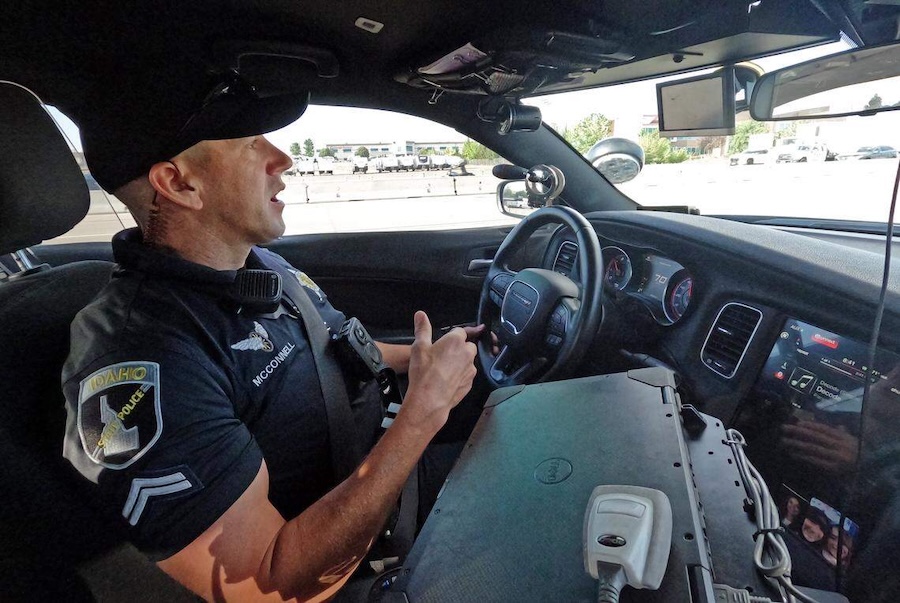
BOISE (Idaho Statesman) — Idaho State Police trooper numbers have plummeted in recent years, leaving about a third of its patrol positions vacant.
There are large areas of Idaho without a single full-time trooper. That has meant hours of waiting for people in car accidents, and no troopers available to respond when a call about a drunken driver comes in, according to ISP.
“There are no troopers in Moscow anymore,” Idaho State Police Col. Bill Gardiner told the Idaho Statesman. “We used to have four, and now there’s just nobody there anymore.”
Gardiner said he’s spent the past year talking with troopers who have quit, and realized it’s all come down to one thing: competitive pay.
“They are flat-out telling me, ‘Colonel, I don’t want to leave, but unfortunately, I have to, because I can go make so much more money over here, and I don’t even have to move. I can just go work for the county,’” Gardiner said.
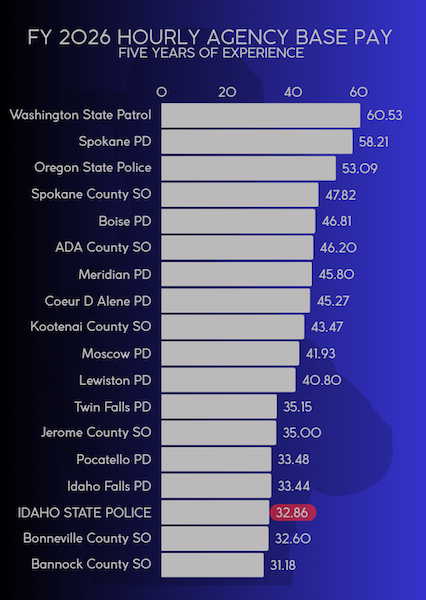
Idaho State Police pays a trooper with five years of experience $32.86 an hour, according to Gardiner. Lewiston’s city police department pays its five-year officers $40.80 an hour. Moscow police pays $41.93, and Coeur d’Alene pays $45.27 an hour.
Securing additional funding for salaries has proved difficult this year. The Joint Finance-Appropriations Committee, which controls the majority of the agency’s funding, has not pursued providing Idaho State Police with additional money to address the issue.
Legislators hold back on police funding
Sen. Jim Woodward, R-Sagle, introduced legislation on March 10 to increase fees through Project CHOICE. This program provides ISP salary funding by charging $3 a year to those registering Idaho vehicles. Under Senate Bill 1379, the annual fee would go up to $8 per year, adding about $10 million for wages.
Woodward estimated that ISP needed between $10 million and $20 million to address the salary situation.
Polling conducted by Boise research firm GS Strategy Group on behalf of the Idaho State Police Association found the concept to be popular. Of 400 Idaho Republicans surveyed across 44 counties, 66% supported raising the registration fee to $12 to increase police wages.
The bill passed the Senate easily, by a vote of 28-7.
But Rep. Joe Palmer, R-Meridian, chairman of the House Transportation and Defense committee, has refused to introduce it.
Woodward suggested that the reason legislators like Palmer have been reluctant to pursue certain Idaho State Police funding solutions is because doing so would “essentially raise taxes, and it’s an election year.”
“I can’t speculate on motivations, but I do know that many legislators still pay attention to their Freedom Foundation score,” Woodward said. “And of course, if we’re spending more money, the Freedom Foundation says that’s wrong. Even if the population has gone up, and even if there is inflation, so there’s always this pressure in here to not spend more.”
Instead, Palmer introduced House Bill 944 in the House Revenue and Taxation Committee on Thursday; it would have allocated $5 million annually to the Idaho State Police from liquor revenue out of the general fund.
“What you have before you is a piece of legislation that will help out the state police and their funding of the troopers that are actually on the road and doing the hard work,” Palmer said.
After introducing it, Palmer sat down and gave the floor to Gardiner, who explained the dire situation that his agency is in.
Palmer then returned to the podium, marking a turning point from a routine hearing to an odd one. He appeared at a loss for words, going from laughing to choking up.
“I’m pretty tired, that’s why I’m getting emotional,” Palmer said.
Palmer explained that he had suddenly changed his mind. He suggested that the ISP funding amount in his bill be reduced to $2.5 million. Instead of being sent to the House floor, he suggested the bill be sent to General Orders. A bill in General Order would be unlikely to come up this late in the session.
“I think at this point, $5 (million) is just too much,” Palmer said.
The Statesman asked Palmer if he could share the reason for his change of heart.
“No, I can’t,” Palmer said by phone. “I don’t want to.”
Then on Friday, Palmer introduced a new, similar bill in the House Ways and Means Committee. House Bill 967 would provide $4 million from liquor revenue — with $1.2 million coming out of county revenue, $870,000 coming out of city revenue and $1.93 million coming out of the general fund.
The committee voted in favor of sending the bill to the floor.
Woodward was not a fan. He said HB 967 wouldn’t be enough money and disagreed with its funding source.
“The proposal to pull from existing liquor tax revenue to pay our ISP troopers more is robbing Peter to pay Paul,” Woodward said. “This would take funding away from our court system, counties and cities. Not only is it insufficient to solve the trooper pay issue, but it creates another issue elsewhere. At some point, we have to acknowledge this is Idaho in 2026, not 2006.”
Gov. Brad Little provided a smaller victory for ISP by signing House Bill 793 into law Thursday. It will transfer about $1.6 million in ongoing revenue from the Permanent Building Fund to the Idaho State Police, with 40% of that going to the Alcohol Beverage Control unit.
Idaho State Police face record vacancies
Idaho State Police has about 40 of its 120 patrol positions vacant, according to Gardiner. The agency is set to graduate one of its smallest academy classes ever this year.
Several areas are in serious crisis, according to Gardiner. District 2, which includes Clearwater, Idaho, Latah, Lewis and Nez Perce counties, has zero full-time troopers.
Gardiner has been forced to rotate troopers from other parts of the state to live in Lewiston for a week. While there, that person is the only state trooper to serve people across five counties.
“We have to supplement a trooper driving up and living there for a week away from their own family to take any of those calls,” Gardiner said. “And I’ll bet you I’m spending about $10,000 a month just trying to keep police services going in that area.”
Leslie Lehman, representing the Fraternal Order of Police for North Idaho Troopers, testified in favor of Woodward’s bill. She said the number of vacancies was “alarming.” In the past, younger troopers were mentored by the older ones, but that’s become impossible with so few experienced officers.
“With each year that passes, we lose more of our commissioned staff to other agencies or to the private sector. … This leaves our agency in a position where less experienced officers are training new troopers in a high-liability profession,” Lehman said.
Lehman said being short-staffed has been difficult for troopers with families because they often don’t know whether their shifts will be 10 or 15 hours.
“You don’t know if you can make it to a Little League game,” Lehman said. “You don’t know if you can make it to a kid’s program at school, even though it’s several hours after the end of what should be a completed shift.”
Gardiner said the lack of funding has had a domino effect across the agency. He has frozen vacancies within his detective force because he can’t afford to promote any troopers and lose numbers there.
Response times that years ago would have been minutes have turned into hours, according to Gardiner.
“The worst thing in the world is for me to say, ‘The guy I’ve got closest is about an hour and a half away, so we’re not going to be able to help,’” Gardiner said.
Funding issue dates back years
Idaho State Police previously paid its troopers through three sources: the state general fund, Project CHOICE fees and a portion of the state’s highway gas tax. But the Legislature removed ISP as a gas-tax recipient in recent years.
Another issue has been how the Legislature has set up ISP raises. Troopers get a 3% raise, also known as a change in employee compensation. But that raise applies only to police income that the Legislature pays through its general fund.
Gardiner used the example of a trooper who makes $25 an hour — $20 may be paid through the general fund, and $5 may be paid through Project CHOICE fees. The trooper’s 3% raise would apply only to the $20. That technicality has meant an ever-widening pay gap between ISP and agencies that give raises based on officers’ entire salaries.
“They get 3% on part of their pay, but not all of their pay,” Gardiner said. “If you kind of extrapolate that out over a 20-year period … you see that every single year, you get further and further and further in the hole.”
Gardiner said he understands that finding the right solution might be difficult. He is open to seeing what the Legislature can come up with, but is anxious about a solution being found.
“I’m bringing a problem forward,” Gardiner said. “I understand that government’s role is to try to work together to solve those problems, and so that’s really my aim.”