



How to find the best gardening information online and in social media
Published at
We live in a glorious age with so much information at our fingertips. You can learn about anything that tickles your fancy — from Cleopatra to the Mola mola fish. You can even learn a new hobby, like origami, without ever leaving your home.
Gardening is no exception.
It has never been more important to have finely tuned critical thinking skills to find accurate and helpful information for your gardening journey. When browsing social media for gardening information or checking Google Lens to identify a plant, there are a few questions you should ask.
No. 1: Where is this information coming from?
Ask yourself: Is the information coming from an educational institution, especially one with an Extension service?
The Extension service exists in almost every county of every state in the entire nation. This is a service set up by the federal government in cooperation with a land grant university (in Idaho, it’s the University of Idaho) to provide the residents of that state with the most up-to-date information and services in many topics — but especially agriculture, horticulture and home gardening.
An Extension center will always have the best research-based, up-to-date information for your particular area.
No. 2: Is the information coming from a company that may be trying to sell me a product?
Keep in mind that while your local garden center often has good information, it is first and foremost a business trying to make a profit from your gardening needs. Business owners want to give you accurate information so you will return — and we have some great garden centers in the area. Just double-check the information, especially if it involves buying a product.
Also, keep in mind that websites that are trying to sell you a book or an expert’s own personal course, especially in novel-type gardening scenarios, may be more interested in your money than your education.
No. 3: How long has this expert been gardening?
If you are watching a YouTube or TikTok video, keep in mind that the main goal for many of these online influencers is to create content you’ll want to watch — and some don’t care to check if it’s accurate. They may have tried it once and decided to share it as something that works, not knowing how it will perform in the long-term or in your location. Unfortunately, a creator may even be making it up.
The best information will come from someone who has been trying a particular practice year after year, getting the same good results. Work to verify this is happening.
No. 4: Where does this person live?
If you are getting gardening information from someone in Southern California, Florida or even central Canada, it will not be the best gardening information for you here in Idaho. Gardeners in other areas will not have the same soil type, water, climate, weather patterns, insect pest or disease issues, or other considerations as you do. It is best to get your gardening information from someone who understands the conditions that you are growing in.
You don’t want to be disappointed when somebody has a beautiful blueberry bush and tells you just how to grow it, only to have it die a year or two later. Watering it with east Idaho water and putting it in east Idaho soil will eventually kill the plant from our alkalinity.
No. 5: Does this person have any formal education in gardening?
Of course, you don’t need to have a formal education to be very experienced and well-learned gardener. But it’s smart to ask: What credentials does this person have in gardening? Does he or she have any formal education in horticulture, botany or agriculture? Has he or she completed a Master Gardener course? Does the person let you know where they’ve obtained their gardening information? Do they have extensive experience?
No. 6: Did this information come from an AI source?
Artificial intelligence can be exceptionally helpful in our modern day, where everything is fast-paced and feels like you need to know it now. But you should also pause to ask: Where is AI getting the information it’s feeding me?
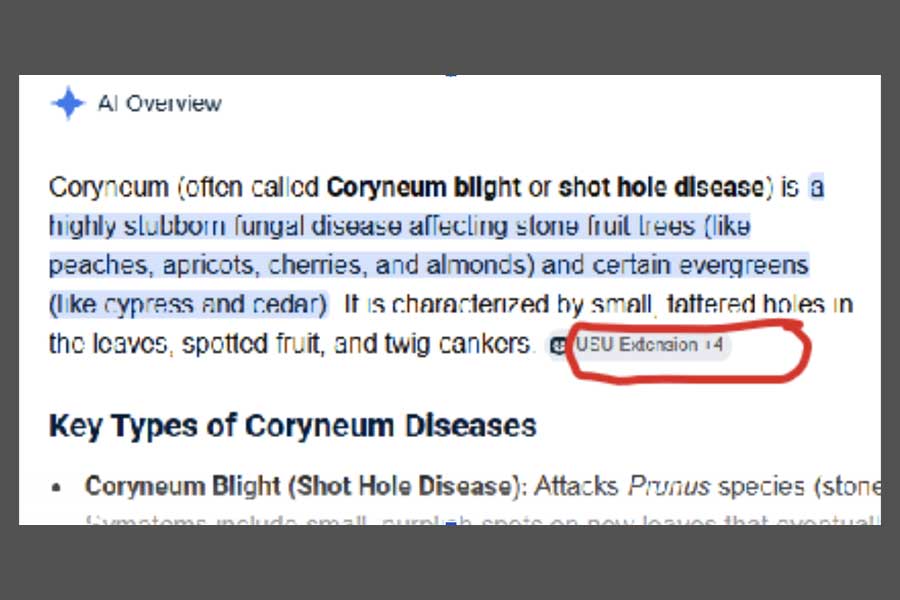
If you are using the Google AI feature that automatically appears at the top of your search results, it will give you sources. I love seeing Extension sources pop up, like the picture below.
If you are in an AI generator — such as ChatGPT, Gemini or CoPilot — ask the chatbot where it got the information it gave you.
For more information on AI gardening information, see Bracken’s article from April: https://www.eastidahonews.com/2026/04/using-artificial-intelligence-in-horticulture/
Photo ID apps
Let’s talk briefly about photo identification apps and services. These can be wonderful tools, and they’re getting better every day. However, the answers they give you are still more often wrong than right, especially when used for diagnosis.
If you are trying to identify a plant, take a picture, ask your app, but do not accept its answer as the final answer. Go back to the internet and search for other images of the plant it recommended, as well as its defining characteristics. Do they match the plant you’re looking at? If not, try again!
If you’re trying to identify an issue with your plant, look up the disease the photo ID app generates. Do the characteristics and the parameters of the disease match your plant and your climate? If it is suggesting a tropical disease common in Florida, where it’s regularly 100 degrees Fahrenheit with 90% humidity, you’d probably better keep looking.
If you’ve stayed with me this long, bless you! It’s unfortunate that we must have this in-depth discussion about finding truth in our world, but it’s never been more important. Enjoy the good! Go find something new you want to learn about today and dive in! Just remember to put your critical thinking skills to use every time you consume online information.
With a few simple inquiries and putting in the work to see it through to the next step, you can ensure you get the best gardening information to help you succeed.