



Review: How ‘Toy Story 5’ made me ask a question I wasn’t expecting
Published at
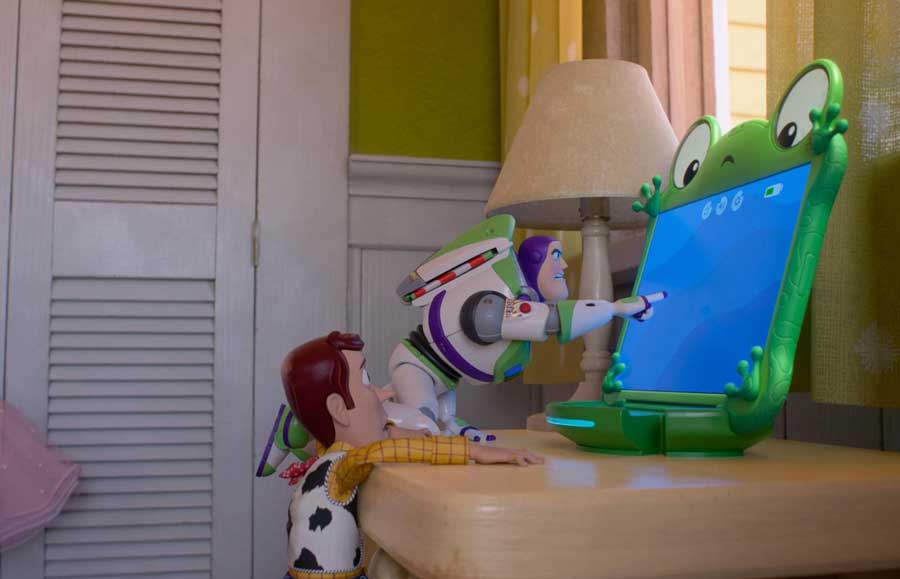
I walked into the early screening of “Toy Story 5” carrying the same question I’ve carried into almost every Toy Story sequel: Why are we doing this again?
It’s a fair question.
The original “Toy Story” wasn’t just a great movie — it was a cultural earthquake. Pixar changed animation forever and introduced characters that instantly became part of our lives.
Then came “Toy Story 2,” which somehow managed the impossible task of matching the original. “Toy Story 3” was released in 2010, and many people — myself included — considered it perfect ending to the saga of Woody and Buzz.
Roll credits. Everybody, go home. Franchise complete.
Except it wasn’t.
“Toy Story 4” arrived in 2019 and proved there was still another story worth telling.
RELATED | ‘Toy Story 4’: You’re gonna want to bring some tissues
Now, somehow, we’re five movies deep and approaching three decades with Woody, Buzz and company. And that raises a much more interesting question: Why does “Toy Story” still work?
The toys were never the point
Most franchises don’t get the opportunity to do five highly successful films.
The movie business is filled with sequels that overstay their welcome. Characters become caricatures. Stories grow repetitive. The things audiences loved get buried beneath bigger budgets and louder spectacles.
Yet, somehow, “Toy Story” keeps finding ways to matter. The reason is surprisingly simple: the toys were never the point.
Nobody fell in love with Woody because he’s made of plastic. Nobody cried during “Toy Story 3” because of action figures. People connected with these characters because they represent something universal — friendship, loyalty, belonging, purpose and change.
That’s why the movies continue to resonate nearly 30 years later.
The first film arrived in 1995. If you were 10 years old when it came out, you’re now in your 40s. Some of those original fans have children of their own. Some have children old enough to drive. And somehow, the franchise has grown right alongside them.
Most animated characters exist in suspended animation. They never really change because their stories never need them to.
“Toy Story” is different.
Each film explores a different season of life, reflecting the questions audiences are asking at that particular moment. The concerns that mattered when we were children aren’t the same ones that matter when we’re adults, and the franchise has continually evolved to meet us where we are.
That’s an extraordinary achievement.
Why ‘Toy Story 5’ works
And that is exactly why “Toy Story 5” works.
Without spoiling anything, “Toy Story 5” tackles a challenge that feels uniquely modern.
The film explores the growing tension between digital entertainment and real-world connections. But thankfully, it never slips into the kind of heavy-handed lecture that lesser movies might deliver.
Instead, Pixar approaches the topic the same way it approaches everything else: through character.
The movie isn’t interested in debating technology; it’s interested in connection. That’s a much more interesting topic, and one that feels relevant whether you’re 8 years old or 48.
That’s always been Pixar’s secret sauce. The film creators have always used toys to explore very human questions:
- What happens when friendships change?
- What happens when the people we love grow in unexpected directions?
- What happens when the things competing for our attention begin pulling us away from one another?
Those questions feel particularly relevant today, which helps explain why this story resonates with both children and adults.
Another reason “Toy Story 5” succeeds is that it never forgets to be entertaining.
The movie is genuinely funny. There were multiple moments in my screening when both children and adults laughed at the same time, often for entirely different reasons. That’s been a hallmark of Pixar from the beginning, and it’s still very much intact here.
RELATED | The 5 best Pixar movies ever made (and yes, I know you’re already mad)
The film also introduces a handful of new characters that inject fresh energy into the franchise, including a fantastic performance from Conan O’Brien. He slides naturally into the Pixar universe and quickly becomes one of the movie’s highlights.
At the same time, Pixar understands that audiences aren’t showing up simply for jokes. They’re showing up because they care — and that’s where “Toy Story 5” continues the franchise’s greatest tradition.
The best family movies give parents and children different reasons to care. In “Toy Story 5, children see an entertaining adventure while adults see pieces of their own lives reflected back at them.
That’s a difficult balancing act, and it’s one Pixar has spent nearly 30 years perfecting.
But people don’t remember “Toy Story” movies because of the jokes; they remember them for the emotions.
Pixar has spent nearly 30 years earning our investment in these characters, and “Toy Story 5” knows exactly how to cash in on that history.
At this point, crying during a “Toy Story” movie feels less like a possibility and more like a tradition. And yes, there is a very good chance you’ll find yourself reaching for a tissue before the credits roll.
No, “Toy Story 5” doesn’t reach the towering heights of the original trilogy (very few films do). What it does accomplish is something almost as impressive: It earns its place.
More importantly, it justifies its existence. That’s a surprisingly difficult thing for a fifth installment to do.
Rather than revisiting old ground, the film finds a fresh question for these characters to wrestle with and trusts that audiences will follow them there. That’s been the secret of the franchise from the beginning.
The real achievement
This is why I think “Toy Story” has remained relevant when so many other beloved franchises have faded. At its core, the series understands something simple: People don’t return to stories because of concepts.
They return because of the connection they feel.
Nobody says, “I can’t wait to spend two hours watching toys.” They say, “I can’t wait to spend two hours with Woody and Buzz.” That’s a completely different thing. It’s the difference between an idea and a relationship.
Technology changes, animation improves, trends come and go, and entire genres rise and fall — but audiences still respond to stories that make them care.
That’s what Pixar got right in 1995.
It’s what they got right in 1999.
It’s what they got right in 2010.
And somehow, against all odds, it’s what they’re still getting right today, in 2026.
After watching “Toy Story 5,” I found myself less impressed by the fact that Pixar made another sequel than by the fact that they found another reason for us to care.
That’s much harder — and maybe that’s the secret.
The greatest achievement of “Toy Story” isn’t that it lasted 30 years. It’s that after 30 years, it still understands what made people fall in love with it in the first place.
Story. Character. Heart. Connection.
Somehow, a fifth movie doesn’t feel like a desperate return to the past. It feels like another chapter.
In the end, a fifth installment of “Toy Story” works not because it reminds us of what came before, but because it gives us a reason to keep going.