




Two contested judicial races bring in heavy donations – the breakdown and ethics of nonpartisan elections
Published at | Updated at
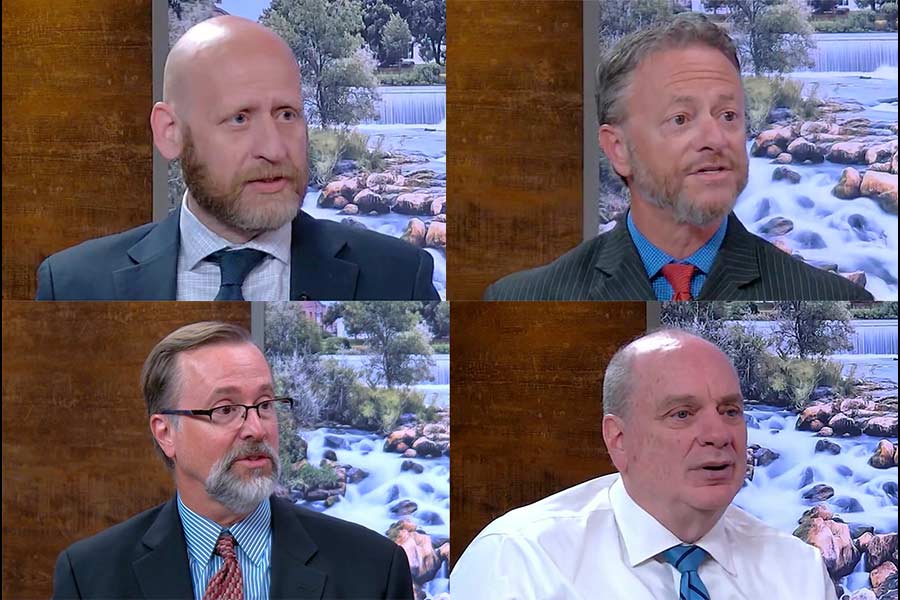
IDAHO FALLS – The primary election is now less than a week away and numerous contested races are happening throughout eastern Idaho.
Among them are two contested races for district judge in Idaho’s Sixth and Seventh Judicial Districts. District 6 includes Bannock, Bear Lake, Caribou, Franklin, Oneida and Power counties. District 7 encompasses Bingham, Bonneville, Butte, Clark, Custer, Fremont, Jefferson, Lemhi, Madison, and Teton counties.
In District 6, incumbent Cody Brower — who was appointed by Gov. Brad Little in September 2023 — is seeking re-election. His opponent is Aaron Thompson, who was appointed as a magistrate judge for the Bannock County Magistrate Court in 2018.
EastIdahoNews.com recently sat down with both of these candidates in separate interviews. Watch our interview with Brower here. Thompson’s interview can be accessed here.
This election marks the first time in 12 years that a judge’s position has been contested in District 7. Judge Steven Boyce, who was first appointed by Gov. Little in 2019 and ran unopposed in 2022, is seeking re-election for his second full term. Randy Neal, the current prosecutor for Bonneville County, is running against him.
Watch our interview with Boyce here. Our interview with Neal is available here.
District judges are elected every four years. Elections for judges are nonpartisan, but are held during primary elections.
Campaign donations and ethics
In the District 6 judicial race, both candidates have received several thousand dollars in campaign donations. In District 7, Boyce is the only candidate who’s received donations.
Information on Idaho’s campaign finance system shows which candidate has raised the most, where the donations come from, and how each candidate has spent their money.
From the beginning of the election cycle to date, the database — which is managed by the Idaho Secretary of State’s office — shows that Brower’s total campaign contributions are $2,545, with total expenditures of $7,271.98. Thompson’s total contributions are $5,975, with expenditures totaling $2,868.25.
Boyce has the highest total of campaign contributions — $22,215.36. His expenditures are $7,270.76.
Under Rule 4.1(A)(8) of the Idaho Judicial Code of Conduct, “judges and judicial candidates must, to the greatest extent possible, be free and appear to be free from political influence and political pressure.” This means that judicial candidates are barred from soliciting or accepting campaign contributions or endorsements, unless it’s through a campaign committee that raises and manages funds. Since judges are nonpartisan, they cannot be nominated, endorsed, or financed by political parties or recognized partisan organizations.
“Public confidence in the independence and impartiality of the judiciary is eroded if judges or judicial candidates are perceived to be subject to political influence,” the code says.
Rule 4.1(A)(13) further prohibits judges from making “pledges, promises, or commitments that are inconsistent with the impartial performance of the adjudicative duties of judicial office” in connection with cases likely to come before the court.
Despite this rule, the state’s publicly accessible campaign finance system lists who contributed to a candidate’s campaign. Even with ethical obligations in place, there’s no way to prevent a judicial candidate from looking at public records. Although campaign committees are required to reject any contribution that could create a conflict of interest, there is no way to effectively enforce that requirement.

Out-of-state donations and expenditures
The database shows that the bulk of contributions to each of these campaigns comes from within the state, but each candidate, except for Neal, has received some donations from out-of-state.
Brower’s out-of-state donations total $250, of which $100 came from John Olson in Afton, Wyoming. Three donations of $50 were paid by separate people: Becky Facer in Hawaii, Leah Bonner in Texas and Laura Prince in California. Brower’s campaign has also received a $50 donation from Big J Burgers in Preston.
Thompson’s campaign has raised $801 from out-of-state donors. The largest one is a $300 contribution from Vince Connolly in Georgia. Another $200 donation came from Scott Thompson in Arkansas, and two donations of $100 and $101 came from two separate people in Salem, Oregon. Bryan Decker donated $101 and Kristopher Walker contributed $100. Thompson’s campaign has also received two $50 donations, one from Micahel Wegner in Kentucky and another from Deborah Thompson in Georgia.
Boyce, who has the largest amount of total campaign contributions also has the largest amount of out-of-state contributions. Of the $2,700 total, two $1,000 donations come from an Oregon and an Arizona resident. The Oregon resident is Valerie Bertoch and the Arizona resident is Douglas Boyce. Judge Boyce’s campaign has also received a $500 donation from Mardean Monk in Nibley, Utah, a $100 donation from James Murdock in Texas and two $50 donations from Utah, one from Mindy Timothy in Cottonwood Heights, and the other from Annie Munk in Taylorsville.
A total of $5,500 was given to Boyce’s campaign from various business owners, all of whom are local. Among the donors are various law firms: Smith Woolf Anderson & Wilkinson in Idaho Falls, Hahn Law, LLC in Idaho Falls, and Forsberg & Evans LLC in Rexburg, among others. Mickelsen Farms LLC in Rigby also contributed $500.
While most of the candidates’ expenditures have been used for advertising, Brower has spent the most — $6,613.58 — on yard signs, campaign buttons, and other advertising. Thompson’s total advertising expenses are split between similar self-promotion methods and print advertising.
Boyce has spent $2,912.66 on the same thing and another $1,945.00 on broadcast advertising.
The primary election will be held on May 19. The polls will be open from 8 a.m. to 8 p.m. EastIdahoNews.com will be working late to provide up-to-the-minute results. To find a polling location or other information, click here.